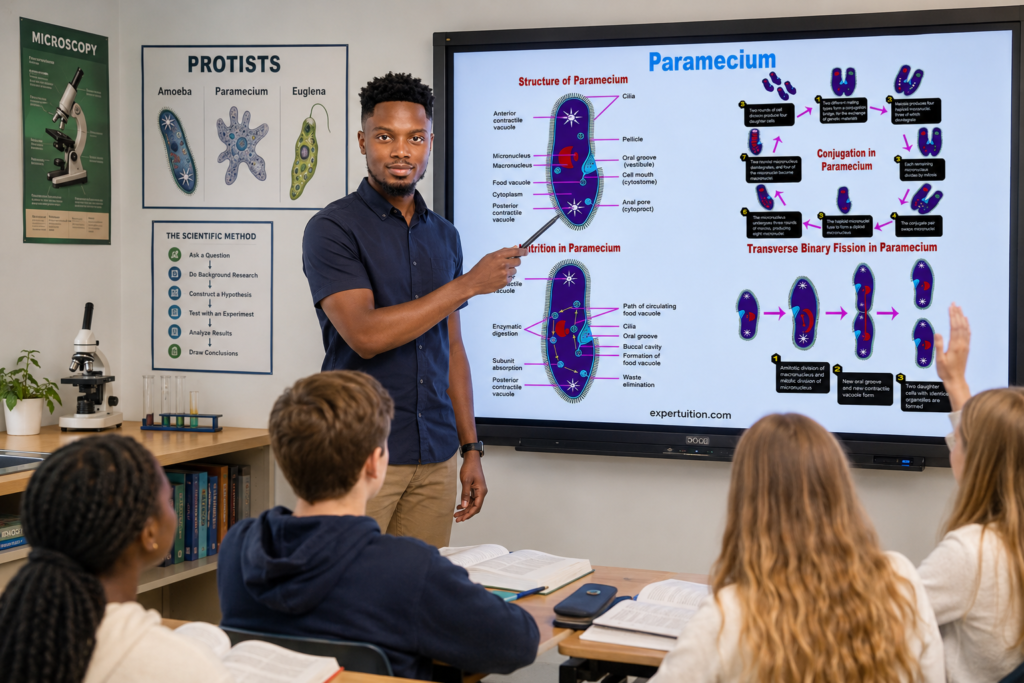
Protists are mostly single-celled organisms with many different structures and ways of carrying out life processes. Amoeba, Paramecium, and Euglena provide useful examples of how one cell can move, obtain food, reproduce, respond to its surroundings, and carry out other activities needed for life.
What Are Protists?
A living organism does not need to have many cells to carry out the activities needed for life.
Some organisms consist of just one cell, yet that single cell performs all the processes necessary for life. Amoeba, Paramecium, and Euglena are examples of such organisms. They belong to the group known as protists.
The three organisms discussed in this series are unicellular eukaryotes. This means that each consists of one cell and that the cell has a nucleus enclosed by a nuclear envelope.
This distinguishes them from prokaryotic organisms, such as bacteria. Prokaryotic cells do not have a nucleus enclosed by a nuclear envelope.
Being made up of one cell does not mean that these organisms are all the same. Amoeba, Paramecium, and Euglena have different structures and carry out their life processes in different ways.
Looking at them together therefore gives us a useful way to understand how a single cell can be organized to support life.
Amoeba, Paramecium, and Euglena: Three Different Protists
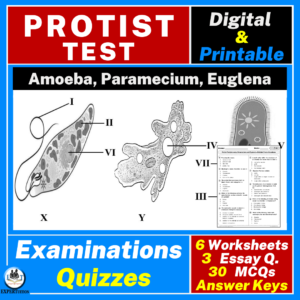
These are all unicellular protists, but they are easy to distinguish from one another.
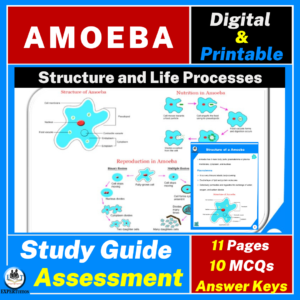
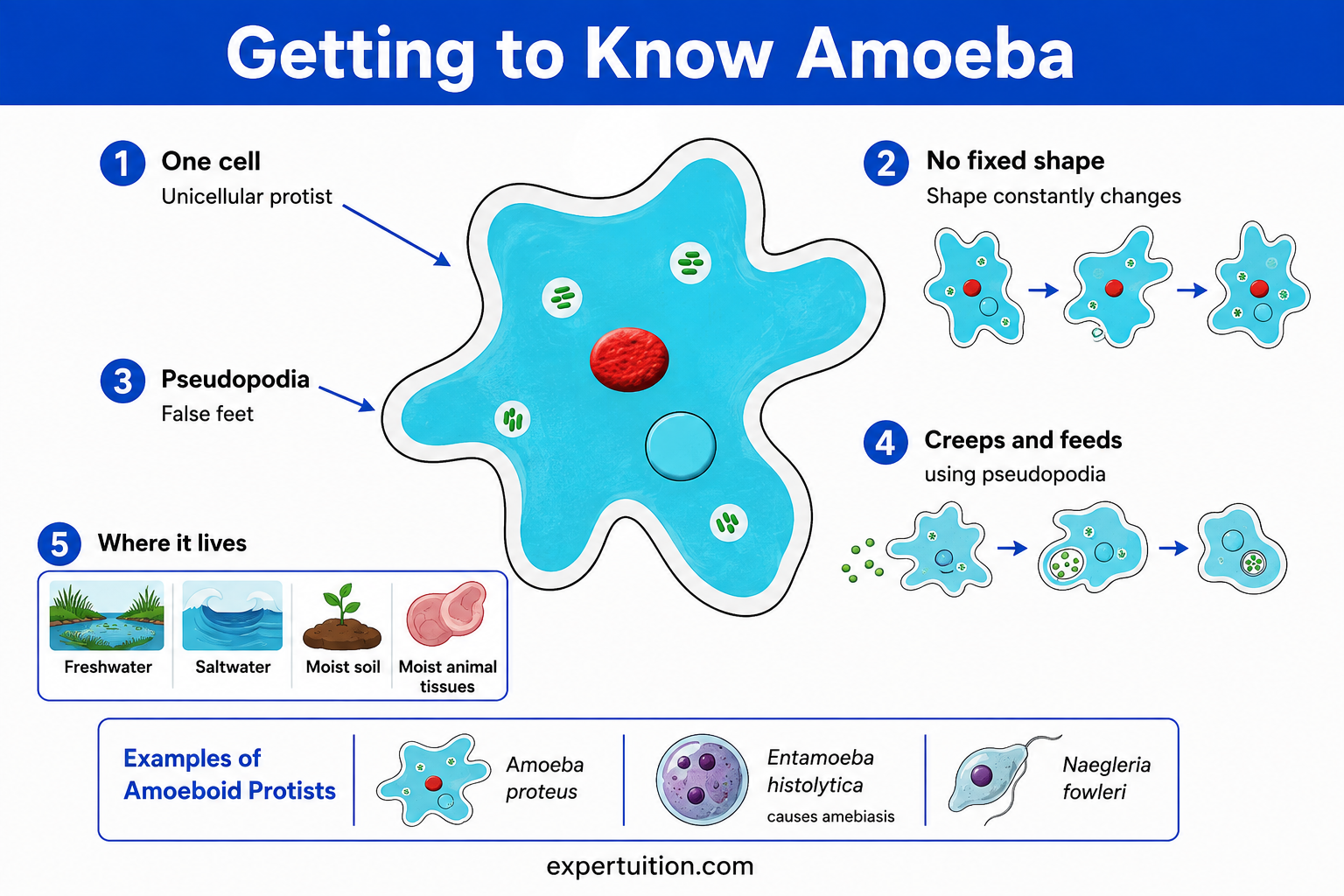
Amoeba has no fixed shape. Its outline changes as it forms temporary extensions called pseudopodia, or false feet.
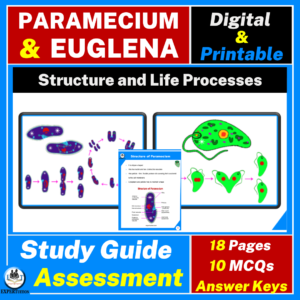
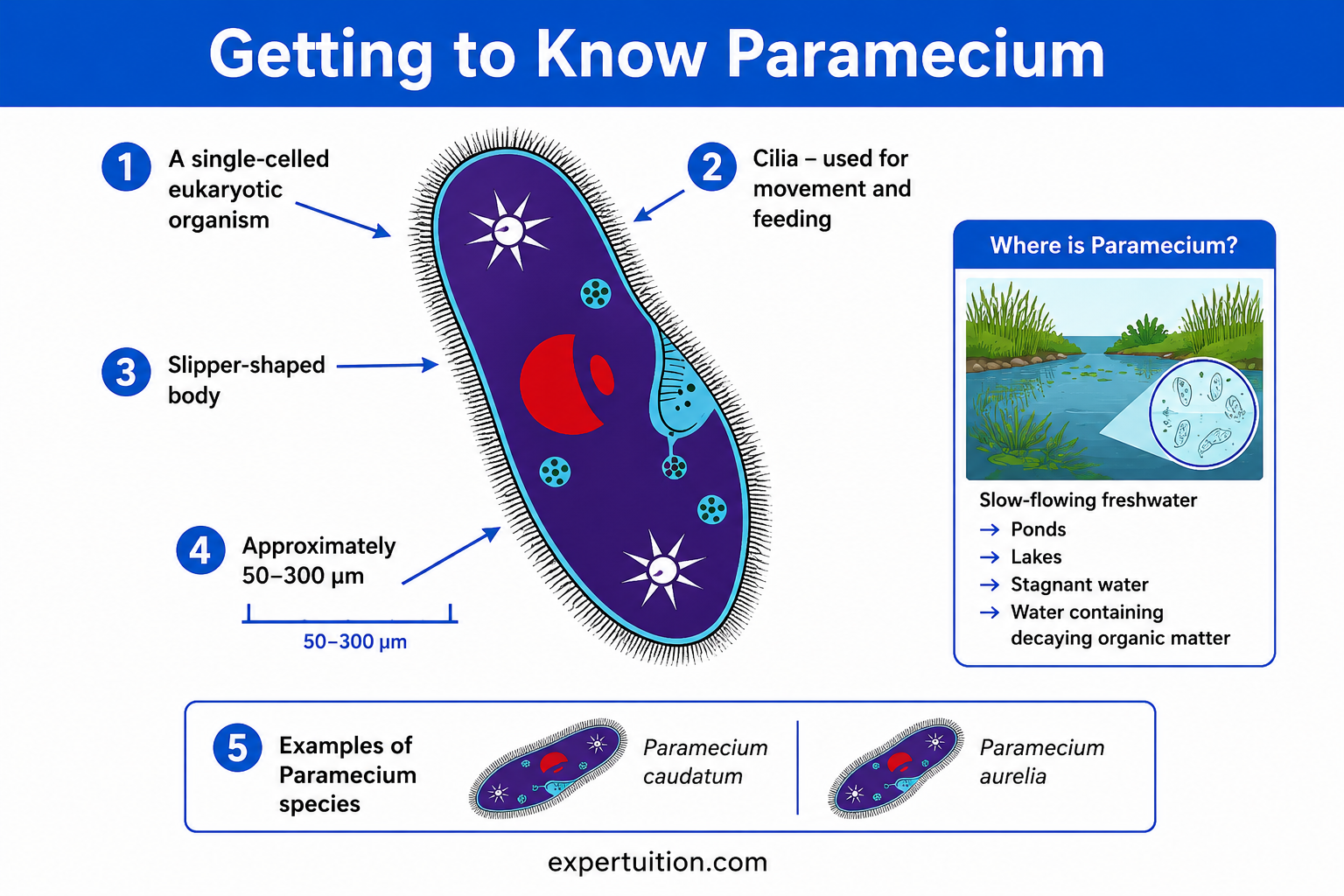
Paramecium has a more definite shape resembling the sole of a shoe. Its body is covered with numerous small, hair-like structures called cilia.
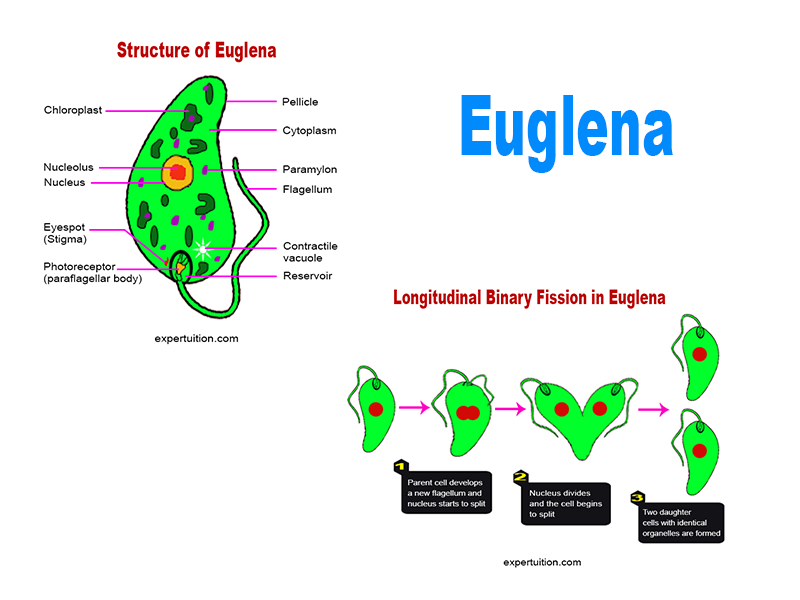
Euglena has an elongated body and is usually green because it contains chlorophyll. It also has flagella and an eyespot.
These differences are more than features that help us identify the organisms. They are connected to the ways in which each organism carries out its life processes.
Amoeba: A Protist That Changes Shape
Amoeba is a good example of how the structure of a single cell can change as the cell carries out its activities.
It appears under a microscope as a tiny, irregular, jelly-like mass because it has no fixed body shape. Its outline changes as pseudopodia form and disappear.
Amoeba can live in freshwater and saltwater. It can also be found in soil and in moist parts of animals, where some species live as parasites.
It is commonly found creeping along while feeding on organisms such as algae and bacteria.
Although Amoeba appears simple, its single cell performs the activities needed for survival. Its structure allows it to move, obtain food, reproduce, exchange gases, remove wastes, and respond to changes in its surroundings.
The details of how these activities occur become clearer when the structure of Amoeba is examined closely.
Paramecium: A Protist Covered with Cilia
Paramecium presents a very different picture.
Its body has a fairly definite shape resembling the sole of a shoe, and its surface is covered with many small cilia.
Paramecium is a microscopic, free-living organism. It is commonly found in slow-flowing freshwater, ponds, lakes, and stagnant water containing decaying organic matter.
The cilia are important to its way of life. They allow Paramecium to move through its aquatic surroundings and also help with feeding.
Like Amoeba, Paramecium consists of only one cell. Yet that cell contains structures that work together to carry out the activities needed for life.
The structure and life processes of Paramecium will be examined more closely later in the series.
Euglena: A Protist with Plant-Like and Animal-Like Features
Euglena provides another interesting example of how different structures can support life within a single cell.
It has an elongated body that is usually green because it contains the pigment chlorophyll. It also has flagella, which help it move through water, and an eyespot that is involved in detecting light.
Euglena is especially interesting because it has characteristics associated with both plants and animals.
Its chlorophyll allows it to carry out photosynthesis. Its flagella and eyespot are among the features associated with its animal-like characteristics.
These features make Euglena different from both Amoeba and Paramecium. They also provide another example of how the structure of a unicellular organism is related to the way it carries out its life processes.
How Do These Protists Carry Out Life Processes?
Although Amoeba, Paramecium, and Euglena look different, they all face the same basic challenge. Each single cell must carry out the activities needed to remain alive.
They must obtain nutrients, move, reproduce, exchange gases, remove wastes, and respond to changes in their surroundings.
However, they do not all carry out these processes in the same way.
Amoeba uses pseudopodia for movement and also uses them to help obtain food. Paramecium uses cilia for movement and feeding. Euglena uses flagella for swimming and can also carry out another type of movement.
Their ways of obtaining food are also different, as are their reproductive processes.
These differences are important because they show that there is no single way for a unicellular organism to carry out the activities needed for life.
A single cell can have structures that are organized in different ways and still perform the functions necessary for survival.
What Can We Learn from These Three Protists?
Amoeba, Paramecium, and Euglena provide three useful examples of how structure and function are connected in living organisms.
Amoeba changes its shape and uses pseudopodia. Paramecium has a more definite shape and moves with cilia. Euglena has chlorophyll, flagella, and an eyespot, giving it characteristics associated with both plants and animals.
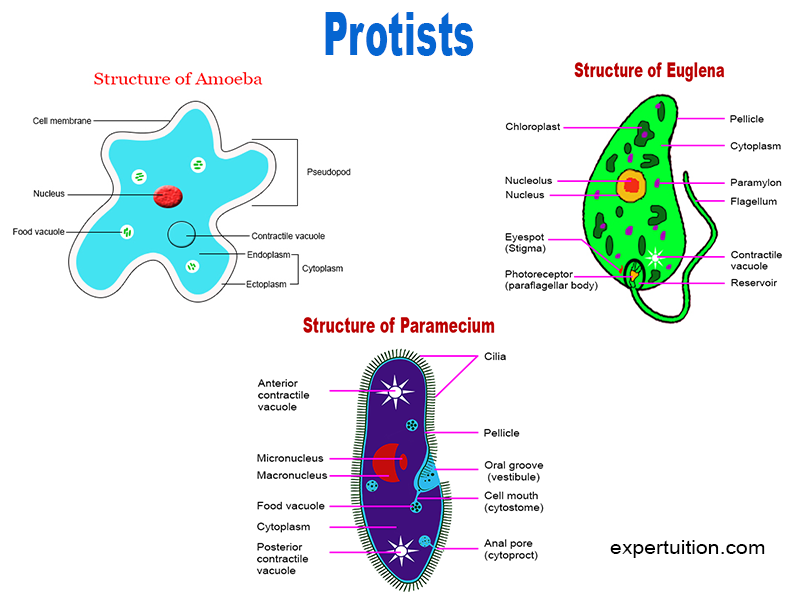
Their differences help us look beyond the idea that a single-celled organism is simply a small and simple form of life.
Each cell has structures that allow it to perform the activities necessary for life.
For students, these three organisms provide useful examples for understanding the relationship between structure and function. For teachers, they provide familiar examples through which important biological ideas can be explained.
The accompanying Protists Classroom Resources can also support teaching, review, and assessment of these ideas.
Among these three organisms, Amoeba provides a particularly clear example of how structure supports life.
Its body has no fixed shape, yet its single cell contains structures that allow it to feed, move, reproduce, remove wastes, exchange gases, and respond to changes in its surroundings.
How can one simple-looking cell carry out all of these activities?
The answer begins with its structure.
Next: Amoeba: Structure, Reproduction, and Other Life Processes
In the next post, we will look closely at Amoeba, beginning with its structure and then examining how it feeds, moves, reproduces, respires, removes wastes, and responds to its environment.
Protists Resources
-
 Protist: Amoeba Structure, Asexual Reproduction, & other Life Processes
 -
Protists Test 1: Amoeba, Paramecium, and Euglena Assessment
-
Protists Test 2: Amoeba, Paramecium, and Euglena Assessment
-
Protists: Paramecium & Euglena Structures & Life Processes
-
Protists Bundle: Amoeba, Paramecium, & Euglena Notes & Assessment