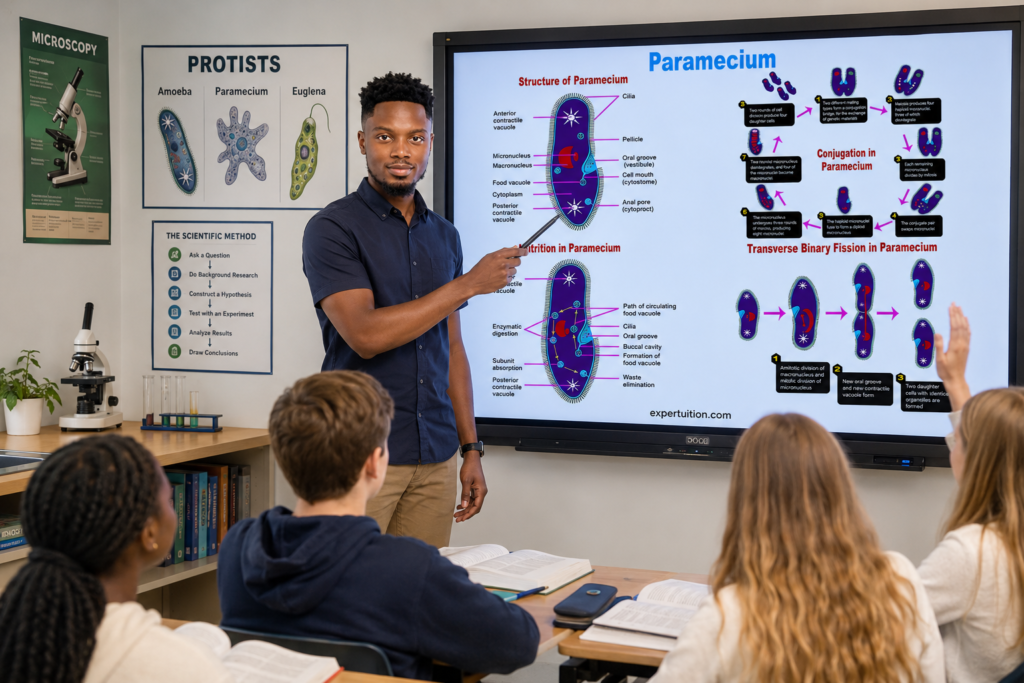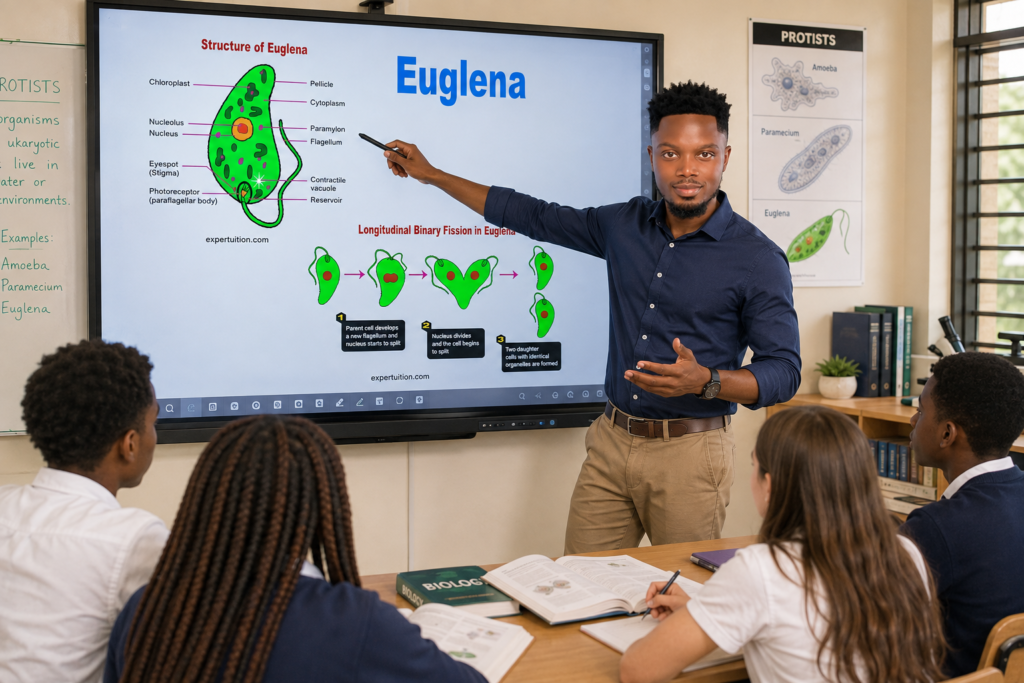
Euglena is a unicellular protist with an unusual combination of characteristics. It contains chlorophyll and can carry out photosynthesis, yet some Euglena can also obtain organic nutrients when light is limited. Its flagellum, eyespot, flexible pellicle, and other specialized structures allow the cell to move, respond to light, and survive changing environmental conditions.
Getting to Know Euglena
Euglena is a unicellular eukaryote. It is traditionally taught within Kingdom Protista, while modern classifications place euglenids within the broader group Euglenozoa. Euglena belongs to the euglenid group.
Euglena is commonly found in freshwater habitats, including ponds, ditches, and slow-moving water. Related euglenids can also occur in marine environments, marshes, and moist soils.
The organism is microscopic, and its size varies among species. Examples include Euglena gracilis and Euglena viridis.
Euglena usually has an elongated body that may appear spindle-shaped or pear-shaped. Many species are green because they contain chlorophyll.
What makes Euglena particularly interesting is the way its cell is adapted to different conditions. It can use light to make food, move through water, and respond to changes in its surroundings.
Its structure helps make these activities possible.
The Structure of Euglena
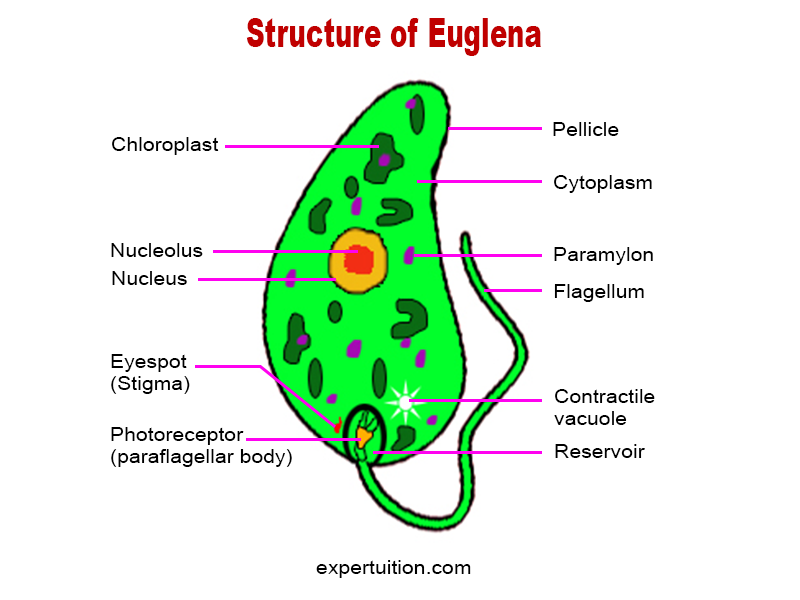
Euglena has a cell membrane covered by a flexible pellicle.
The pellicle lies just beneath the cell membrane. It helps maintain the general shape of the organism while still allowing the body to bend and change shape during euglenoid movement.
Inside the pellicle is the cytoplasm, which contains the structures needed for the activities of the cell.
Euglena has a single nucleus. It contains the genetic material and helps control the activities of the cell.
At the anterior end is a small cavity called the reservoir. A flagellum arises from this region and extends into the surrounding water.
The flagellum is a long, whip-like structure that allows Euglena to swim.
Euglena also contains chloroplasts with chlorophyll. These enable the organism to carry out photosynthesis when suitable light is available.
Associated with the chloroplasts are pyrenoids, which are involved in photosynthetic activity and the storage of photosynthetic products.
Near the reservoir is an eyespot, a light-sensitive structure that helps Euglena detect changes in light.
A contractile vacuole is associated with the reservoir. It helps remove excess water from the cell and contributes to maintaining the cell’s internal balance.
These structures are closely connected to the way Euglena lives. The flagellum provides movement, the chloroplasts allow photosynthesis, and the eyespot helps the organism respond to light.
Movement is particularly interesting because Euglena can move in two different ways.
How Does Euglena Move?
Swimming with the Flagellum
Euglena can swim through water using its flagellum.
The flagellum beats in a whip-like manner, pushing against the surrounding water and allowing the organism to move from one place to another.
This form of movement is especially useful when Euglena needs to change its position in the water.
Euglenoid Movement
Euglena can also move by changing the shape of its body.
During euglenoid movement, different parts of the cell contract and relax. The organism can become longer, shorter, or more irregular in shape as it moves.
This movement is possible because the pellicle is flexible.
The two forms of movement give Euglena different ways of responding to its surroundings. It can swim with its flagellum or move by changing the shape of its flexible body.
Movement is closely connected to another important part of Euglena’s life: obtaining food.
How Does Euglena Obtain Food?
Euglena has a mixotrophic mode of nutrition. This means that it can use more than one nutritional strategy.
When sufficient light is available, Euglena carries out photosynthesis using chlorophyll in its chloroplasts.
During photosynthesis, light energy is used to produce organic food from carbon dioxide and water.
Some of the food produced is stored as paramylon, a carbohydrate reserve characteristic of Euglena and related organisms.
The stored food can be used when conditions are less suitable for photosynthesis.
When light is insufficient, some Euglena can also obtain organic nutrients from their surroundings. This gives them another way of obtaining nutrients when photosynthesis cannot provide all that is needed.
In some Euglena, prolonged growth in darkness can result in the loss of chlorophyll. Such cells may then depend more heavily on organic sources of nutrients.
Euglena’s ability to use different nutritional strategies is one of the features that makes it particularly interesting to study.
Euglena must also produce new cells so that its kind can continue.
How Does Euglena Reproduce?
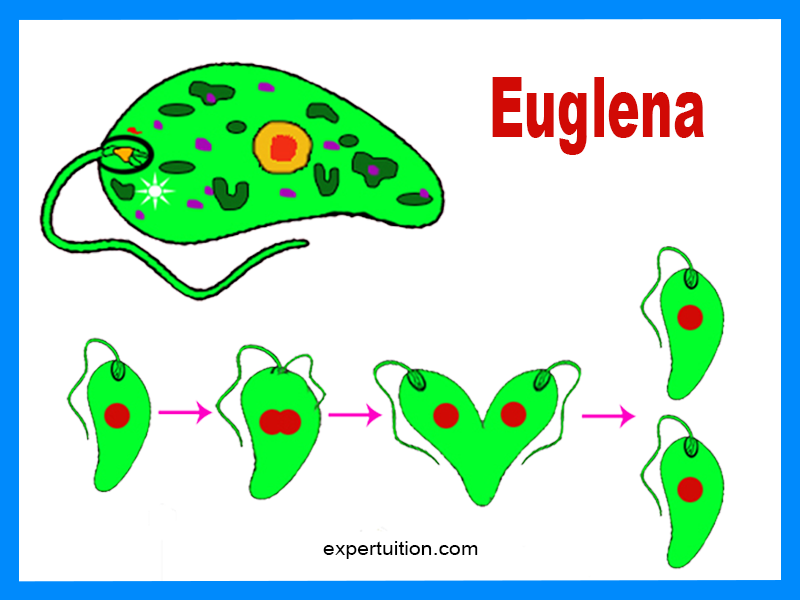
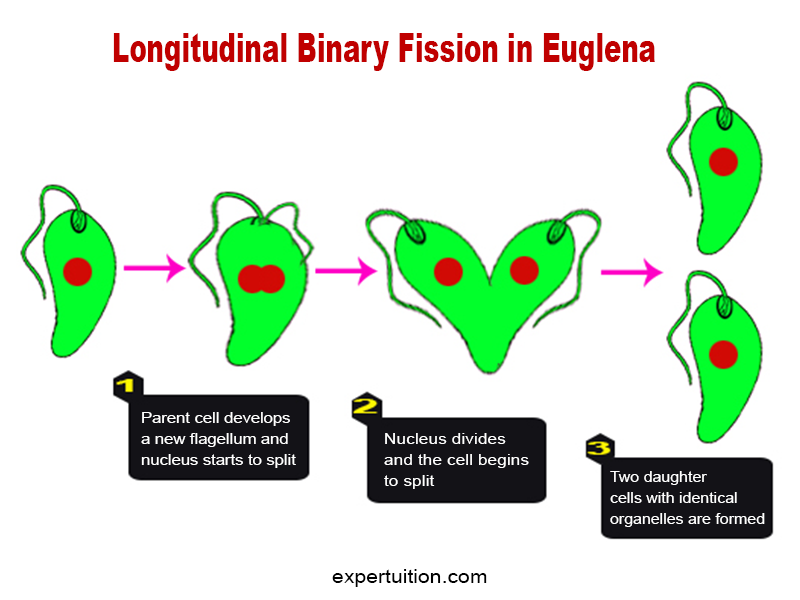
Euglena reproduces asexually, mainly by longitudinal binary fission.
During this process, one Euglena divides to form two daughter cells.
The process begins with the division of the nucleus. Other important cell structures are also duplicated as the cell prepares to divide.
The cell then divides lengthwise along its long axis.
This produces two daughter cells. Each daughter cell receives the structures needed to carry out its activities independently.
The daughter cells can then grow and develop into mature Euglena.
Longitudinal binary fission therefore allows Euglena to increase its numbers through asexual reproduction.
Reproduction is only one part of Euglena’s existence. The organism can also change its condition when the environment becomes unsuitable.
Euglena’s Life Stages and Survival Conditions
Euglena normally exists as a free-swimming flagellated cell.
In this active condition, it moves through the water using its flagellum and carries out its normal activities, including feeding, respiration, and reproduction.
When environmental conditions become unfavourable, some Euglena can enter a cyst condition.
The cell becomes protected by a covering and remains inactive while conditions are unsuitable. When the environment becomes favourable again, it can return to an active state.
Euglena can also occur in a palmelloid condition.
During this condition, cells become embedded in a gelatinous material and remain together rather than continuing their usual free-swimming existence.
The palmelloid condition is therefore different from longitudinal binary fission. It is associated with changes in environmental conditions rather than being the process by which Euglena reproduces.
These different conditions allow Euglena to persist when its surroundings do not support normal active growth.
Euglena must also regulate the substances that enter and leave its cell.
How Does Euglena Remove Wastes and Maintain Water Balance?
Euglena removes soluble waste materials mainly by diffusion through the cell membrane.
Some dissolved wastes move from the cell into the surrounding environment.
The contractile vacuole also has an important role in maintaining water balance.
Because many Euglena live in freshwater, water can enter the cell by osmosis. The contractile vacuole collects excess water and releases it through the reservoir.
This prevents excessive water from accumulating inside the cell and helps maintain the appropriate water and ionic balance of the organism.
Euglena therefore has a mechanism for maintaining relatively stable internal conditions even while living in an environment where water can continually enter the cell.
It must also exchange gases with its surroundings.
How Does Euglena Exchange Gases?
Euglena exchanges gases through the cell membrane by diffusion.
Oxygen can enter the cell when it is needed for respiration, while carbon dioxide can leave the cell.
During photosynthesis, carbon dioxide is also taken up as a raw material for food production.
Euglena does not need a specialized respiratory organ. Its cell membrane provides the surface through which gas exchange occurs.
Light is also an important environmental factor because Euglena can use it for photosynthesis.
How Does Euglena Respond to Light and Environmental Conditions?
Euglena is sensitive to light, and the eyespot helps it detect changes in light intensity and direction.
This sensitivity helps the organism respond to its light environment, which is particularly important when it is relying on photosynthesis.
Euglena can alter its movement and position in response to environmental conditions.
However, very strong sunlight or other harsh conditions can become unfavourable.
Under such conditions, Euglena may enter the cyst condition described earlier and become inactive.
When conditions improve, it can return to a more active state.
The ability to detect light and survive unfavourable conditions shows how Euglena can respond to changes in its environment even though it consists of only one cell.
Its unusual combination of characteristics leads to another important question.
Why Is Euglena Described as Both Plant-Like and Animal-Like?
Euglena is often described as having both plant-like and animal-like characteristics.
Its plant-like characteristics are most clearly seen in its ability to carry out photosynthesis.
Euglena contains chlorophyll within chloroplasts, allowing it to manufacture organic food when light is available. This form of nutrition is often described as holophytic nutrition.
Its pyrenoids are associated with photosynthetic activity and the storage of photosynthetic products, while food can be stored as paramylon.
These features give Euglena characteristics commonly associated with plants.
At the same time, Euglena has characteristics commonly associated with animals.
It can move actively using a flagellum, and it can change the shape of its body during euglenoid movement.
Its eyespot helps it respond to light, while some Euglena can obtain organic nutrients when photosynthesis is limited.
The contractile vacuole also helps regulate the water content of the cell.
These characteristics do not mean that Euglena is partly a plant and partly an animal. Euglena is a protist with its own distinctive combination of characteristics.
This combination makes Euglena particularly useful for understanding the diversity of life. It shows that organisms do not always fit neatly into the simple categories we may first associate with plants and animals.
| Plant-like features | Animal-like features |
| Holophytic nutrition | Heterotrophic nutrition |
| Photosynthesis | Organic food uptake |
| Chlorophyll | Flagellar movement |
| Chloroplasts | Euglenoid movement |
| Pyrenoids | Eyespot |
| Paramylon storage | Response to stimuli |
Bringing the Protist Series Together
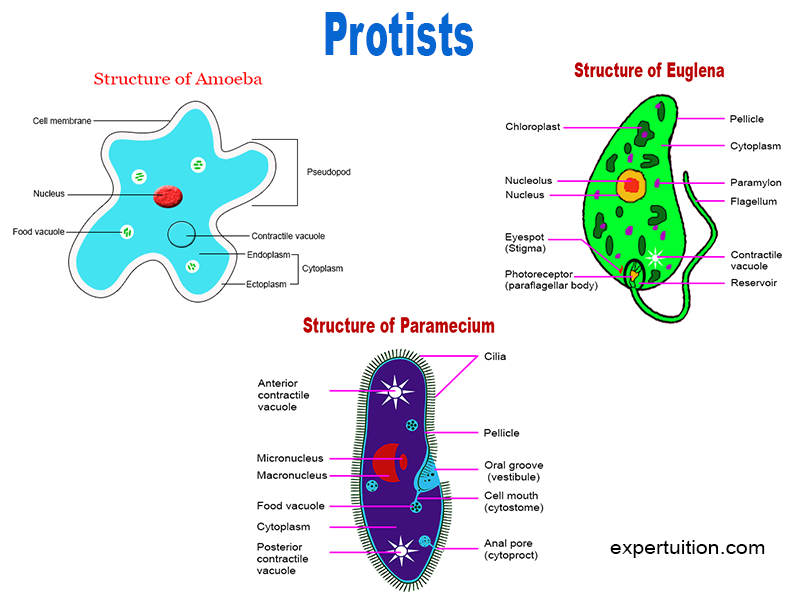
Amoeba, Paramecium, and Euglena are all unicellular organisms, yet each has a different way of carrying out the activities needed for life.
Amoeba changes its shape and moves with pseudopodia. Paramecium has a more definite body shape and uses numerous cilia for movement and feeding. Euglena uses a flagellum for swimming and can also change the shape of its body during euglenoid movement.
Their differences extend beyond movement. They also obtain food, reproduce, respond to their surroundings, and maintain their internal conditions in different ways.
Yet all three demonstrate the same important biological idea.
One cell can contain the structures and organization needed to carry out the major processes of life.
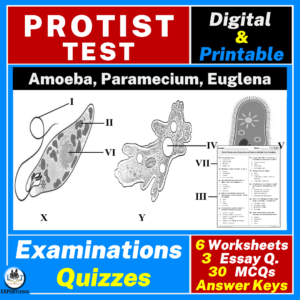
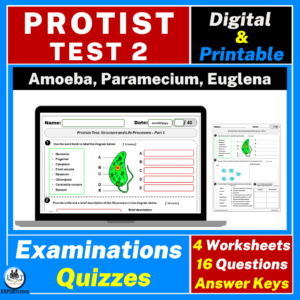
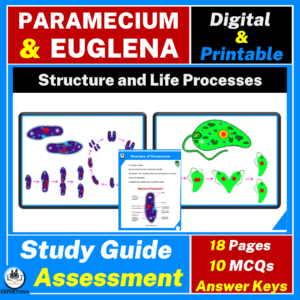
For teachers who want additional material to support this topic, the Paramecium and Euglena Notes and Assessment can provide lesson material and assessment opportunities for students. The Protist Test 1 and Protist Test 2 can also be used to assess students’ understanding of Amoeba, Paramecium, and Euglena. The Protists Bundle brings the complete collection of resources together in one place.
The study of these organisms therefore goes beyond identifying microscopic organisms. It helps students understand how structure and function are connected and how different organisms can solve the same basic problems of survival in different ways.
From Amoeba’s pseudopodia to Paramecium’s cilia and Euglena’s flagellum, these organisms show that being single-celled does not mean being simple.
Protists Resources