
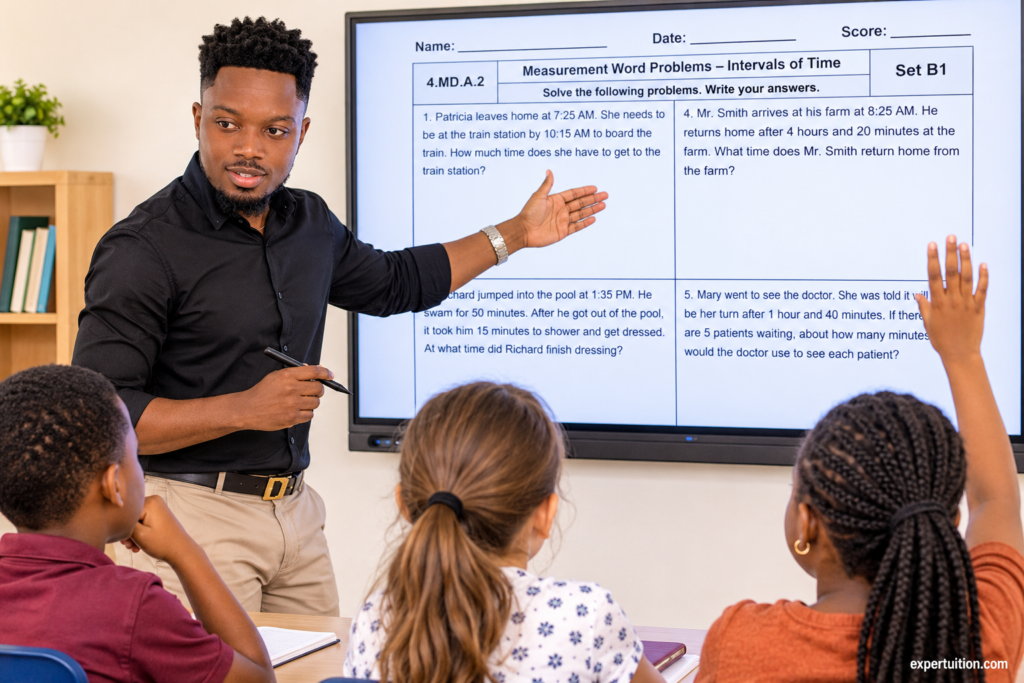
Learn how to solve Grade 4 measurement word problems with 11 worked examples covering length and distance, time intervals, liquid volume, mass and weight, and money. Follow a five-step approach to identify the information, choose the correct operations, and solve each problem.
Understanding Measurement Word Problems
Measurement word problems help us apply Math to everyday situations. We use measurement to describe distances, track time, compare the amounts of liquid in containers, determine the mass of objects, and work with money.
Solving these problems requires more than knowing how to convert units or perform calculations. We must understand what the problem is asking, identify the quantities involved, decide whether a conversion is necessary, and choose the correct operations.
A Five-Step Approach to Solving Measurement Word Problems
You can use the following five-step approach to solve measurement word problems.
1. Understand the Problem
Read the problem carefully. What are you trying to find? Identify the question and the information provided.
Pay attention to words and phrases that describe the situation. For example, a problem may ask you to find:
- How much longer or shorter one distance is than another.
- How much time has passed between two events.
- How much liquid remains in a container.
- The total mass of several objects.
- How much money is left after a purchase.
Understanding the question helps you focus on the information you need.
2. Identify the Information
Identify the quantities given in the problem and the units used to measure them.
For example, a problem may give distances in kilometers and meters or liquid volumes in liters and milliliters.
Write down the important measurements and check whether their units are the same or different.
3. Plan the Solution
Decide whether you need to convert any units and which operations will help you solve the problem.
When comparing or calculating measurements expressed in different units, convert them to the same unit first.
For example, to find how much farther 3 kilometers is than 2,500 meters, express both distances in meters before subtracting.
Remember that unit conversions should be made within the same measurement system.
For a closer look at the two main measurement systems and their unit conversions, read Grade 4 Measurement Conversions: Customary and Metric Units.
4. Solve the Problem
Carry out the calculations using the operations you selected. Keep track of the units throughout the solution.
You may use an equation, a number line, or another diagram to organize your work and show how the quantities are related.
5. Check and Answer
Does your result make sense? Check your calculations and make sure you have answered the question.
State your answer clearly using the correct unit.
Measurement Word Problems: Worked Examples
Work through these examples involving five areas of measurement.
Length and Distance Word Problems
Length and distance problems involve measuring or comparing how long or far something is. Depending on the problem, you may need to convert units, find a difference, or divide a measurement into equal parts.
Example 1: Steve’s Travel Distances
Problem: Steve travels 3 kilometers on Monday and 2,500 meters on Tuesday. How many meters farther does he travel on Monday?
Understand the Problem: We need to find how many meters farther Steve travels on Monday.
Identify the Information:
- Monday’s distance = 3 kilometers
- Tuesday’s distance = 2,500 meters
- Difference = ? meters
Plan the Solution: The distances are expressed in different units. Convert 3 kilometers to meters, then subtract Tuesday’s distance from Monday’s distance.
Solve the Problem:
Since 1 kilometer = 1,000 meters:
3 × 1,000 = 3,000 m
3,000 − 2,500 = 500 m
Check and Answer: 3,000 meters − 2,500 meters = 500 meters, confirming the difference.
Answer: Steve travels 500 meters farther on Monday.
Example 2: Stephen’s Height
Problem: Stephen was 4 feet 8 inches tall. He grew 10 inches. How tall is he now in inches?
Understand the Problem: We need to find Stephen’s new height in inches.
Identify the Information:
- Original height = 4 feet 8 inches
- Growth = 10 inches
- Required unit = inches
Plan the Solution: Convert the feet to inches, add the remaining inches to find his original height, then add his growth.
Solve the Problem:
Since 1 foot = 12 inches:
4 × 12 = 48 inches
48 + 8 = 56 inches
56 + 10 = 66 inches
Check and Answer: 66 − 56 = 10 inches, matching the amount Stephen grew.
Answer: Stephen is now 66 inches tall.
Example 3: Measuring a Hiking Trail
Problem: A hiking trail is 3½ miles long. A family walks 1½ miles in the morning and ½ mile in the afternoon. How many miles do they have left to walk?
Understand the Problem: We need to find how many miles of the trail the family has left to walk.
Identify the Information:
- Total trail length = 3½ miles
- Distance walked in the morning = 1½ miles
- Distance walked in the afternoon = ½ mile
- Remaining distance = ? miles
Plan the Solution: Add the distances the family walked, then subtract the total distance walked from the trail’s length.
Solve the Problem:
1½ + ½ = 2 miles
3½ − 2 = 1½ miles
Check and Answer: 2 miles walked + 1½ miles remaining = 3½ miles, confirming the total trail length.
Answer: The family has 1½ miles left to walk.
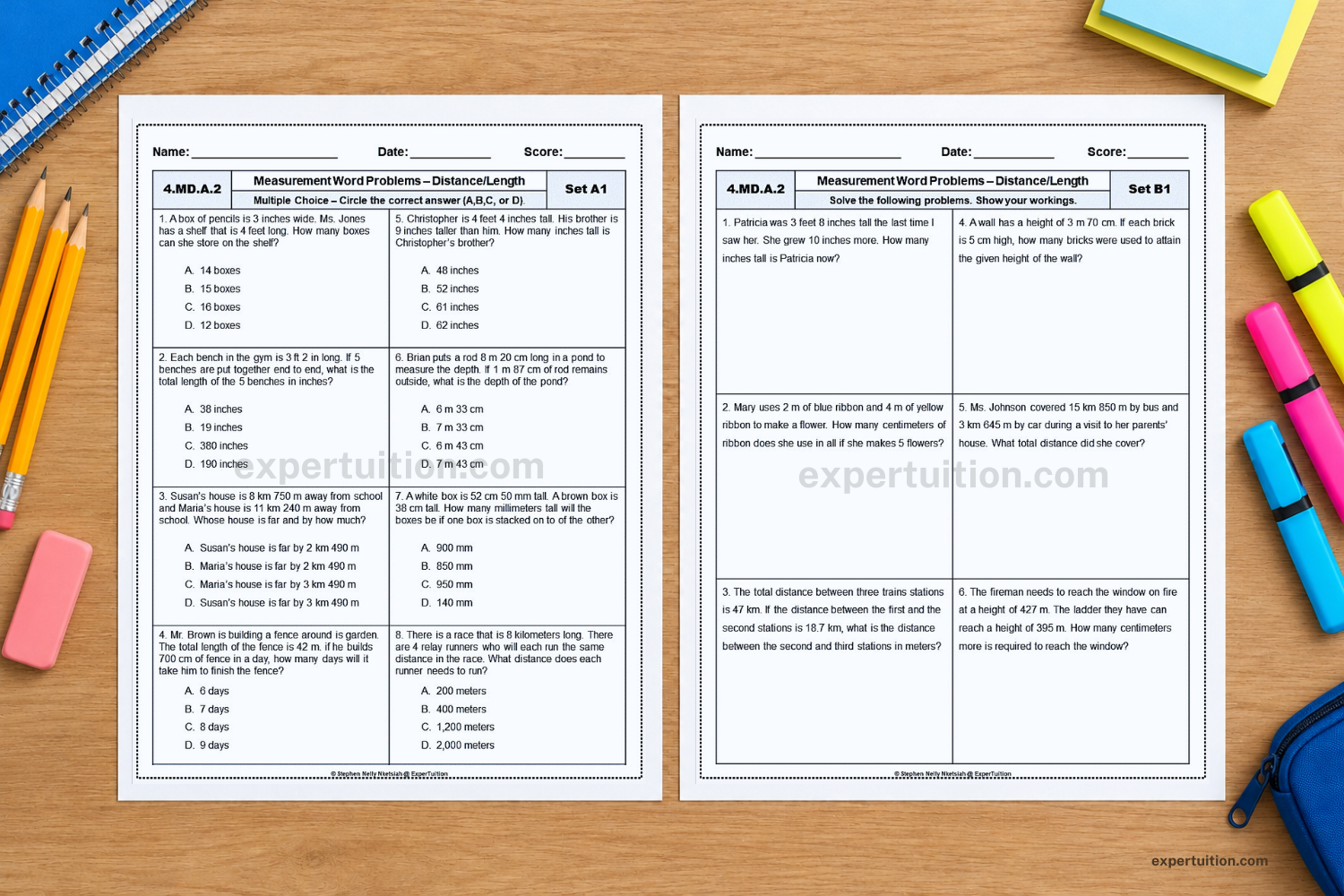
For more practice, explore my Distance and Length Word Problems Worksheets.
Time-Interval Word Problems
Time problems often involve finding the amount of time between two events or calculating how long an activity takes.
A number line can help you count forward from the starting time to the ending time.
Example 1: Patricia’s Journey
Problem: Patricia leaves home at 7:00 a.m. and arrives at the train station at 8:25 a.m. How long does her journey take in minutes?
Understand the Problem: We need to find how long Patricia’s journey takes.
Identify the Information:
- Starting time = 7:00 a.m.
- Arrival time = 8:25 a.m.
- Required unit = minutes
Plan the Solution: Count forward from 7:00 a.m. to 8:25 a.m., using one-hour and smaller time intervals.
Solve the Problem:
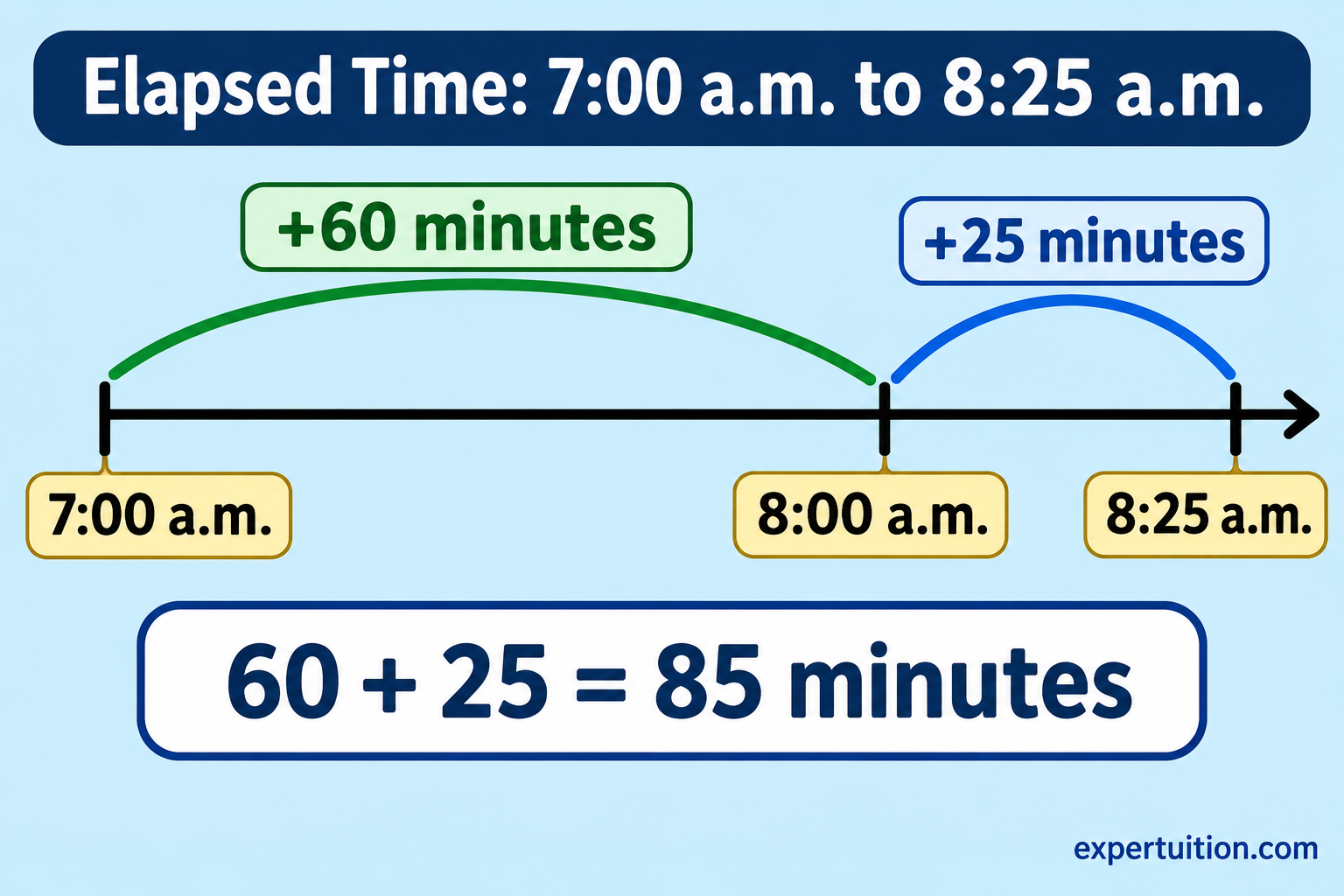
- 7:00 a.m. to 8:00 a.m. = 60 minutes
- 8:00 a.m. to 8:25 a.m. = 25 minutes
60 + 25 = 85 minutes
Check and Answer: 85 minutes = 1 hour and 25 minutes, which matches the time between 7:00 a.m. and 8:25 a.m.
Answer: Patricia’s journey takes 85 minutes.
Example 2: John’s Trip
Problem: John leaves home at 2:30 p.m. and arrives at his destination at 4:30 p.m. He then waits for 15 minutes. How many minutes pass from the time he leaves home until he finishes waiting?
Understand the Problem: We need to find the total time from when John leaves home until he finishes waiting.
Identify the Information:
- Starting time = 2:30 p.m.
- Arrival time = 4:30 p.m.
- Waiting time = 15 minutes
- Required unit = minutes
Plan the Solution: Find the travel time, convert it to minutes, then add the waiting time.
Solve the Problem:
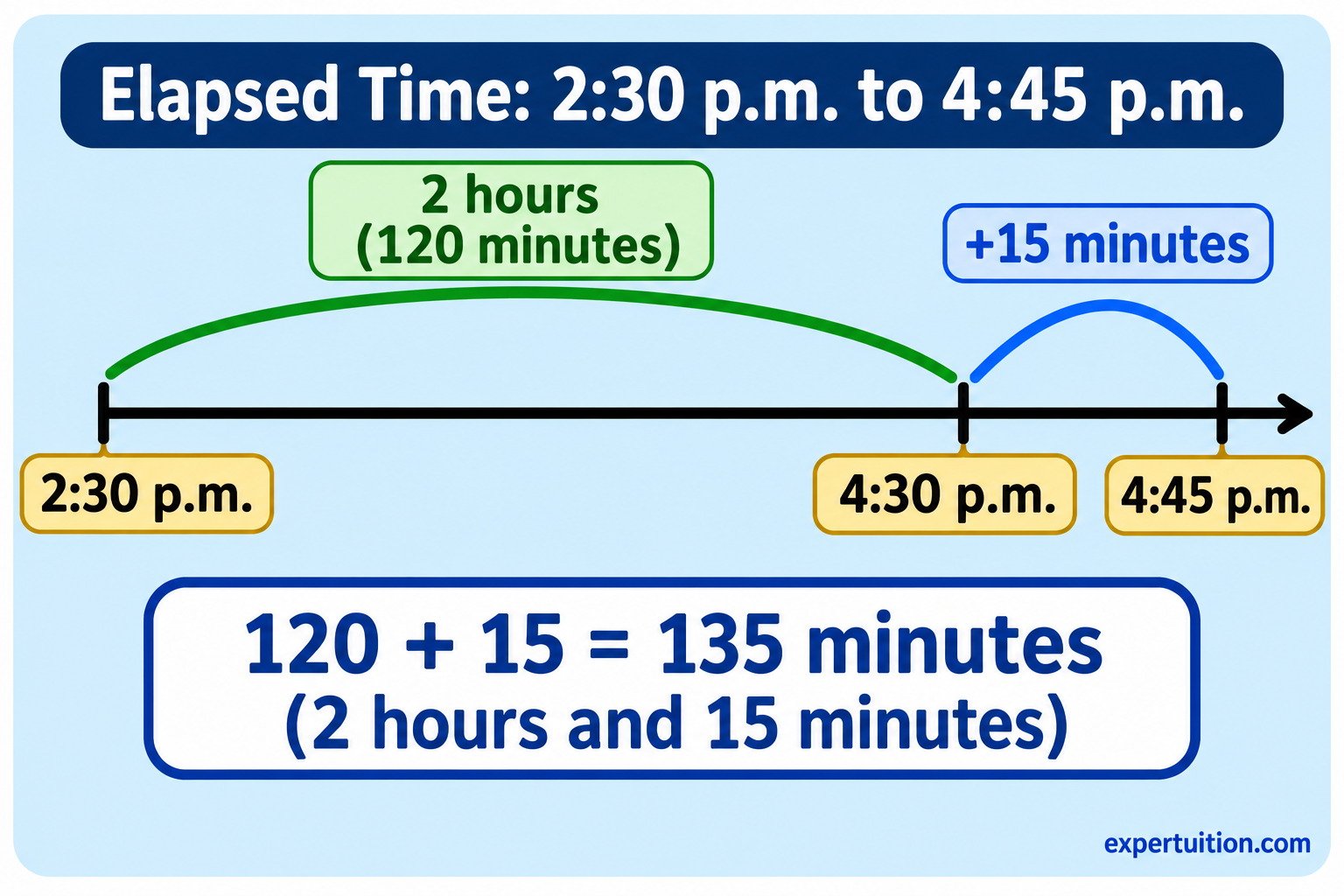
From 2:30 p.m. to 4:30 p.m. is 2 hours.
2 × 60 = 120 minutes
120 + 15 = 135 minutes
Check and Answer: 135 minutes = 2 hours and 15 minutes, which includes both the travel time and the waiting time.
Answer: A total of 135 minutes pass from the time John leaves home until he finishes waiting.
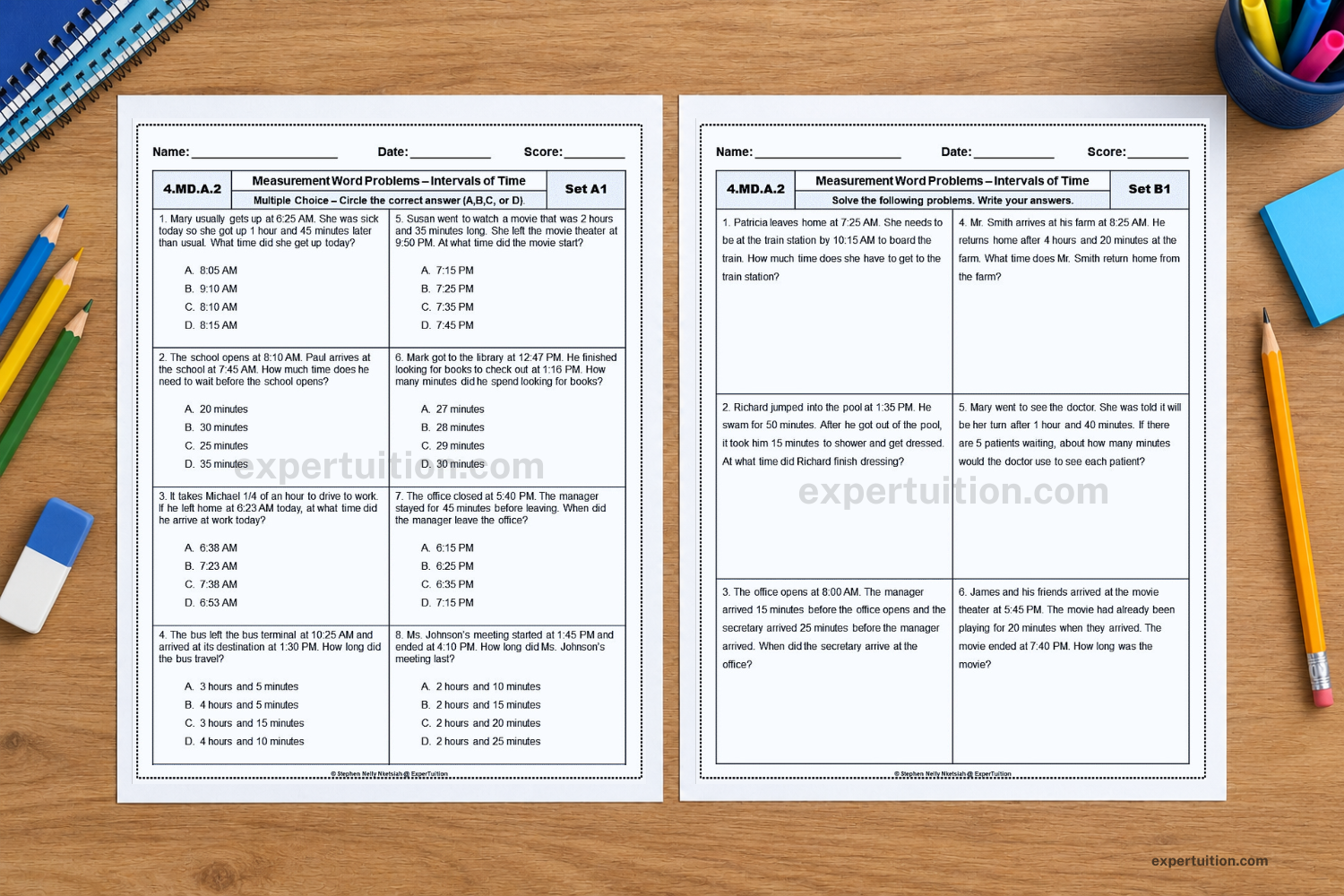
For more practice, explore these Elapsed Time and Time Interval Word Problems Worksheets.
Liquid-Volume Word Problems
Liquid-volume problems involve measuring the amount of liquid in containers. You may need to convert units, find how much liquid was used, or calculate the amount in each container.
Example 1: Filling Bottles with Oil
Problem: A container holds 3 liters of oil. After filling 4 bottles, 600 milliliters of oil remain. How much oil was poured into each bottle?
Understand the Problem: We need to find the amount of oil in each bottle.
Identify the Information:
- Initial amount of oil = 3 liters
- Amount remaining = 600 milliliters
- Number of bottles = 4
- Required unit = milliliters
Plan the Solution: Convert the initial amount to milliliters, subtract the amount remaining, then divide the amount used equally among the 4 bottles.
Solve the Problem:
Since 1 liter = 1,000 milliliters:
3 × 1,000 = 3,000 mL
3,000 − 600 = 2,400 mL
2,400 ÷ 4 = 600 mL
Check and Answer: Four bottles containing 600 mL each hold 2,400 mL altogether. Adding the remaining 600 mL gives the original 3,000 mL.
Answer: Each bottle contains 600 milliliters of oil.
Example 2: Finding the Original Amount of Cereal
Problem: A large container held some cereal. After 15 cups were eaten, 3 quarts remained. How many cups of cereal were in the container originally?
Understand the Problem: We need to find the original amount of cereal in cups.
Identify the Information:
- Cereal eaten = 15 cups
- Cereal remaining = 3 quarts
- Required unit = cups
Plan the Solution: Convert the remaining cereal from quarts to cups, then add the amount eaten.
Solve the Problem:
Since 1 quart = 4 cups:
3 × 4 = 12 cups
15 + 12 = 27 cups
Check and Answer: 27 cups − 15 cups = 12 cups, which is equal to the 3 quarts remaining.
Answer: There were originally 27 cups of cereal.
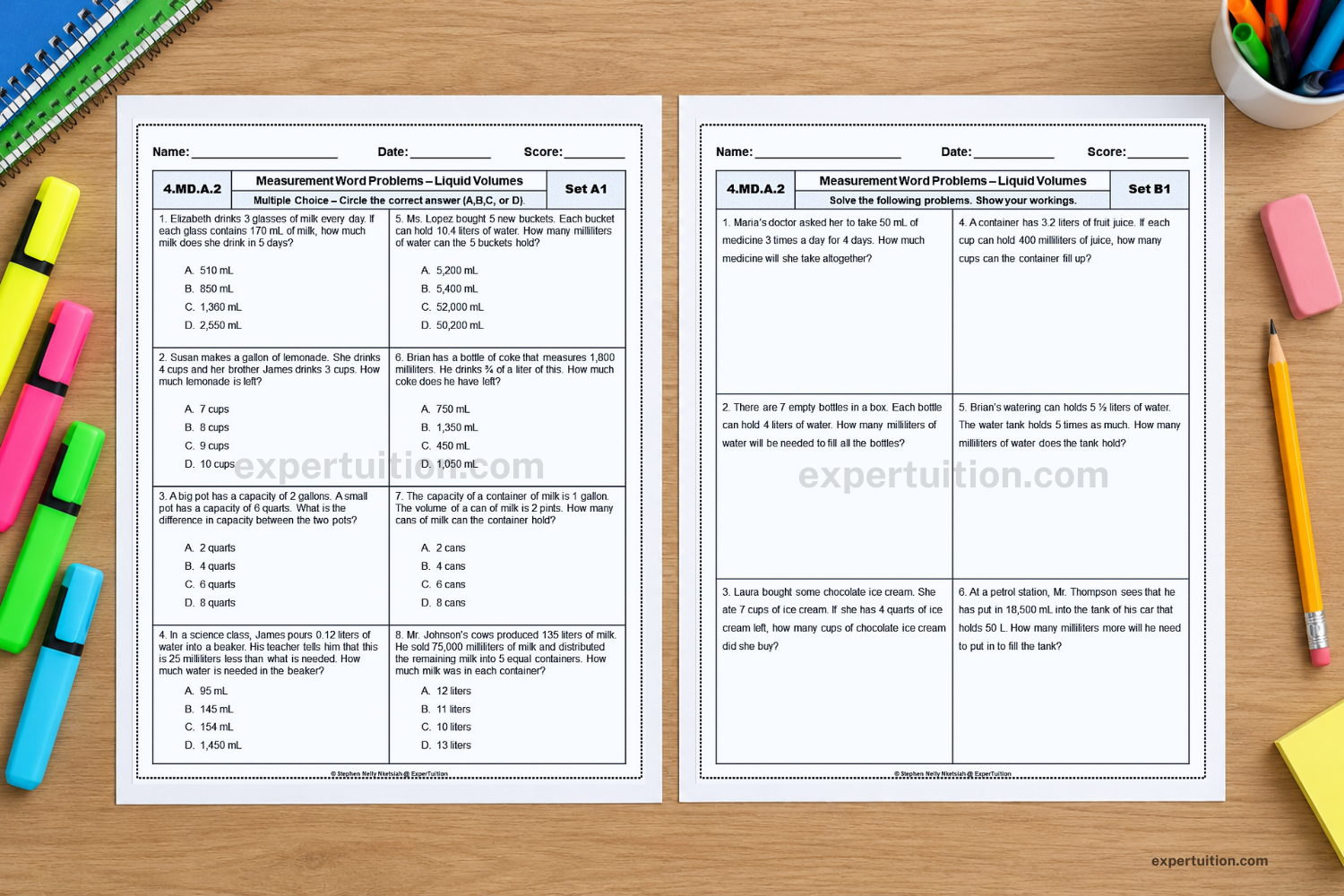
For more practice, explore these Liquid Volume Word Problems Worksheets.
Mass and Weight Word Problems
Mass and weight problems involve finding the mass of objects or comparing measurements. The units used depend on the measurement system. Kilograms and grams measure mass, while pounds and ounces are commonly used in everyday weight measurements.
Example 1: Sacks of Potatoes
Problem: Two sacks of potatoes have a combined mass of 106 kilograms. If one sack has a mass of 64 kilograms, what is the mass of the other sack in grams?
Understand the Problem: We need to find the mass of the second sack in grams.
Identify the Information:
- Combined mass = 106 kilograms
- Mass of one sack = 64 kilograms
- Required unit = grams
Plan the Solution: Subtract the mass of the known sack from the combined mass, then convert the remaining mass from kilograms to grams.
Solve the Problem:
106 − 64 = 42 kg
Since 1 kilogram = 1,000 grams:
42 × 1,000 = 42,000 g
Check and Answer: 64 kg + 42 kg = 106 kg. The remaining 42 kg is equal to 42,000 g.
Answer: The other sack has a mass of 42,000 grams.
Example 2: Strawberries in a Bag
Problem: A bag contains 3 pounds of strawberries. Someone eats 10 ounces and gives away another 12 ounces. How many ounces of strawberries remain?
Understand the Problem: We need to find how many ounces of strawberries are left in the bag.
Identify the Information:
- Original amount = 3 pounds
- Amount eaten = 10 ounces
- Amount given away = 12 ounces
- Required unit = ounces
Plan the Solution: Convert the original amount from pounds to ounces, add the amounts removed, then subtract that total from the original amount.
Solve the Problem:
Since 1 pound = 16 ounces:
3 × 16 = 48 ounces
10 + 12 = 22 ounces
48 − 22 = 26 ounces
Check and Answer: 26 ounces remaining + 22 ounces removed = 48 ounces, the original amount.
Answer: 26 ounces of strawberries remain.
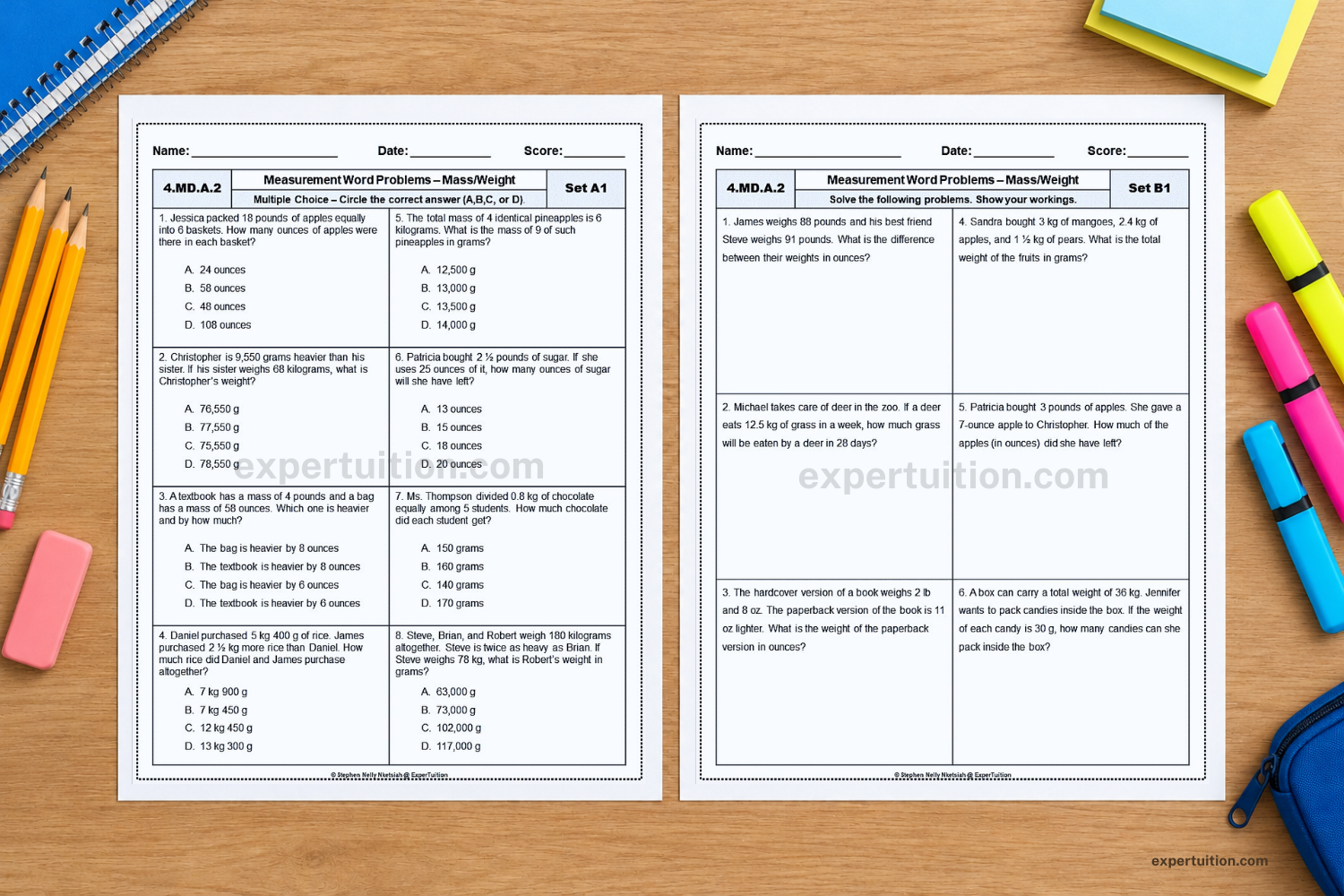
For more practice, explore these Mass and Weight Word Problems Worksheets.
Money Word Problems
Money problems involve finding totals, calculating differences, and determining how much money remains after purchases.
Example 1: Shopping for Clothes
Problem: A woman has $70 to spend. She buys two dresses for $18 each and a hat for $7. How much money does she have left?
Understand the Problem: We need to find how much money the woman has left after her purchases.
Identify the Information:
- Total budget = $70
- Price of each dress = $18
- Number of dresses = 2
- Price of hat = $7
Plan the Solution: Multiply the price of one dress by 2, add the cost of the hat, then subtract the total spent from the budget.
Solve the Problem:
2 × $18 = $36
$36 + $7 = $43
$70 − $43 = $27
Check and Answer: $43 spent + $27 remaining = $70, confirming the original budget.
Answer: She has $27 left.
Example 2: Buying Groceries
Problem: A shopper buys 2 bags of pasta for $6.40 each and 3 packages of meat for $5.20 each. How much does the shopper spend altogether?
Understand the Problem: We need to find the total cost of the pasta and meat.
Identify the Information:
- Price of each bag of pasta = $6.40
- Number of pasta bags = 2
- Price of each meat package = $5.20
- Number of meat packages = 3
Plan the Solution: Multiply each item’s price by the number purchased, then add the two costs.
Solve the Problem:
2 × $6.40 = $12.80
3 × $5.20 = $15.60
$12.80 + $15.60 = $28.40
Check and Answer: $28.40 − $12.80 = $15.60, confirming that the total includes the cost of both groups of items.
Answer: The shopper spends $28.40 altogether.
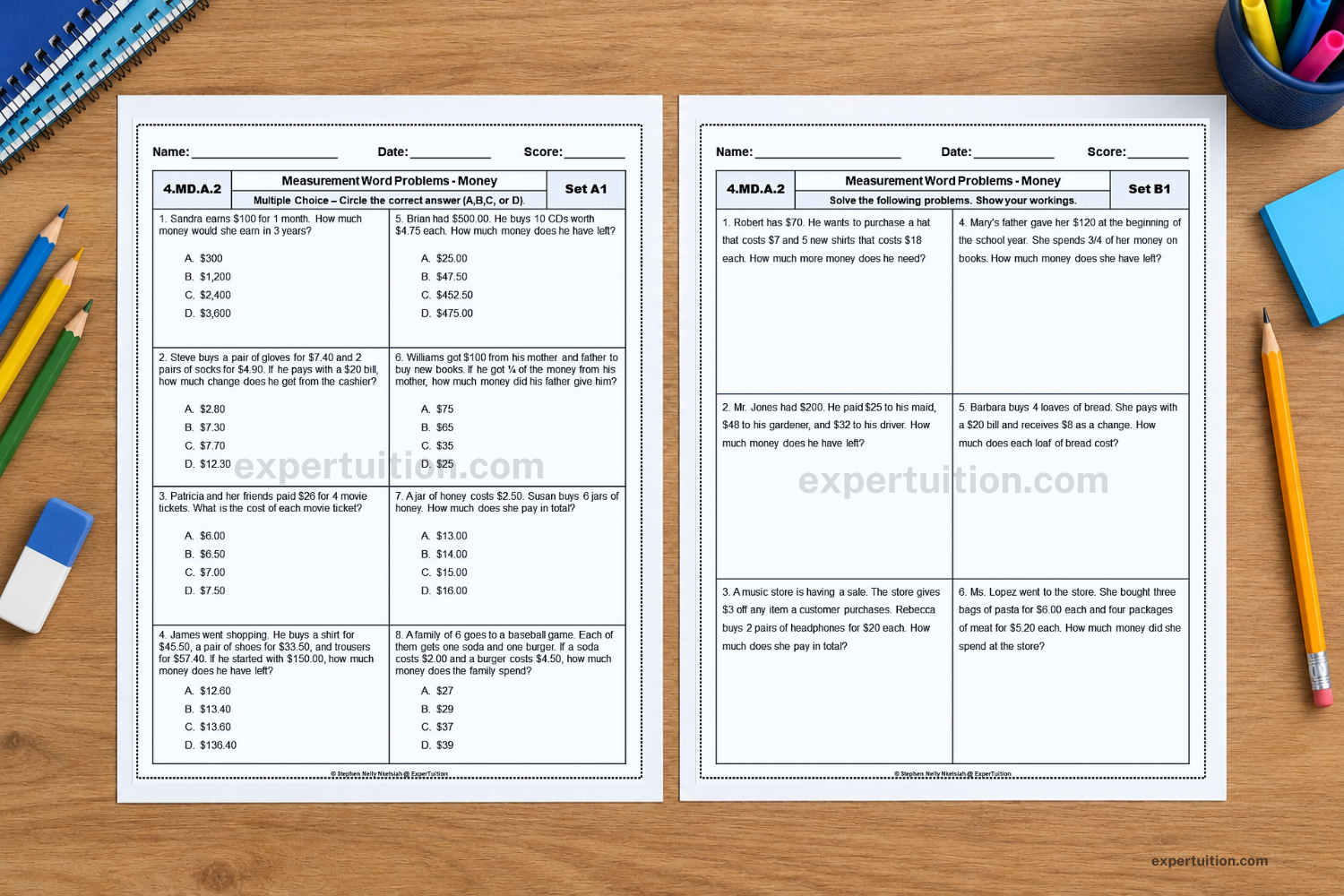
For more practice, explore these Money Word Problems Worksheets.
Measurement Word Problem Resources
Give students more opportunities to solve one-step and multi-step measurement word problems with resources covering five areas: distance and length, time intervals, liquid volume, mass and weight, and money.
Measurement Word Problems Bundle: Worksheets, Task Cards, and Google Forms
The Measurement Word Problems Bundle brings all three formats together in one purchase. It includes 15 products: five worksheet sets, five task-card sets, and five Google Forms products.
The resources cover all five measurement topics and include multiple-choice and open-ended questions. The printable worksheets and task cards come with answer keys and supporting materials, while the Google Forms are self-grading and provide instant data.
Choose a Resource Format
If you prefer to purchase a particular format, explore these options:
- Measurement Word Problems Worksheets Bundle: Five worksheet products covering the five measurement topics, with multiple-choice and open-ended practice.
- Measurement Word Problems Task Cards Bundle: Five task-card products covering all five topics for classroom practice, math centers, and other activities.
- Measurement Word Problems Google Forms Bundle: Five digital products with self-grading Google Forms for paperless practice and assessment.
- Measurement Word Problem Worksheets and Task Cards Bundle: A combined option with five worksheet products and five task-card products.
You can also browse the complete Measurement Word Problems Collection to find individual worksheets, task cards, Google Forms, and bundles.
Grade 4 Measurement Word Problems
Grade 4 measurement word problems involve working with different units, making conversions, comparing measurements, calculating elapsed time, and using the four operations to solve problems. The examples in this article cover length and distance, time intervals, liquid volume, mass and weight, and money.
For additional strategies to help students develop measurement understanding and solve increasingly complex problems, read my article on How to Teach Measurement in Grades 3–5: Estimation, Conversions, and Problem-Solving.

