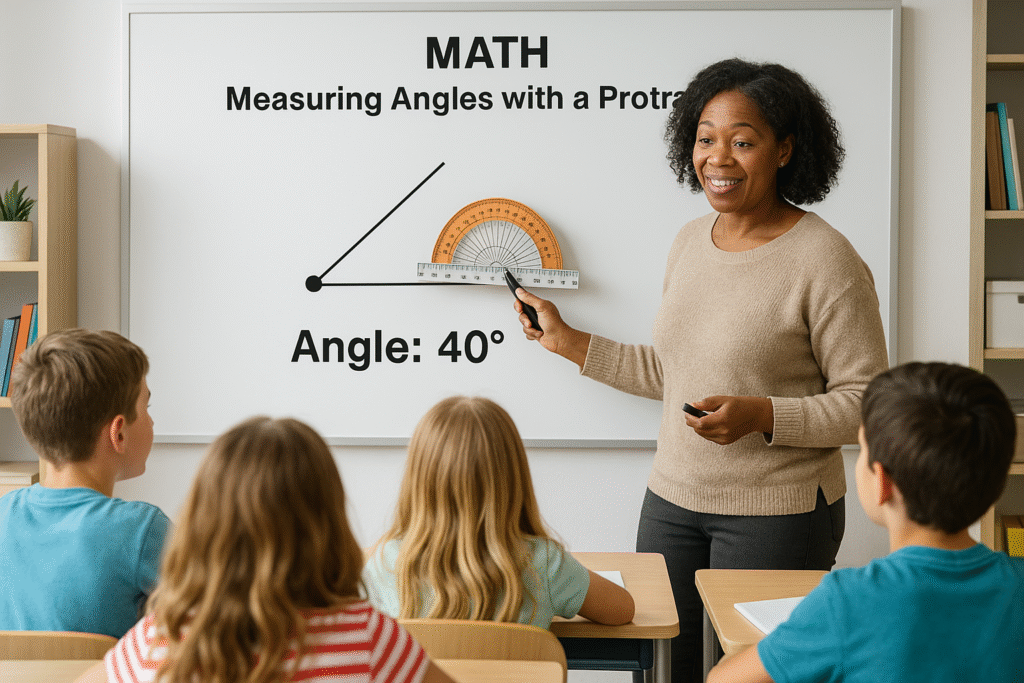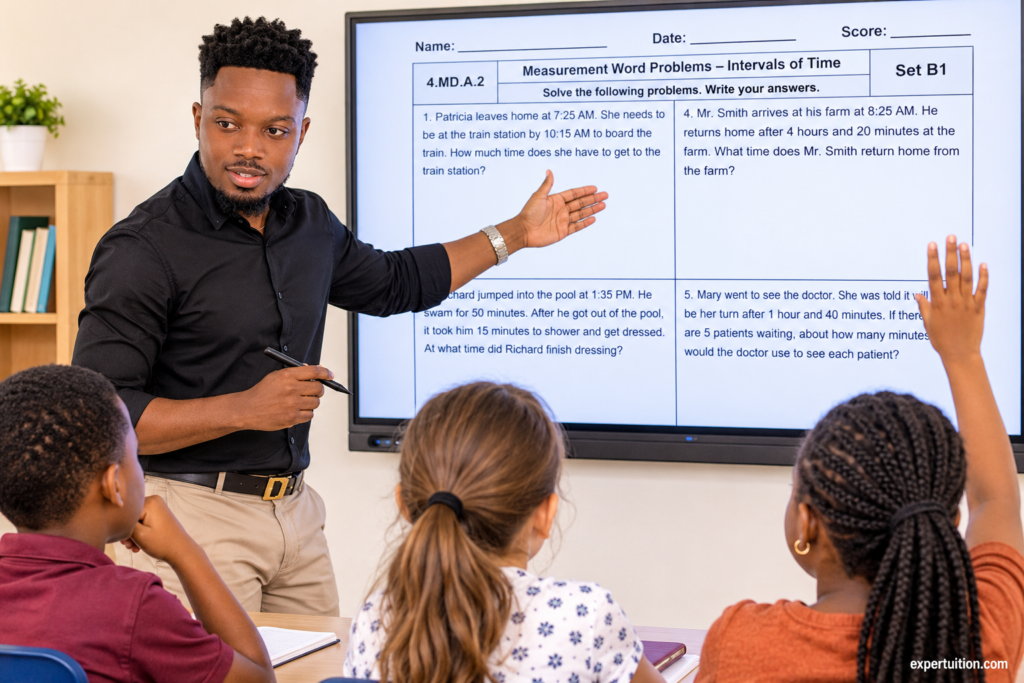
Learn how to convert customary and metric units of measurement in Grade 4. Explore conversion relationships for length, liquid volume, mass, and time, with clear examples showing when to multiply or divide. Includes measurement conversion worksheets and task cards for classroom practice.
Understanding Measurement Systems
We use measurement to describe the length of objects, the distance between places, the volume or capacity of containers, and the mass of different items. To measure these quantities consistently, we use standard units.
The two main measurement systems are the Customary System and the Metric System. They use different units, but both allow us to measure and compare the same quantities.
The Customary System is used primarily in the United States, while the Metric System is used in most other countries.
In Grade 4, students learn how measurement units relate to one another within a single system. They express larger units in smaller units and record equivalent measurements in a two-column table. This includes relationships such as feet and inches, pounds and ounces, kilograms and grams, liters and milliliters, and hours and minutes.
The Customary Measurement System
The Customary System uses units such as inches, feet, yards, miles, ounces, pounds, cups, pints, quarts, and gallons. These units describe distance and length, volume and capacity, and mass and weight.
Customary Units of Distance and Length
Inches, feet, yards, and miles are used to measure length and distance. The appropriate unit depends on what is being measured.
Inches and feet are useful for smaller objects and spaces, while yards and miles are better suited to longer distances.
| Unit | Equivalent measurement |
|---|---|
| 1 foot (ft) | 12 inches (in) |
| 1 yard (yd) | 3 feet (ft) |
| 1 yard (yd) | 36 inches (in) |
| 1 mile (mi) | 1,760 yards (yd) |
| 1 mile (mi) | 5,280 feet (ft) |
Consider where you might encounter these units:
- A pencil’s length is usually measured in inches.
- A person’s height may be measured in feet.
- A football field is measured in yards.
- The distance between two cities is measured in miles.
The relationship between feet and inches tells us that every foot contains 12 inches. Therefore, 3 feet = 36 inches.
A conversion table can help students see how the relationship between two units remains consistent as the measurements increase.
| Feet | Inches |
|---|---|
| 1 | 12 |
| 2 | 24 |
| 3 | 36 |
| 4 | 48 |
Customary Units of Volume and Capacity
Volume describes the amount of space a substance occupies, while capacity describes how much a container can hold. The Customary System uses fluid ounces, cups, pints, quarts, and gallons to measure liquid volume and capacity.
These units are common in cooking and when measuring or buying liquids.
| Unit | Equivalent measurement |
|---|---|
| 1 cup (c) | 8 fluid ounces (fl oz) |
| 1 pint (pt) | 2 cups |
| 1 quart (qt) | 2 pints |
| 1 gallon (gal) | 4 quarts |
| 1 gallon (gal) | 16 cups |
A recipe may call for a few fluid ounces of an ingredient or several cups of milk. A larger container of milk may hold a gallon.
A fluid ounce measures liquid volume, while an ounce used with pounds measures mass. They are different units, even though both use the word ounce.
Customary Units of Mass and Weight
Mass describes the amount of matter in an object, while weight describes the force of gravity acting on it. In everyday US measurements, ounces and pounds are commonly used to describe how heavy objects are. People also express their own weight in pounds, while tons are used for much heavier loads.
| Unit | Equivalent measurement |
|---|---|
| 1 pound (lb) | 16 ounces (oz) |
| 1 US short ton | 2,000 pounds (lb) |
A small food item may be described as weighing a few ounces, while a person’s weight is commonly expressed in pounds. The weight of a heavy load carried by a truck may be expressed in tons.
The relationship between pounds and ounces is useful when converting measurements. Since 1 pound = 16 ounces, 3 pounds = 48 ounces.
The Metric Measurement System
The Metric System is used in most countries around the world. Its units are based on powers of ten, so conversions often involve multiplying or dividing by 10, 100, or 1,000.
The main units used to measure distance and length, volume and capacity, and mass include kilometers, meters, centimeters, millimeters, liters, milliliters, kilograms, grams, and milligrams.
Metric Units of Distance and Length
Kilometers, meters, centimeters, and millimeters measure length and distance. The meter is the base unit of length in the Metric System.
| Unit | Equivalent measurement |
|---|---|
| 1 kilometer (km) | 1,000 meters (m) |
| 1 meter (m) | 100 centimeters (cm) |
| 1 centimeter (cm) | 10 millimeters (mm) |
| 1 meter (m) | 1,000 millimeters (mm) |
The unit depends on the length being measured. The distance between towns may be expressed in kilometers, while the length of a room is more likely to be measured in meters. Centimeters are useful for smaller objects, and millimeters can describe very small lengths.
For example, a meter contains 100 centimeters. A length of 4 meters = 400 centimeters.
Metric Units of Volume and Capacity
Liters and milliliters are used to measure liquid volume and the capacity of containers. A liter is suitable for larger quantities, while milliliters are used for smaller amounts.
| Unit | Equivalent measurement |
|---|---|
| 1 liter (L) | 1,000 milliliters (mL) |
A large bottle of water may contain 1 liter, while a smaller container may hold 250 milliliters.
Since 1 liter = 1,000 milliliters, 3 liters = 3,000 milliliters.
Metric Units of Mass
The Metric System uses kilograms, grams, and milligrams to measure mass. Kilograms are suitable for heavier objects, while grams and milligrams are used for smaller masses.
| Unit | Equivalent measurement |
|---|---|
| 1 kilogram (kg) | 1,000 grams (g) |
| 1 gram (g) | 1,000 milligrams (mg) |
| 1 kilogram (kg) | 1,000,000 milligrams (mg) |
A person’s mass may be expressed in kilograms. A small food item may be measured in grams, while very small quantities may require milligrams.
For example, 1 kilogram contains 1,000 grams. A bag with a mass of 5 kilograms is therefore equivalent to 5,000 grams.
Understanding Measurement Conversions
A measurement conversion expresses the same quantity in a different unit. For example, 2 feet and 24 inches describe the same length. The number changes because the units are different, but the actual length stays the same.
To convert a measurement, students must know how the two units relate. They can then use multiplication or division to find the equivalent measurement.
Converting Customary Units
Customary conversions rely on the relationships between units. Consider the relationship between feet and inches.
Convert 4 feet to inches.
Since 1 foot = 12 inches, multiply 4 by 12.
4 × 12 = 48
Therefore, 4 feet = 48 inches.
Convert 36 inches to feet.
Since 12 inches = 1 foot, divide 36 by 12.
36 ÷ 12 = 3
Therefore, 36 inches = 3 feet.
The same approach applies to other customary units. Students should identify the relationship between the units before choosing the operation.
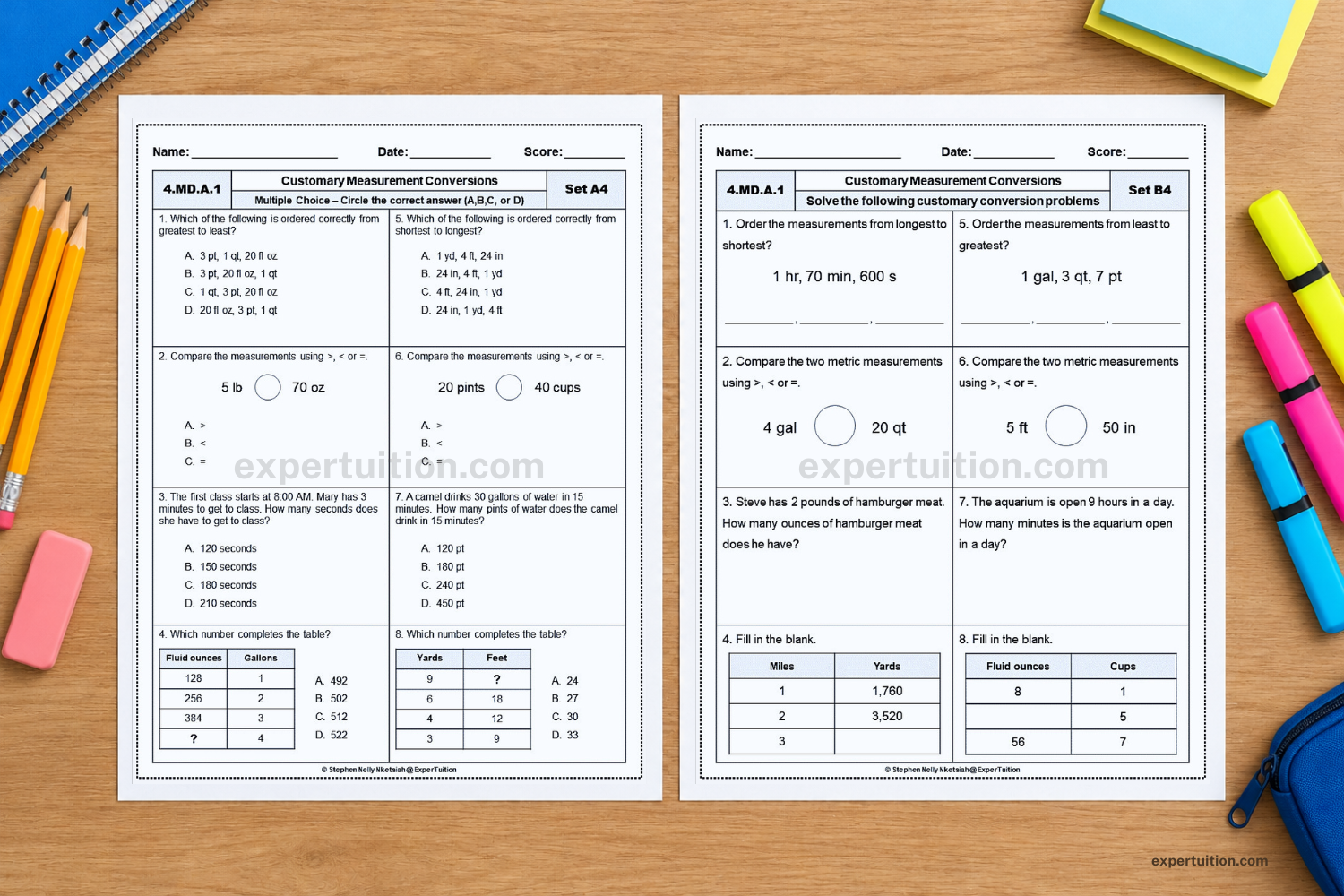
For additional practice, see my Customary System Measurement Conversion Worksheets and Customary System Measurement Conversion Task Cards.
Converting Metric Units
Metric conversions follow a consistent pattern because the units are based on powers of ten.
Convert 5 meters to centimeters.
Since 1 meter = 100 centimeters, multiply 5 by 100.
5 × 100 = 500
Therefore, 5 meters = 500 centimeters.
Convert 3,000 grams to kilograms.
Since 1 kilogram = 1,000 grams, divide 3,000 by 1,000.
3,000 ÷ 1,000 = 3
Therefore, 3,000 grams = 3 kilograms.
Students can use the same reasoning for other metric conversions. Knowing the relationship between the units helps them select the correct operation and check whether their answers make sense.
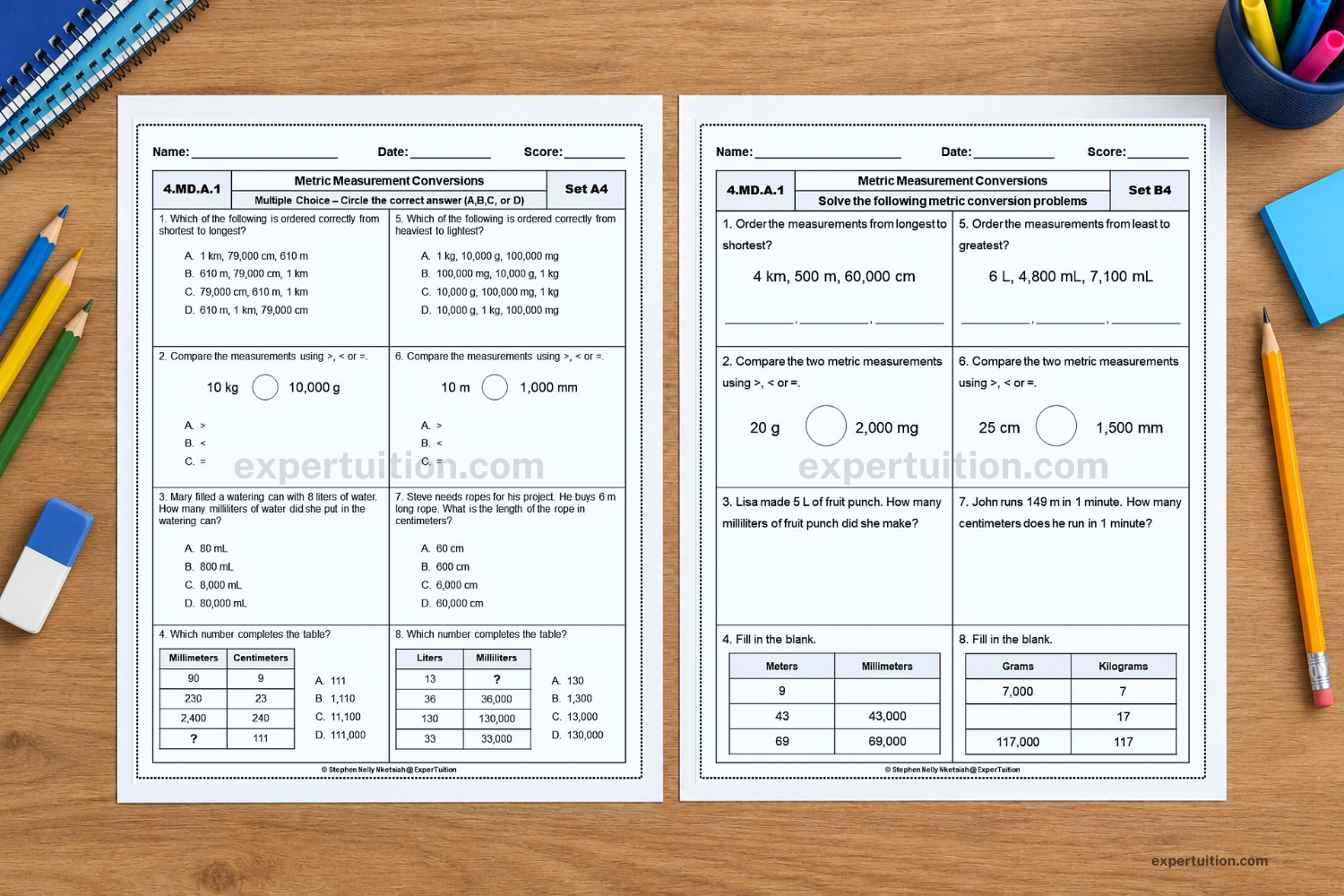
For more practice, explore my Metric System Measurement Conversion Worksheets and Metric System Measurement Conversion Task Cards. These resources give students practice converting metric units of measurement.
Understanding Time Units and Conversions
Time is a separate measurement quantity, not part of the Customary or Metric System. However, Grade 4 measurement work also includes understanding the relationships between hours, minutes, and seconds.
| Unit | Equivalent measurement |
|---|---|
| 1 minute (min) | 60 seconds (sec) |
| 1 hour (hr) | 60 minutes (min) |
| 1 hour (hr) | 3,600 seconds (sec) |
For example, to convert 3 hours to minutes, multiply by 60 because each hour contains 60 minutes.
3 × 60 = 180
Therefore, 3 hours = 180 minutes.
The same conversion principle applies to time: use the relationship between the units to find an equivalent measurement.
Using Multiplication and Division in Conversions
When converting between units of the same measurement quantity, the relationship between the units determines whether to multiply or divide.
- Multiply when converting from a larger unit to a smaller unit. More of the smaller units are needed to express the same quantity.
- Divide when converting from a smaller unit to a larger unit. Fewer of the larger units are needed to express the same quantity.
The following examples show how these operations apply across different measurement units.
| Conversion | Operation | Equivalent measurement |
|---|---|---|
| 6 feet to inches | 6 × 12 | 72 inches |
| 48 ounces to pounds | 48 ÷ 16 | 3 pounds |
| 4 meters to centimeters | 4 × 100 | 400 centimeters |
| 5,000 grams to kilograms | 5,000 ÷ 1,000 | 5 kilograms |
| 2 hours to minutes | 2 × 60 | 120 minutes |
The important step is identifying how many smaller units make up one larger unit, or how many larger units are equivalent to the smaller measurement. Once students know that relationship, they can choose the appropriate operation.
Students also apply measurement conversions when solving problems involving distances, time intervals, liquid volumes, and masses. Grade 4 problem-solving also includes word problems involving money. For worked examples and problem-solving approaches, read Grade 4 Measurement Word Problems: Strategies and Worked Examples.
Measurement Conversion Worksheets and Task Cards
Students need practice converting measurements in both the Customary and Metric Systems. Worksheets and task cards give them opportunities to work with equivalent measurements, apply unit relationships, and solve conversion exercises.
My Measurement Conversion Worksheets and Task Cards Bundle includes four resources: two worksheet products and two task card products. The activities cover customary and metric conversions involving length, liquid volume, and mass, as well as time conversions. Each product includes multiple-choice and open-ended questions, and the bundle also includes answer keys, a measurement conversion chart, and a data tracker.
Choose a Resource Format
If you prefer to purchase a particular format, explore these options:
- Customary and Metric Conversions Worksheets Bundle
- Customary and Metric Conversions Task Cards Bundle
For more measurement conversion resources, browse my Conversions collection.
Understanding and Applying Measurement Conversions
The Customary and Metric Systems use different units to measure distance and length, volume and capacity, and mass. Time has its own relationships between seconds, minutes, and hours.
The central skill is recognizing how these units relate and using those relationships to convert measurements accurately. Knowing when to multiply or divide helps students express the same quantity in different units and apply conversions when solving measurement problems.
For practical ways to teach measurement through estimation, hands-on activities, visual models, and problem-solving, read my article on How to Teach Measurement in Grades 3–5: Estimation, Conversions, and Problem-Solving.