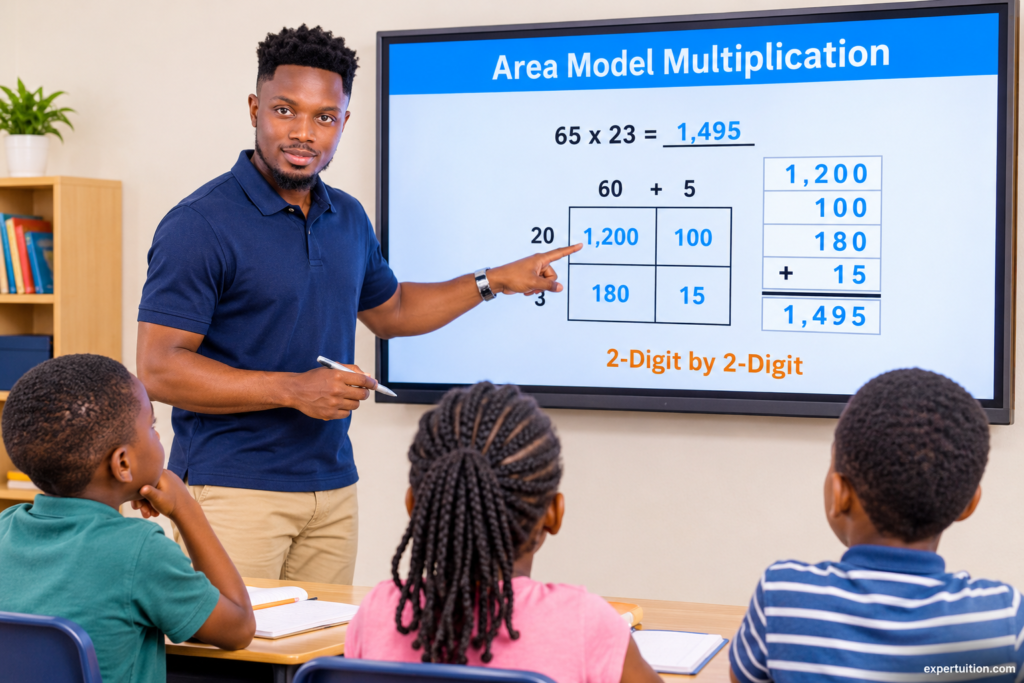
Learn how the partial products multiplication method works through place-value decomposition and the distributive property. Explore worked examples with different factor combinations, along with common errors and how to correct them.
What Is the Partial Products Method?
The partial products method is a way to multiply multi-digit numbers by breaking them into smaller parts according to place value. Students multiply the parts separately and add the resulting products to find the final answer.
Each individual result is called a partial product. Together, these products account for the multiplication of the original factors.
The method helps students understand what happens when they multiply tens, hundreds, and ones rather than treating a multi-digit number as a collection of unrelated digits. It also gives them a way to apply the distributive property when solving multiplication problems.
The Role of Place Value and the Distributive Property
Two mathematical ideas make the partial products method work: place value and the distributive property.
Place value allows students to break numbers into their actual values. For example, a two-digit number can be decomposed into tens and ones, while a three-digit number can be separated into hundreds, tens, and ones.
The distributive property allows students to multiply each part separately and then combine the results. It states that multiplying a number by a sum gives the same result as multiplying the number by each addend and adding those products.
For example:
a × (b + c) = (a × b) + (a × c)
When both factors are decomposed, the distributive property is applied to each factor. This produces every possible combination of their place-value parts, and the resulting products are added together.
For example:
(60 + 5) × (20 + 3)
= (60 × 20) + (60 × 3) + (5 × 20) + (5 × 3)
Students are not changing the original multiplication problem or using a different multiplication rule. They are using the distributive property to express the same calculation in smaller, more manageable steps.
How to Multiply Using Partial Products
The process begins by decomposing the factors according to place value. Students then multiply the parts, record each partial product, and add them to find the final answer.
The number of partial products depends on the number of place-value parts in both factors. Each part of one factor is multiplied by every part of the other. The following examples show how the method works with different factor combinations.
Multiplying a Two-Digit Number by a One-Digit Number
Consider:
54 × 2
Step 1: Decompose the two-digit number.
Break 54 into tens and ones:
54 = 50 + 4
Step 2: Multiply each part by 2.
Multiply the ones:
4 × 2 = 8
Multiply the tens:
50 × 2 = 100
These calculations produce two partial products: 8 and 100.
Step 3: Add the partial products.
8 + 100 = 108
Therefore:
54 × 2 = 108
The calculation can be organized vertically:
  54
×  2
----
   8
 100
----
 108
The 5 in 54 represents 50, so students multiply 50 × 2 rather than 5 × 2. The partial product must reflect the actual value of the digit.
Multiplying Two Two-Digit Numbers
When both factors contain tens and ones, students must multiply every place-value part of one factor by every part of the other.
Consider:
65 × 23
Step 1: Decompose both factors.
65 = 60 + 5
23 = 20 + 3
Step 2: Multiply each part of the first factor by each part of the second.
First, multiply by the ones in 23:
60 × 3 = 180
5 × 3 = 15
Next, multiply by the tens in 23:
60 × 20 = 1,200
5 × 20 = 100
There are four partial products because each of the two parts in 65 is multiplied by each of the two parts in 23.
Step 3: Add the four partial products.
1,200 + 180 + 100 + 15 = 1,495
Therefore:
65 × 23 = 1,495
The calculation can also be arranged vertically:
   65
×  23
-----
   15
  180
  100
1,200
-----
1,495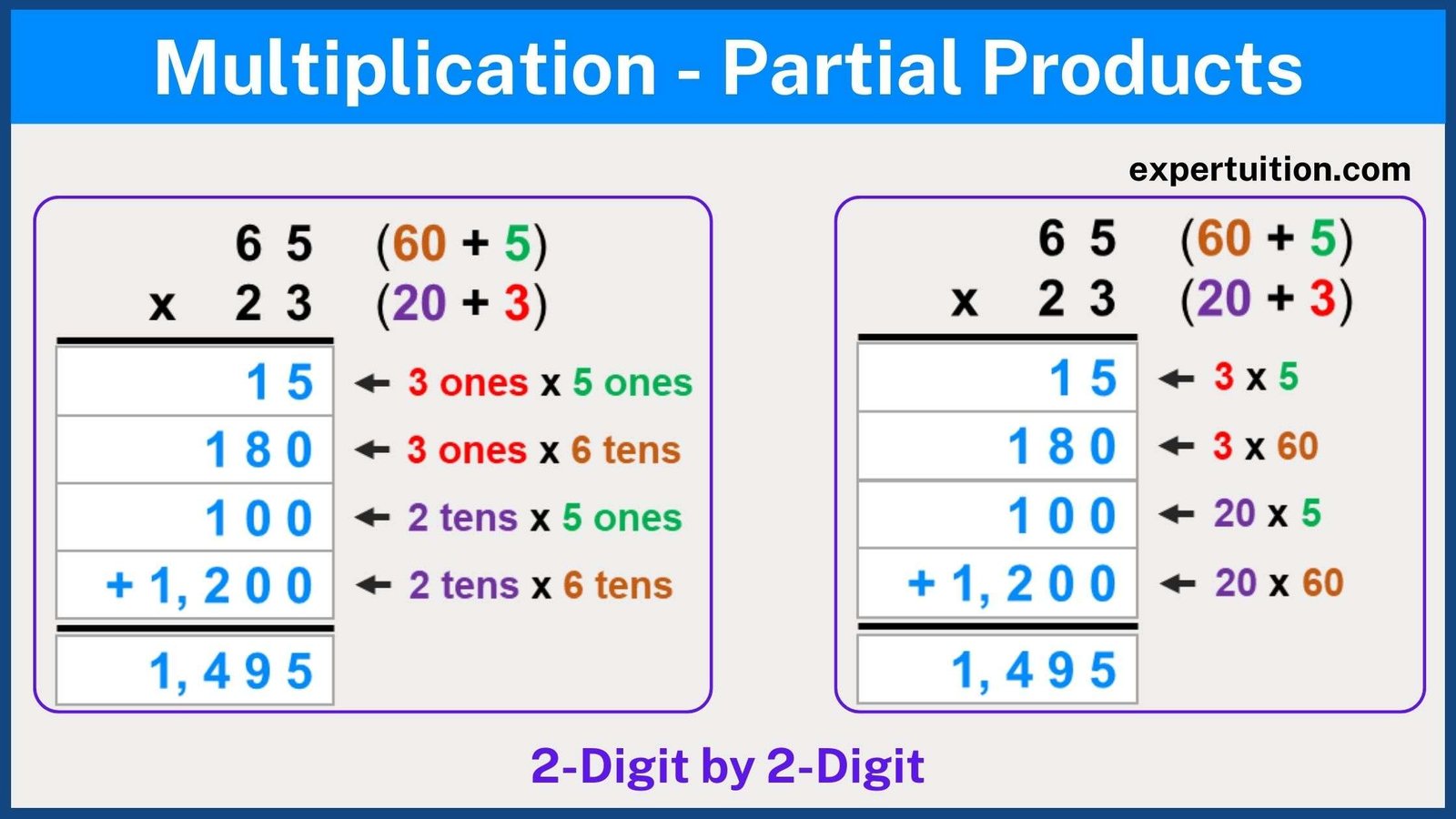
Each line represents a multiplication of place-value parts. For instance, 60 × 20 = 1,200 because the calculation involves six tens multiplied by two tens.
Students should understand the value represented by each partial product, not simply memorize where to write the answers.
Multiplying a Four-Digit Number by a One-Digit Number
The method also works with larger numbers. Students follow the same process, but decompose the multiplicand into more place-value parts.
Consider:
2,346 × 3
Step 1: Decompose the number.
2,346 = 2,000 + 300 + 40 + 6
Step 2: Multiply each part by 3.
2,000 × 3 = 6,000
300 × 3 = 900
40 × 3 = 120
6 × 3 = 18
Step 3: Add the partial products.
6,000 + 900 + 120 + 18 = 7,038
Therefore:
2,346 × 3 = 7,038
The number of calculations increases as the multiplicand contains more place-value parts, but the method follows the same steps, even with larger numbers.
Why Do the Partial Products Give the Correct Answer?
The partial products method works because the individual calculations account for the entire value of both original factors.
When students decompose a number, they do not remove any part of its value. They simply express it as a sum of its place-value components.
The distributive property then allows the multiplication to be separated into smaller calculations. When all the resulting products are added, they reconstruct the original multiplication.
For two two-digit factors, every part of the first factor must be multiplied by every part of the second. If one combination is missing, the calculation is incomplete. If every combination is included, the sum represents the product of the original factors.
The partial products are not unrelated answers that happen to add up to the correct result. They are the individual parts of the original multiplication.
Common Errors When Using Partial Products
Students can make mistakes at different stages of the process. Some errors come from misunderstanding place value, while others involve incomplete calculations or inaccurate addition.
Ignoring Place Value When Multiplying
A common mistake is multiplying the digits instead of their actual values.
For example, a student working with 65 × 23 might calculate 6 × 2 instead of 60 × 20.
The digits are correct, but their place values have been ignored. The 6 represents 60, and the 2 represents 20. Therefore, the correct calculation is 60 × 20 = 1,200.
How to address it: Have students write the factors in expanded form before multiplying. Ask them to identify the value represented by each digit. For example, they should recognize that 6 represents 60 and 2 represents 20 before calculating their product. Practising with expanded notation helps them distinguish between a digit and its place value.
Leaving Out a Partial Product
When multiplying two two-digit numbers, students may calculate only three of the four required products.
This usually happens when they lose track of the combinations they need to complete.
How to address it: Have students list the parts of both factors before beginning. They should then check that each part of the first factor has been multiplied by each part of the second. For two two-digit factors, there should be four partial products. They can use this check before adding their results.
Adding the Partial Products Incorrectly
Students may calculate the individual products correctly but make an error when combining them.
How to address it: Ask students to arrange the partial products clearly, keeping digits in their correct place-value columns. They should check the addition separately and estimate the final product to decide whether their answer is reasonable. If the estimate and calculated answer differ significantly, they should review the addition.
Losing Track of the Calculations
When several partial products are required, students may write them unclearly, repeat a calculation, or struggle to keep track of the steps.
How to address it: Have students record each partial product on a separate line and keep the original multiplication visible. They should check each recorded line against the place-value parts of the factors before adding. This helps them organize their work and identify repeated or poorly recorded calculations.
Partial Products Multiplication Worksheets
For additional practice, explore my Partial Products Multiplication Worksheets Bundle or browse my Partial Products Multiplication Worksheets Collection for individual worksheet sets.
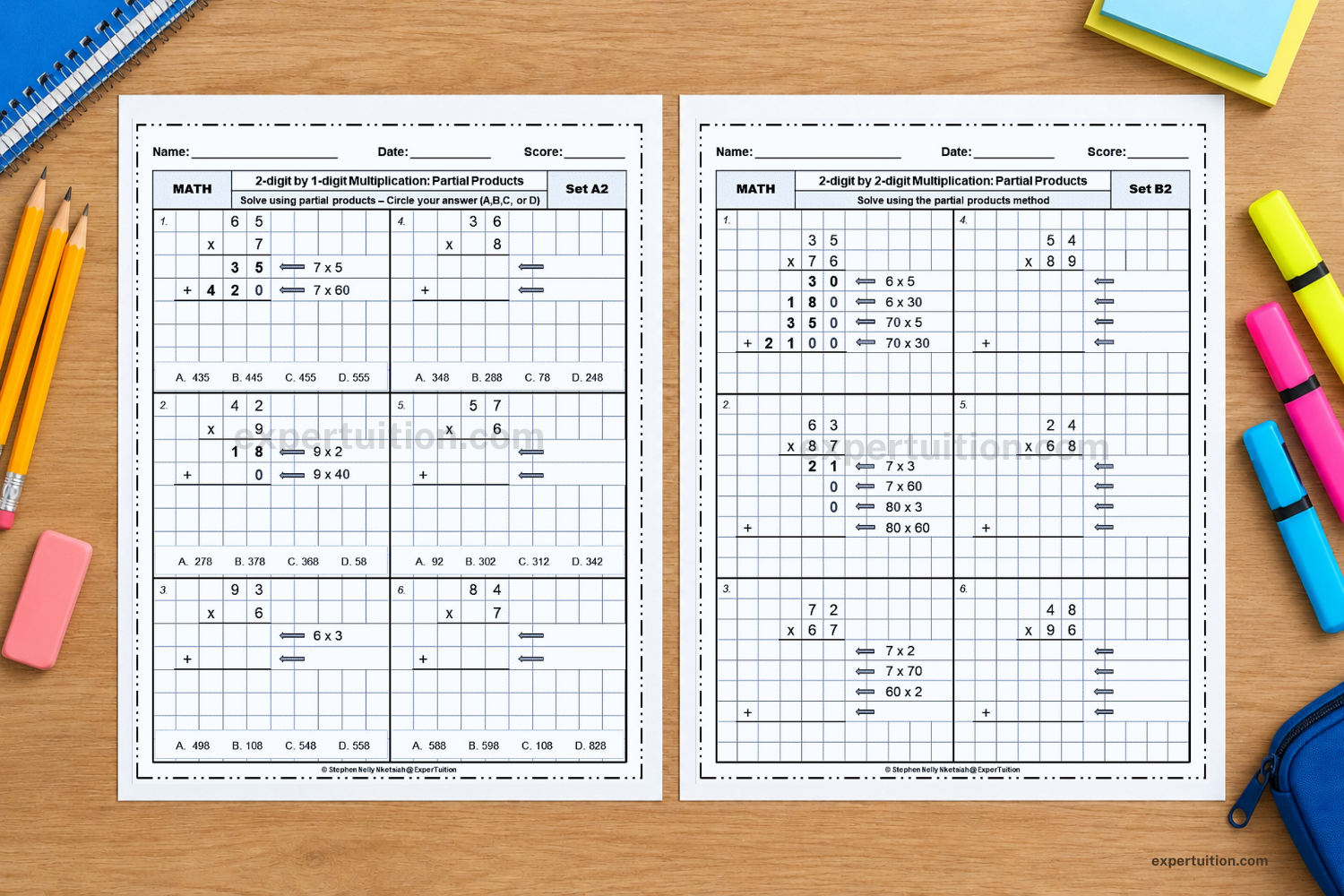
Choose worksheets based on the factor combinations students are practicing. For example, use 2-digit by 1-digit problems to practice decomposing one factor, then 2-digit by 2-digit problems to practice finding all four partial products.
For help comparing multiplication worksheets and bundles by method, factor size, and other features, and choosing the resources that best fit your classroom, see Multiplication Worksheets for Grades 4–5.
Understanding Partial Products
The partial products method helps students understand multi-digit multiplication by connecting place value, the distributive property, and multiplication.
When students understand how the partial products are formed and why they are added, they can explain the reasoning behind their calculations rather than simply follow a procedure.