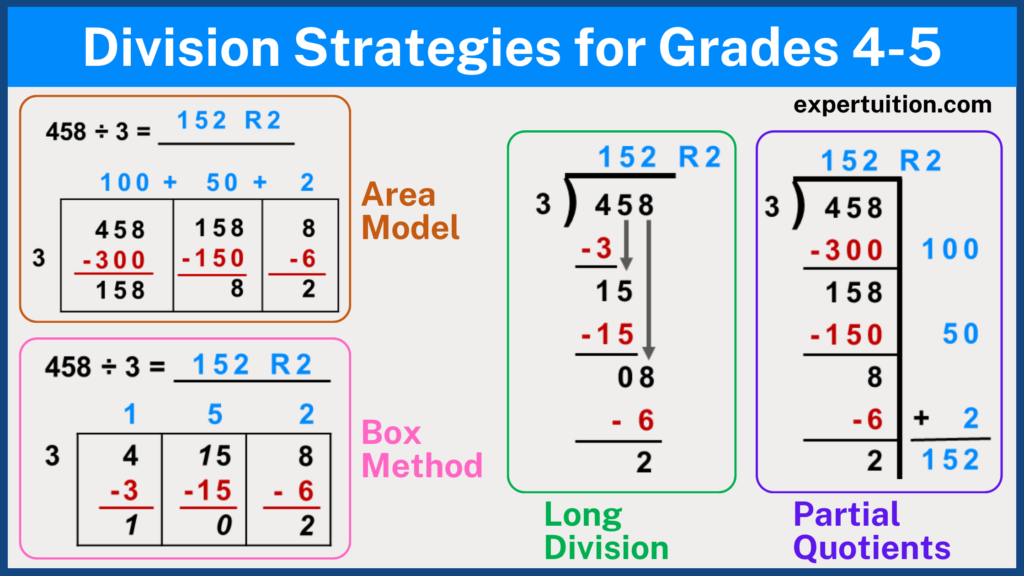
Learn how the Box Method division strategy combines the visual representation of area model division with the step-by-step calculation process of traditional long division. Work through examples with 1-digit and 2-digit divisors, including how to bring up remainders, keep quotient digits in the correct place-value positions, and check your answers.
What Is the Box Method Division?
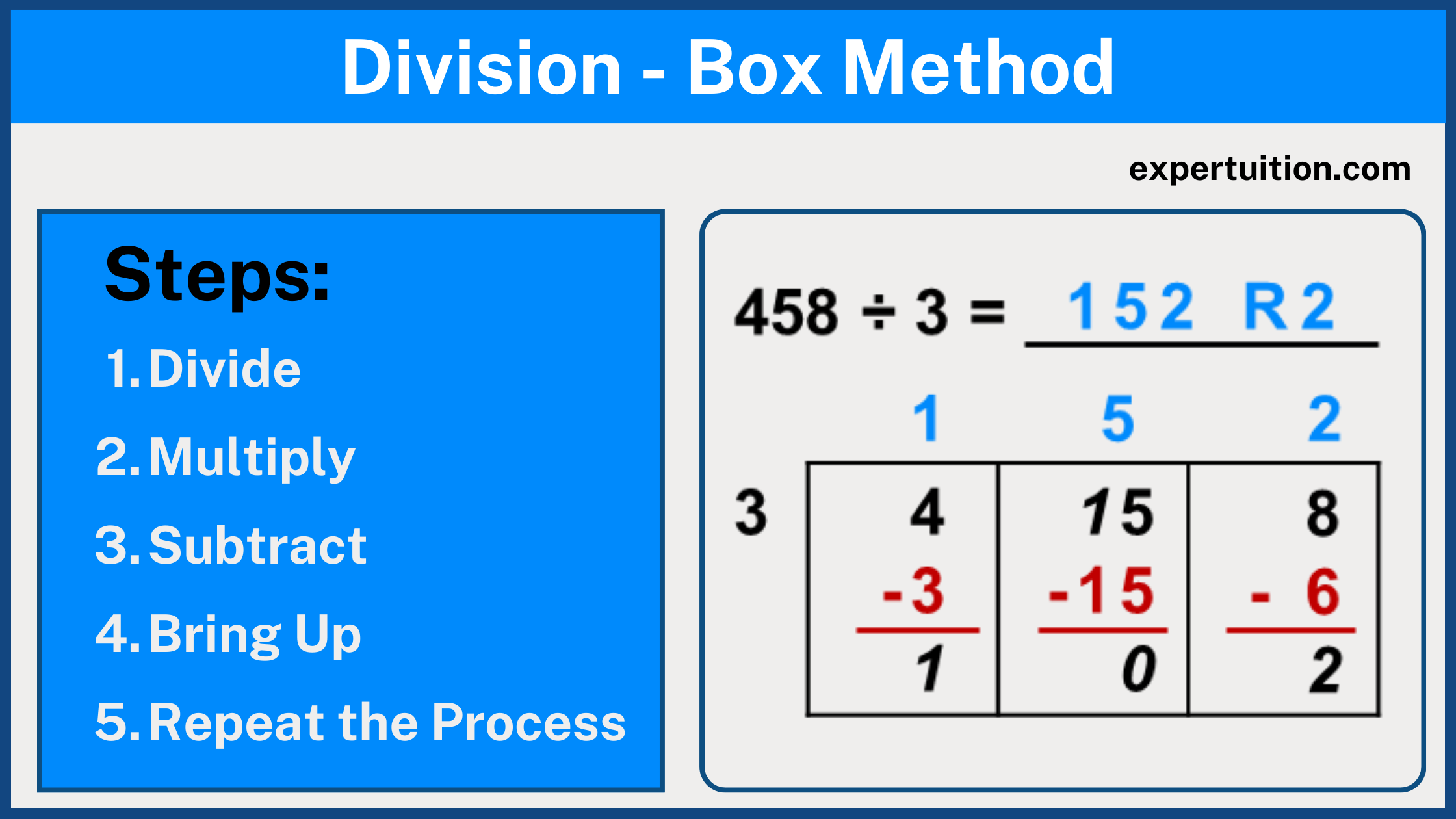
The Box Method is a division strategy that combines the visual representation of area model division with the step-by-step calculation process of traditional long division. It uses a rectangular layout to organize the calculation into columns while following the familiar steps of divide, multiply, subtract, and bring up the remainder.
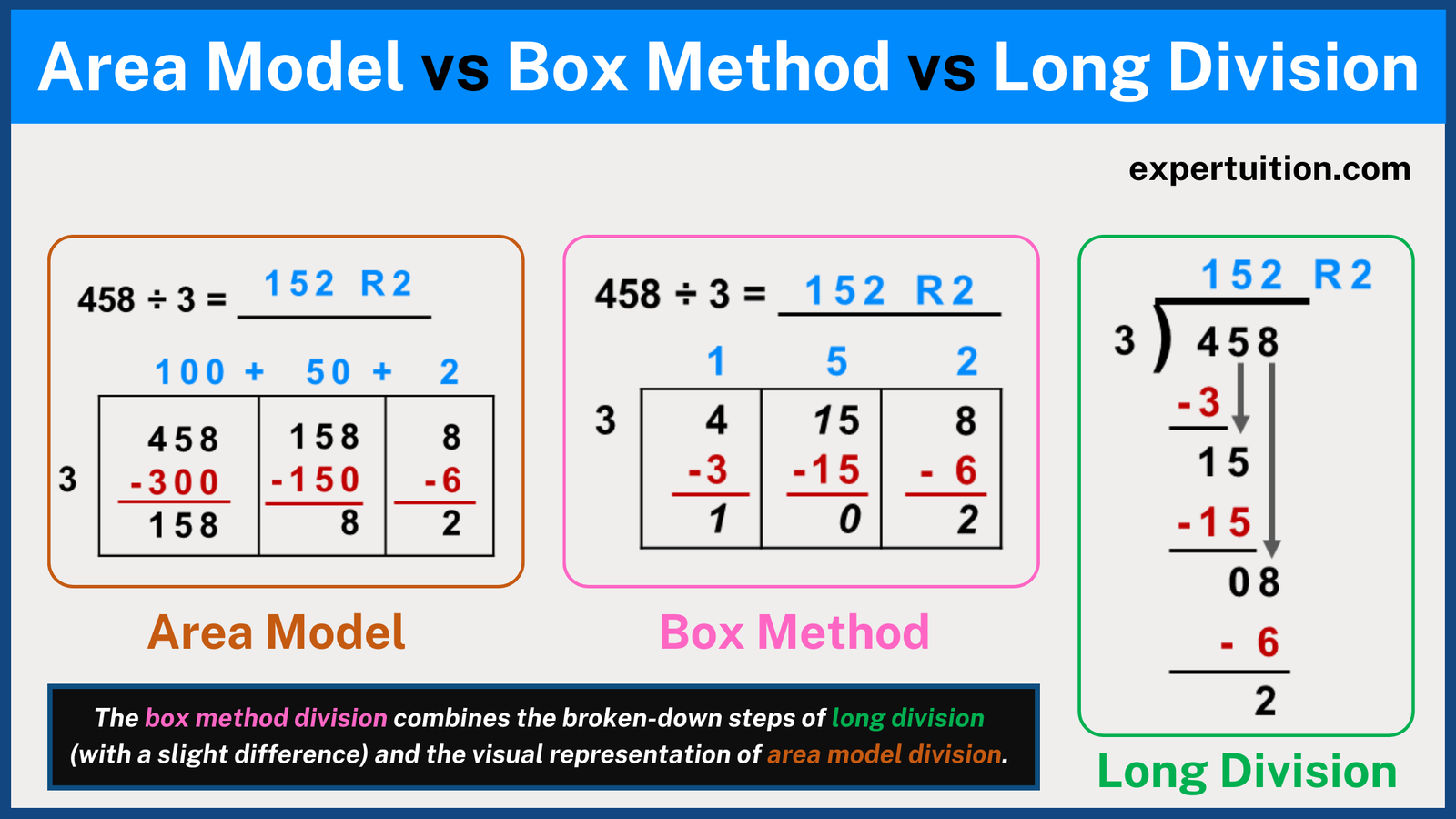
Each digit of the dividend has its own column, and each column represents its place value: hundreds, tens, or ones. The quotient digits are written above the corresponding columns, keeping them in their correct place-value positions.
As you work across the columns, you bring each remainder up and place it in front of the next digit of the dividend to form the next number to divide. Unlike traditional long division, where the next digit is brought down beside the remainder, the Box Method brings the remainder up into the next column.
To understand the visual structure behind this strategy, read The Area Model Division Method: How It Works. For a closer look at the calculation process behind it, see the Traditional Long Division Method.
How to Divide Using the Box Method
Consider:
458 ÷ 3
The goal is to find how many times 3 goes into 458 and what remains.
The Box Method follows five steps:
- Divide
- Multiply
- Subtract
- Bring Up
- Repeat the Process
Step 1: Divide
Draw a rectangle and divide it into columns, with one column for each digit of the dividend.
Write the divisor, 3, to the left of the rectangle. Place the digits of the dividend, 458, in separate columns, leaving space above and below them.
Start with the first digit, 4. Ask how many times 3 goes into 4 without exceeding it.
Since:
3 × 1 = 3
3 goes into 4 once. Write 1 above the first column. This is the first digit of the quotient.
Step 2: Multiply
Multiply the divisor by the quotient digit you just wrote:
3 × 1 = 3
Write 3 beneath the 4 in the first column.
Step 3: Subtract
Subtract the product from the number in the column:
4 − 3 = 1
Write 1 beneath the subtraction line. This is the remainder.
Step 4: Bring Up
Move the remainder to the next column and place it in front of the next digit of the dividend.
The remainder is 1, and the next digit is 5. Putting them together gives 15 in the second column.
Step 5: Repeat the Process
Continue with the divide, multiply, subtract, and bring up steps until you have worked through all the columns.
Second column
Divide 15 by 3:
15 ÷ 3 = 5
Write 5 above the second column.
Multiply:
3 × 5 = 15
Write 15 beneath 15, then subtract:
15 − 15 = 0
The remainder is 0. Bring it up to the next column and place it in front of the final digit, 8. This gives 08, which is 8.
Third column
Divide 8 by 3:
8 ÷ 3 = 2 R 2
Write 2 above the third column.
Multiply:
3 × 2 = 6
Write 6 beneath 8, then subtract:
8 − 6 = 2
There are no more digits to bring up, so 2 is the final remainder.
Read the digits above the columns to get the quotient:
152
The first column represents hundreds, the second tens, and the third ones. The quotient digits therefore represent 1 hundred, 5 tens, and 2 ones.
Add the remainder to complete the answer:
458 ÷ 3 = 152 R 2
The quotient is 152, and the remainder is 2.
Why Does the Box Method Division Work?
Each quotient digit shows how many times the divisor goes into the number in its column. Multiplying the divisor by that digit gives the amount accounted for in that stage of the division.
Subtracting shows what remains. Bringing the remainder up in front of the next dividend digit gives the number for the next column.
Here is how the calculation works in 458 ÷ 3:
- 3 goes into 4 once, leaving 1.
- The remainder 1 joins the next digit, 5, to make 15.
- 3 goes into 15 five times, leaving 0.
- The remainder 0 joins the final digit, 8, to make 8.
- 3 goes into 8 twice, leaving 2.
The quotient digits are 1, 5, and 2, giving 152.
The method also follows the relationship between division and multiplication:
Dividend = (Divisor × Quotient) + Remainder
For this example:
458 = (3 × 152) + 2
458 = 456 + 2
The calculation returns the original dividend, confirming the quotient and remainder.
How Does the Box Method Work with Two-Digit Divisors?
The same five steps apply when dividing by a two-digit number. The main difference is that the divisor may be greater than the first digit of the dividend. When that happens, the first quotient digit is 0.
Consider:
672 ÷ 24
Step 1: Divide
Draw a rectangle with three columns. Write 24 to the left and place the digits 6, 7, and 2 in separate columns.
Start with the first digit, 6.
Since 24 is greater than 6, it goes into 6 zero times. Write 0 above the first column.
Step 2: Multiply
Multiply the divisor by the quotient digit:
24 × 0 = 0
Write 0 beneath 6.
Step 3: Subtract
Subtract:
6 − 0 = 6
Write 6 beneath the subtraction line. The remainder is 6.
Step 4: Bring Up
Bring the remainder 6 to the second column and place it in front of 7.
This gives:
67
Step 5: Repeat the Process
Second column
Find how many times 24 goes into 67 without exceeding it.
Since:
24 × 2 = 48
Write 2 above the second column and 48 beneath 67.
Subtract:
67 − 48 = 19
Bring the remainder 19 to the third column and place it in front of 2.
This gives:
192
Third column
Find how many times 24 goes into 192.
Since:
24 × 8 = 192
Write 8 above the third column and 192 beneath 192.
Subtract:
192 − 192 = 0
There is no remainder, so the division is complete.
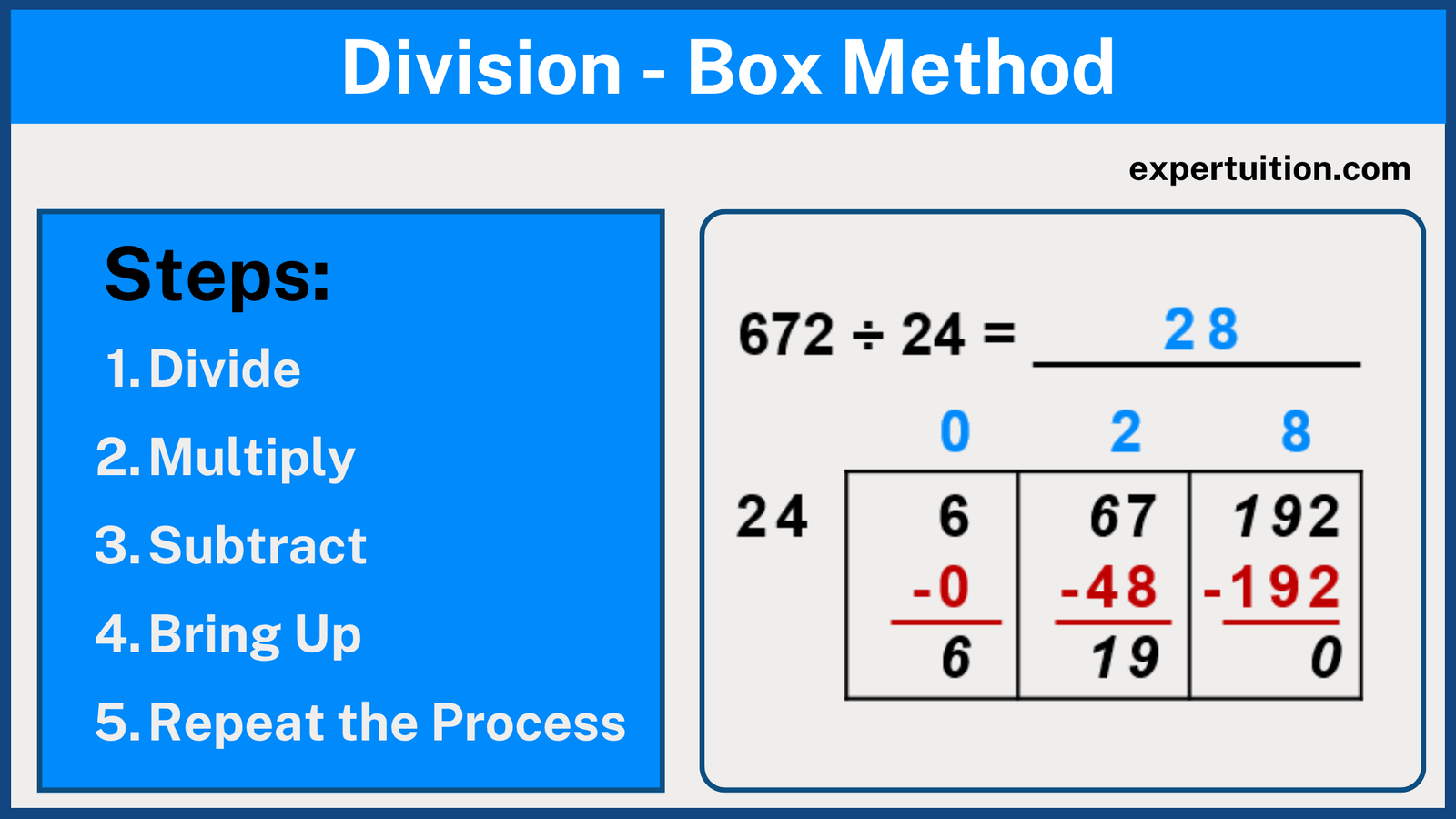
The quotient digits are 0, 2, and 8. They represent 0 hundreds, 2 tens, and 8 ones. The zero holds the hundreds position, so the quotient is written as 28, not 028.
Therefore:
672 ÷ 24 = 28
Check the answer:
24 × 28 = 672
The calculation is correct.
Understanding Remainders in Box Method Division
The remainder is the amount left after subtracting the product of the divisor and the quotient digit in the final column.
In 458 ÷ 3, the final subtraction is:
8 − 6 = 2
Since there are no more digits to bring up, 2 is the remainder.
A remainder must always be smaller than the divisor. If the amount left is equal to or greater than the divisor, another complete group can still be formed.
You can check a division problem with a remainder using this relationship:
Dividend = (Divisor × Quotient) + Remainder
For 458 ÷ 3 = 152 R 2:
458 = (3 × 152) + 2
458 = 456 + 2
458 = 458
The equation returns the original dividend, confirming the answer.
Common Errors in Box Method Division
Forgetting to Bring Up the Remainder
The remainder from one column must be brought up and placed in front of the next dividend digit.
For example, after subtracting 3 from 4 in 458 ÷ 3, the remainder is 1. Bring it up in front of 5 to make 15.
If you leave out the remainder, you change the number being divided in the next column.
Leaving Out a Zero in the Quotient
A zero may be needed when the divisor does not go into the first digit of the dividend.
In 672 ÷ 24, for example, 24 goes into 6 zero times. Write 0 above the first column before continuing with 67.
The zero keeps the quotient digits in their correct positions. Without it, the quotient may be read incorrectly.
Multiplying by the Wrong Quotient Digit
In each column, multiply the divisor by the quotient digit written above it.
For example, if the divisor is 3 and the quotient digit is 5, the product must be:
3 × 5 = 15
Check the multiplication before subtracting.
Subtracting Incorrectly
Subtract the product from the number in the current column, not from the original dividend or a previous column.
In the second column of 458 ÷ 3, subtract 15 from 15 to get 0.
Forgetting to Record the Final Remainder
If the final subtraction leaves an amount greater than 0, record it as the remainder.
For 458 ÷ 3, the final remainder is 2. Write the answer as 152 R 2.
Always check that the remainder is smaller than the divisor.
Box Method Division Worksheets
For additional practice with one-digit divisors, the Box Method Division Worksheets for 4th Grade Bundle provides problems with and without remainders.
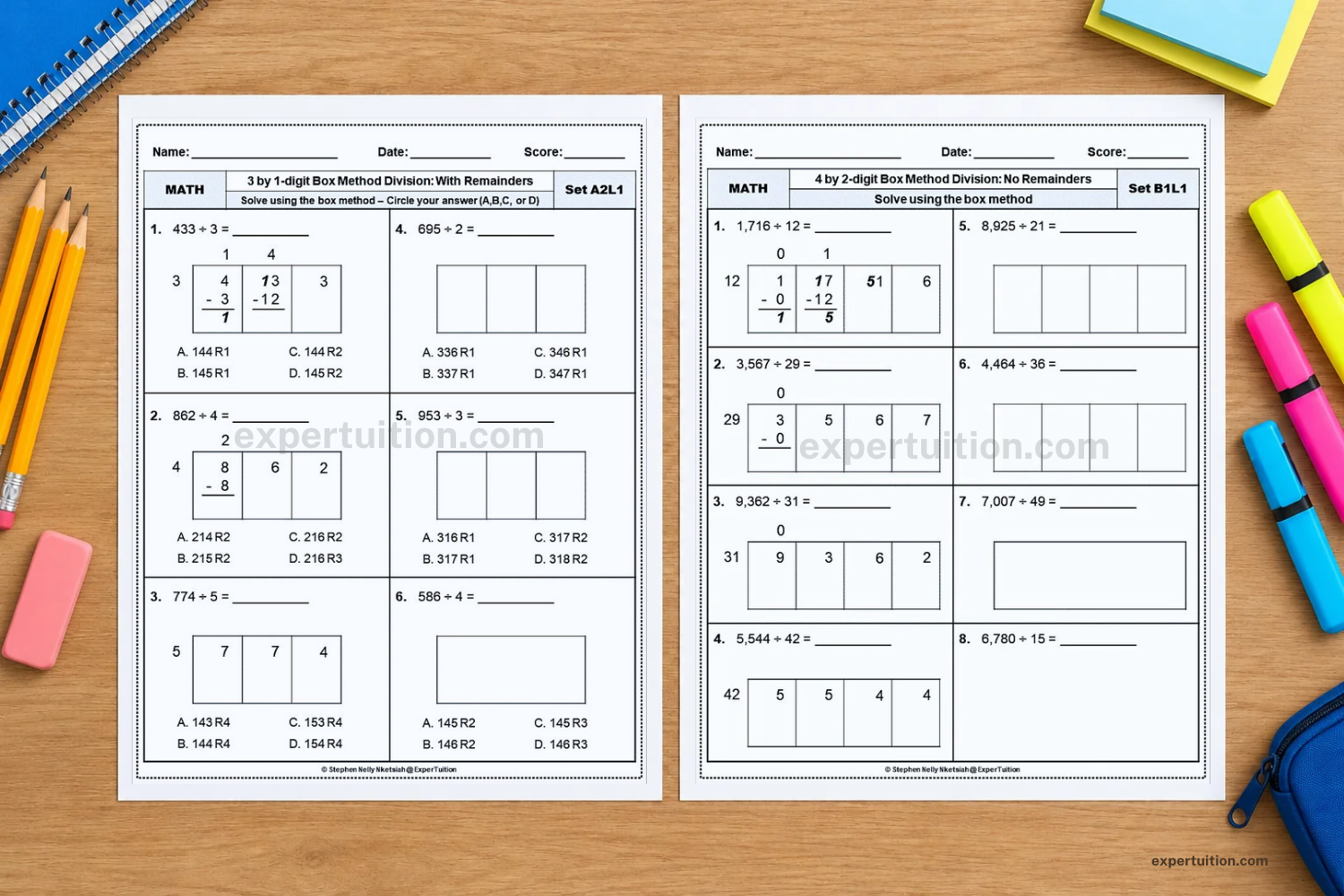
For practice with two-digit divisors, the Box Method Division Worksheets for 5th Grade Bundle includes problems with three- and four-digit dividends. You can also browse the Box Method Division Worksheets collection for individual worksheet sets and other practice options.
Final Check: Understanding the Box Method
Students should be able to explain what happens in each column, why the remainder is brought up, and how the quotient digits are recorded. They should also know when a zero is needed in the quotient and how to identify the final remainder.
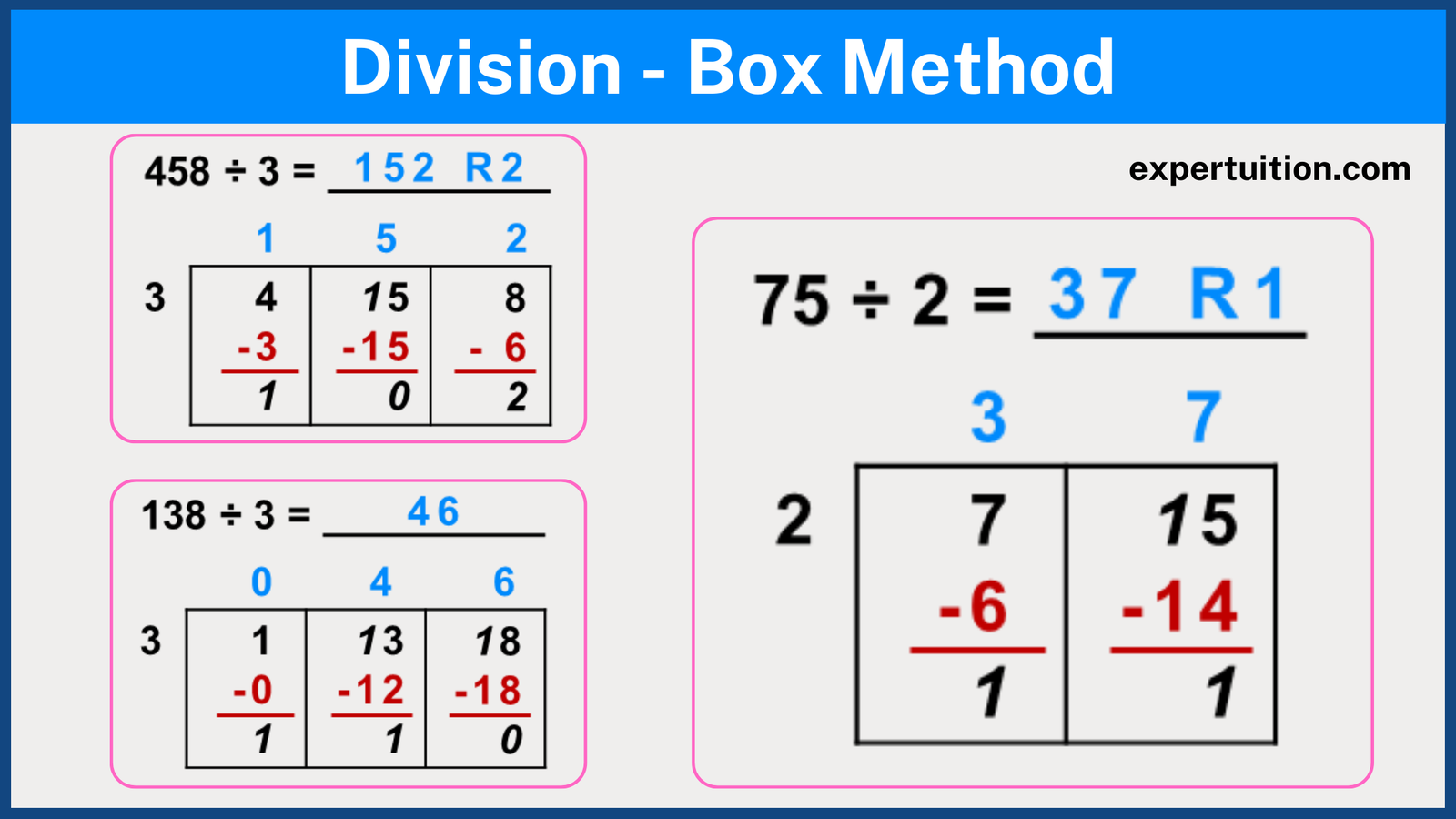
The Box Method combines the rectangular layout of area model division with the calculation steps of long division. It gives students a visual way to organize each stage of multi-digit division while following a familiar calculation process.
To compare this method with other approaches to division, read Division Strategies for Grade 4 and Grade 5.