Learn how the area model division method works through step-by-step examples with 1-digit and 2-digit divisors. See how to break the dividend into smaller sections, use multiplication to find the amounts to subtract, and combine partial quotients to find the quotient. The article also explains how to handle remainders and check division answers.
What Is the Area Model Division Method?
The area model division method uses a rectangular model divided into sections to show how a dividend can be broken into smaller, manageable amounts. Each section represents a number of groups of the divisor. The number written above each section shows how many groups are represented, while the subtraction inside the section shows how much of the dividend is accounted for.
The divisor stays the same throughout the model. You choose useful multiples of the divisor, subtract them from the amount remaining, and continue until the remainder is smaller than the divisor. Adding the numbers above the sections gives the quotient.
This gives students a visual way to connect multiplication, division, and place value.
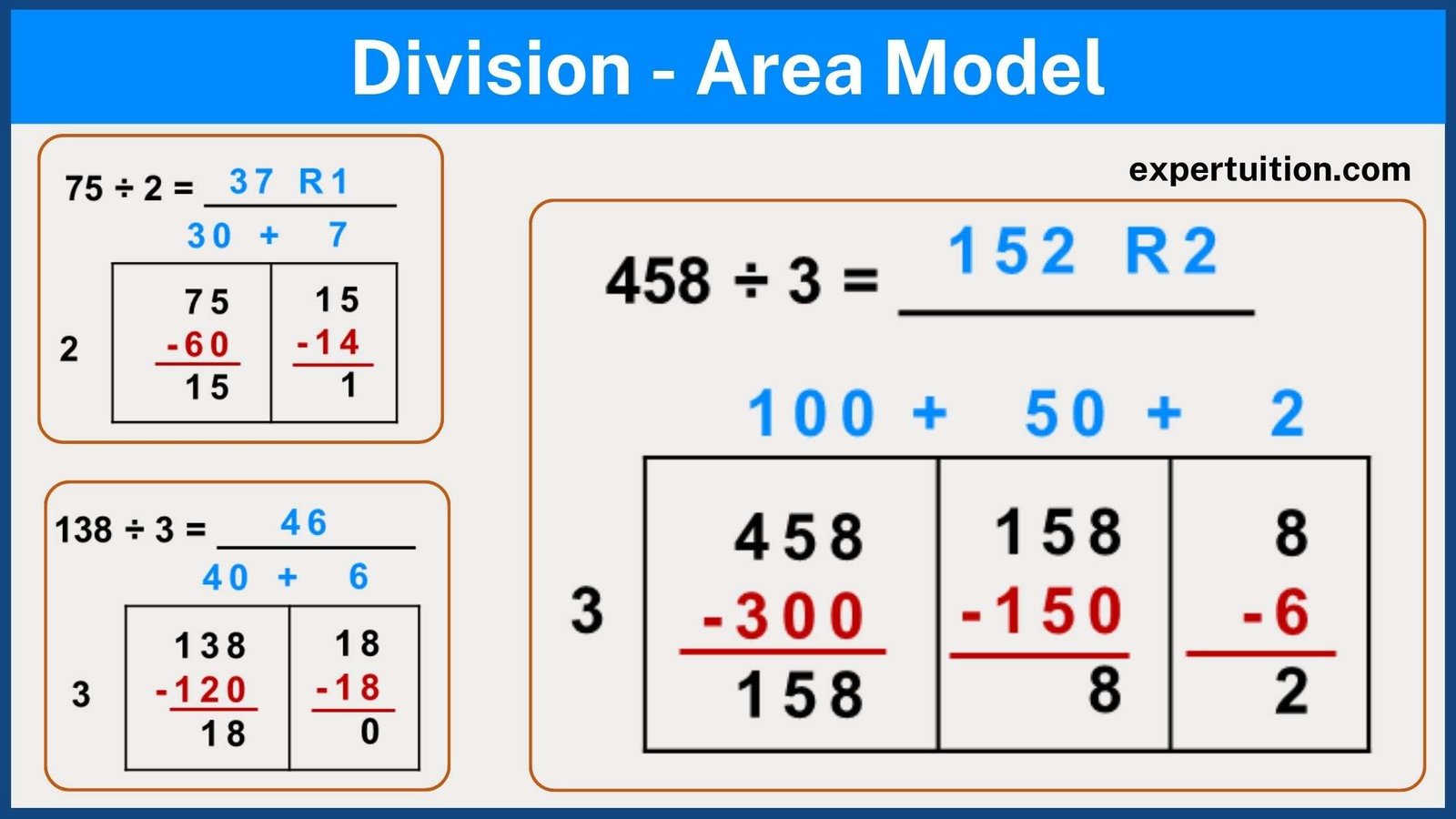
How to Divide Using the Area Model Method
Consider:
458 ÷ 3
The task is to find how many complete groups of 3 fit into 458 and what remains.
The method follows three main steps:
- Find and subtract an easy multiple.
- Repeat the process.
- Add the partial quotients.
Step 1: Find and Subtract an Easy Multiple
Set up the problem by drawing a rectangle and dividing it into columns. Write the divisor, 3, to the left of the rectangle and the dividend, 458, inside the first column. Leave space above the column for the partial quotient and below the dividend for the subtraction.
Choose an easy multiple of the divisor that does not exceed the dividend.
For example:
3 × 100 = 300
The first section represents 100 groups of 3. Write 100 above the first column and 300 beneath 458.
Subtract:
458 − 300 = 158
Write 158 beneath the subtraction line. This is the amount remaining after the first section.
Step 2: Repeat the Process
Use the amount remaining to complete the next column.
Write 158 at the top inside the second column. Choose another multiple of 3 that does not exceed 158.
Since:
3 × 50 = 150
The second section represents 50 groups of 3. Write 50 above the second column and 150 beneath 158.
Subtract:
158 − 150 = 8
Write 8 beneath the subtraction line.
There are now 8 left. Repeat the process in a third column.
Since:
3 × 2 = 6
The third section represents 2 groups of 3. Write 2 above the third column and 6 beneath 8.
Subtract:
8 − 6 = 2
The remaining 2 is smaller than the divisor, 3. No more complete groups of 3 can be formed, so the division is complete.
Step 3: Add the Partial Quotients
The completed area model has three columns. Each column shows the number of groups represented above it, the amount subtracted, and the amount remaining.
The model should show:
- First column: 100 groups; subtract 300 from 458 to leave 158.
- Second column: 50 groups; subtract 150 from 158 to leave 8.
- Third column: 2 groups; subtract 6 from 8 to leave 2.
Add the numbers above the columns:
100 + 50 + 2 = 152
The subtractions account for 456 of the original 458, leaving 2.
Therefore:
458 ÷ 3 = 152 R 2
The quotient is 152, and the remainder is 2.
Why Does the Area Model Division Method Work?
Each section represents a multiplication fact involving the divisor and the number of groups written above it. The amounts subtracted are multiples of the divisor.
In 458 ÷ 3, the three sections account for:
(3 × 100) + (3 × 50) + (3 × 2) = 456
Using the distributive property, this becomes:
3 × (100 + 50 + 2) = 456
Since 100 + 50 + 2 = 152, we can write:
3 × 152 = 456
This shows that 152 complete groups of 3 account for 456, leaving 2 from the original 458. That is why adding the numbers above the sections gives the quotient, while the amount remaining gives the remainder.
How Do You Choose the Section Sizes?
You can choose different section sizes and still get the correct quotient. Each number above a section represents a number of groups of the divisor. Multiplying that number by the divisor gives the amount to subtract.
For 458 ÷ 3, you could use 100, 50, and 2. You could also use 150 and 2.
With the second approach:
3 × 150 = 450
458 − 450 = 8
Then:
3 × 2 = 6
8 − 6 = 2
Both approaches account for 456 and give a quotient of 152 with a remainder of 2.
The first approach uses three sections, while the second uses two. Larger section sizes can reduce the number of sections, while smaller ones may be easier for students to calculate.
Use these checks when choosing section sizes:
- Check the divisor: Every section must use the same divisor.
- Check the multiplication: Multiply the divisor by the number of groups to find the amount to subtract.
- Check the amount remaining: The amount subtracted cannot exceed what is remaining.
- Record the number of groups correctly: The number above each section represents the groups, not the amount subtracted.
Multiplication facts, place-value knowledge, and estimation help students choose useful section sizes.
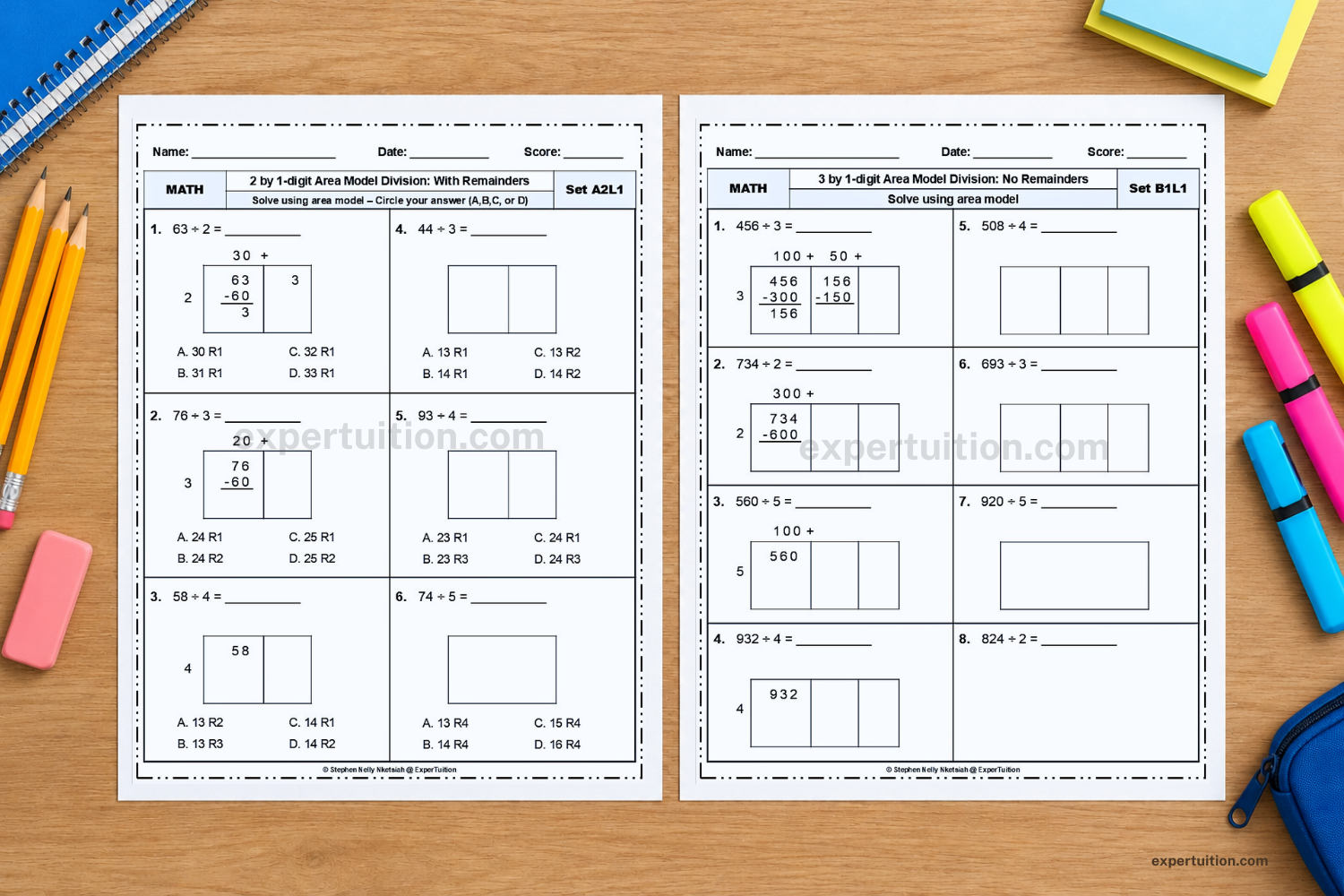
For additional practice with multi-digit dividends divided by one-digit divisors, the Area Model Division for Grade 4 Worksheets Bundle includes problems with and without remainders.
Understanding Remainders in Area Model Division
The remainder is what is left when no more complete groups of the divisor can be formed.
In 458 ÷ 3, the sections account for 456:
3 × 152 = 456
Subtracting 456 from 458 leaves 2. Because 2 is smaller than 3, another complete group cannot be formed.
The final remainder must be nonnegative and smaller than the divisor. If the amount remaining is equal to or greater than the divisor, another complete group can still be accounted for by adding another section.
You can check any division problem with a remainder using this relationship:
Dividend = (Divisor × Quotient) + Remainder
For 458 ÷ 3 = 152 R 2:
458 = (3 × 152) + 2
The equation returns 458, the original dividend. If it does not, check the section calculations and the remainder.
How Does Area Model Division Work with Two-Digit Divisors?
The same approach applies when dividing by a two-digit number. The divisor stays the same throughout the model, and each section represents a number of groups of that divisor. Multiplying the divisor by the number of groups gives the amount to subtract.
Consider:
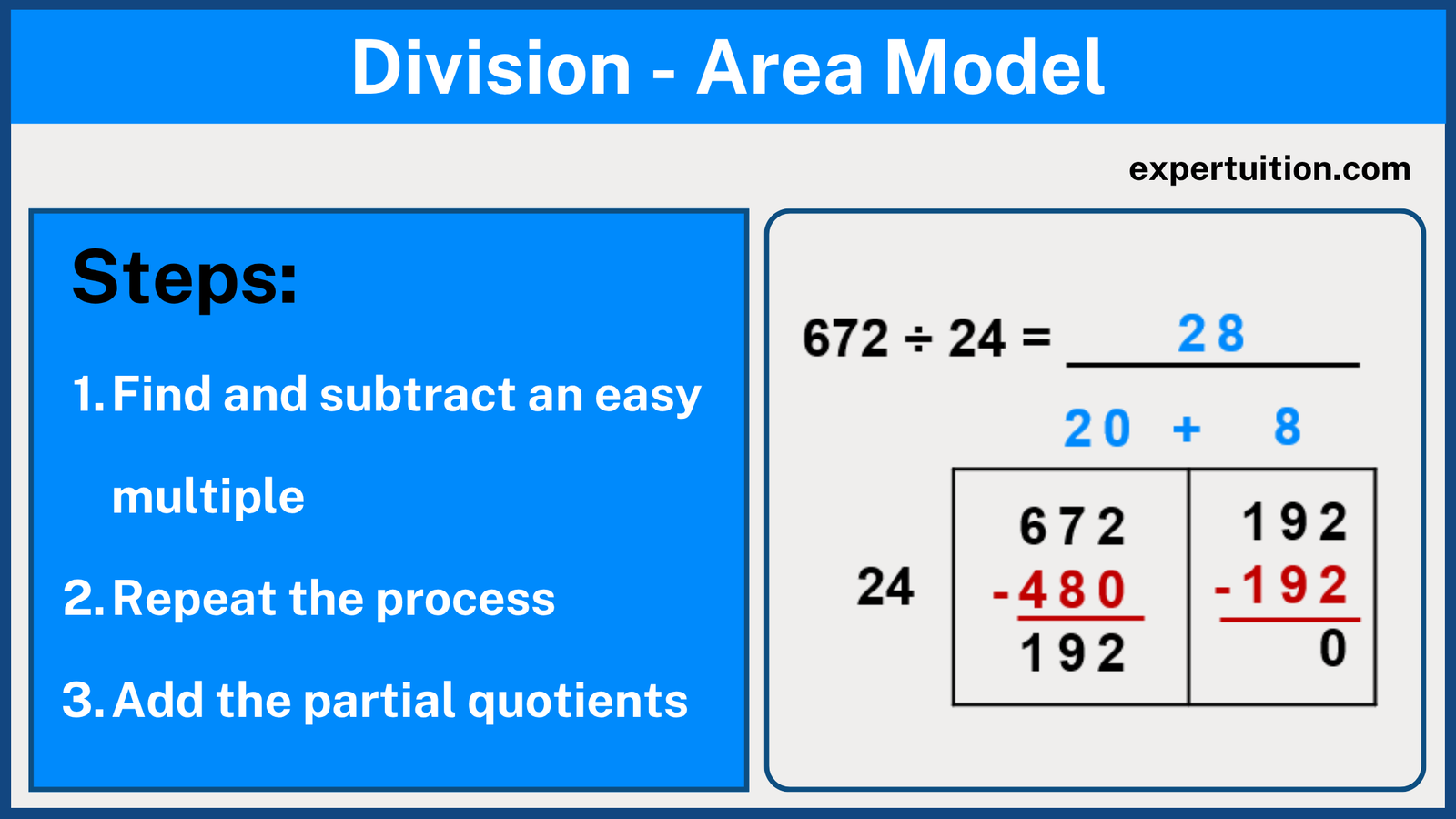
672 ÷ 24
Step 1: Find and Subtract an Easy Multiple
Draw a rectangle divided into columns. Write 24 to the left of the rectangle and 672 inside the first column.
Choose a useful multiple of 24:
24 × 20 = 480
The first section represents 20 groups of 24. Write 20 above the first column and 480 beneath 672.
Subtract:
672 − 480 = 192
Write 192 beneath the subtraction line.
Step 2: Repeat the Process
Use the remaining 192 to complete the second column.
Since:
24 × 8 = 192
The second section represents 8 groups of 24. Write 8 above the second column and 192 beneath the 192 remaining.
Subtract:
192 − 192 = 0
The entire dividend has now been accounted for, so the division is complete.
Step 3: Add the Partial Quotients
The completed model has two sections:
- First column: 20 groups; subtract 480 from 672 to leave 192.
- Second column: 8 groups; subtract 192 from 192 to leave 0.
Add the numbers above the columns:
20 + 8 = 28
Therefore:
672 ÷ 24 = 28
Check the answer:
24 × 28 = 672
The same reasoning applies with a two-digit divisor. Students may need to use estimation and multiplication facts to choose useful section sizes, but the relationship between the numbers above the sections, the amounts subtracted, and the quotient remains the same.
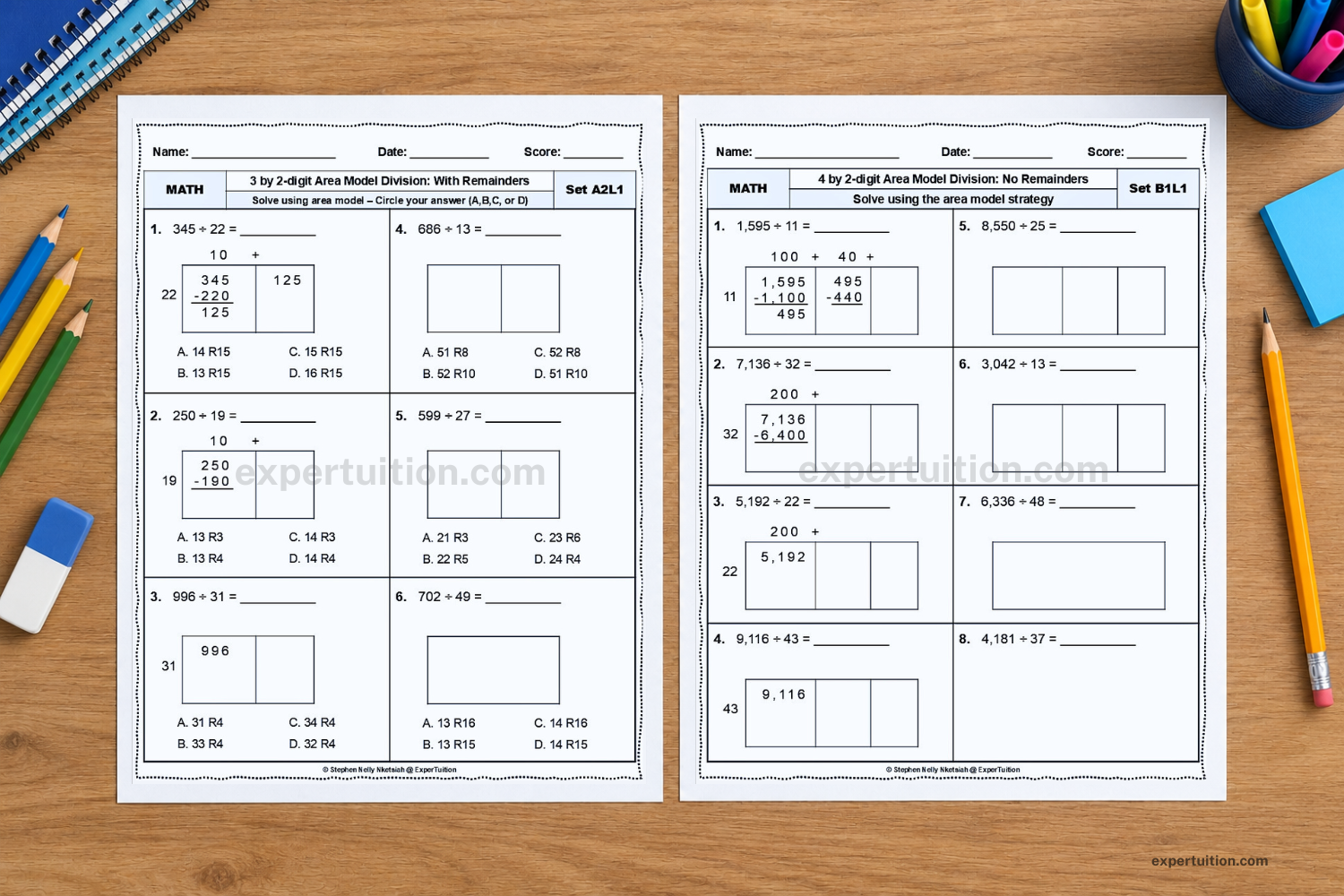
For practice with three-digit and four-digit dividends by two-digit divisors, the 2-Digit Divisors Area Model Division for Grade 5 Worksheets Bundle includes problems with and without remainders.
Common Errors in Area Model Division
Using the Wrong Amount to Subtract
The amount subtracted in each section must equal the divisor multiplied by the number of groups represented.
For example, if the divisor is 3 and the section represents 50 groups, the amount to subtract must be 150.
3 × 50 = 150
Check each multiplication fact before subtracting.
Changing the Divisor Between Sections
The divisor must remain the same throughout the model.
In 458 ÷ 3, every section uses 3, even though the numbers of groups and the amounts subtracted change.
Forgetting to Add the Numbers Above the Sections
The final quotient is the sum of the numbers above the sections, not the sum of the amounts subtracted.
For 458 ÷ 3:
100 + 50 + 2 = 152
Adding the amounts subtracted gives 456, the amount accounted for in the dividend. Adding the numbers above the sections gives 152, the quotient.
Stopping Too Soon
Do not stop while the amount remaining can still form another complete group.
For example, if 5 remains when dividing by 3, another section representing 1 group can be added. Subtract 3, leaving a remainder of 2.
Recording an Invalid Remainder
The remainder must be smaller than the divisor.
For 458 ÷ 3, the remainder is 2 because it is smaller than 3. If the remaining amount is equal to or greater than the divisor, another complete group can still be accounted for.
Check the answer using:
458 = (3 × 152) + 2
The result must return the original dividend.
Final Check: What the Area Model Shows Us
Students should be able to explain why each amount is subtracted, what the numbers above the sections represent, and why the process stops when the remainder is smaller than the divisor. These checks help them understand the method rather than simply follow its steps.
For a broader look at how area model division fits alongside other approaches, read Division Strategies for Grade 4 and Grade 5. You can also browse the Area Model Division Worksheets collection for additional practice with different dividend sizes and divisors.