Help students build a strong understanding of factors, multiples, prime numbers, and composite numbers through a clear sequence of instruction. Learn how to use equal groups, arrays, factor pairs, and multiplication patterns to introduce these concepts, address common difficulties, guide practice, and develop students’ mathematical reasoning.
Build Understanding Through Multiplication and Division
Students need a strong understanding of multiplication and division before they can work confidently with factors, multiples, prime numbers, and composite numbers. These ideas are connected: multiplication shows how numbers can be combined to make a product, while division helps determine whether a number can be separated into equal groups without a remainder.
Begin by reviewing multiplication facts and related division facts. Use familiar examples to help students recognize that the same numbers can describe different ways of thinking about a quantity.
For example, write:
4 × 6 = 24
24 ÷ 4 = 6
24 ÷ 6 = 4
Have students explain what each equation represents. In the multiplication equation, 24 is the product of 4 and 6. In the division equations, 24 is separated into equal groups of 4 or 6.
Connect these equations to equal groups. Give students 24 counters and ask them to arrange the counters into equal groups. They might make 4 groups of 6, 6 groups of 4, 3 groups of 8, or 8 groups of 3.
Discuss which arrangements use equal groups and how multiplication and division describe the same relationship. These equations also introduce the connection between factors and multiples: 4 and 6 are factors of 24, while 24 is a multiple of both 4 and 6.
This review provides a useful starting point for exploring factors and factor pairs. Students can see that the numbers used to make equal groups are connected to the total number of objects.
Teach Factors and Factor Pairs with Arrays
Once students can represent multiplication and division with equal groups, introduce factors through arrangements that show how a number can be divided into equal groups.
Use Equal Groups and Arrays to Introduce Factors
Give students counters or square tiles and ask them to arrange 12 objects into equal rows. Let them explore different arrangements before recording their findings.
They may create:
- 1 row of 12
- 2 rows of 6
- 3 rows of 4
- 4 rows of 3
- 6 rows of 2
- 12 rows of 1
Connect each arrangement to a multiplication equation:
1 × 12 = 12
2 × 6 = 12
3 × 4 = 12
Explain that the numbers in each multiplication equation are factors of 12. Each factor tells how many equal groups there are or how many objects are in each group.
Use the arrays to help students see that factors are not just numbers to memorize. They describe the equal-group arrangements that make a given product.
Repeat the activity with other numbers, such as 16, 18, and 20. Give students opportunities to build the arrays themselves and record the multiplication equations.
As they work, ask questions such as:
- How many equal rows can you make?
- How many objects are in each row?
- Can you arrange the same number in another way?
- What multiplication equation represents this arrangement?
- How do you know you have found all the possible arrangements?
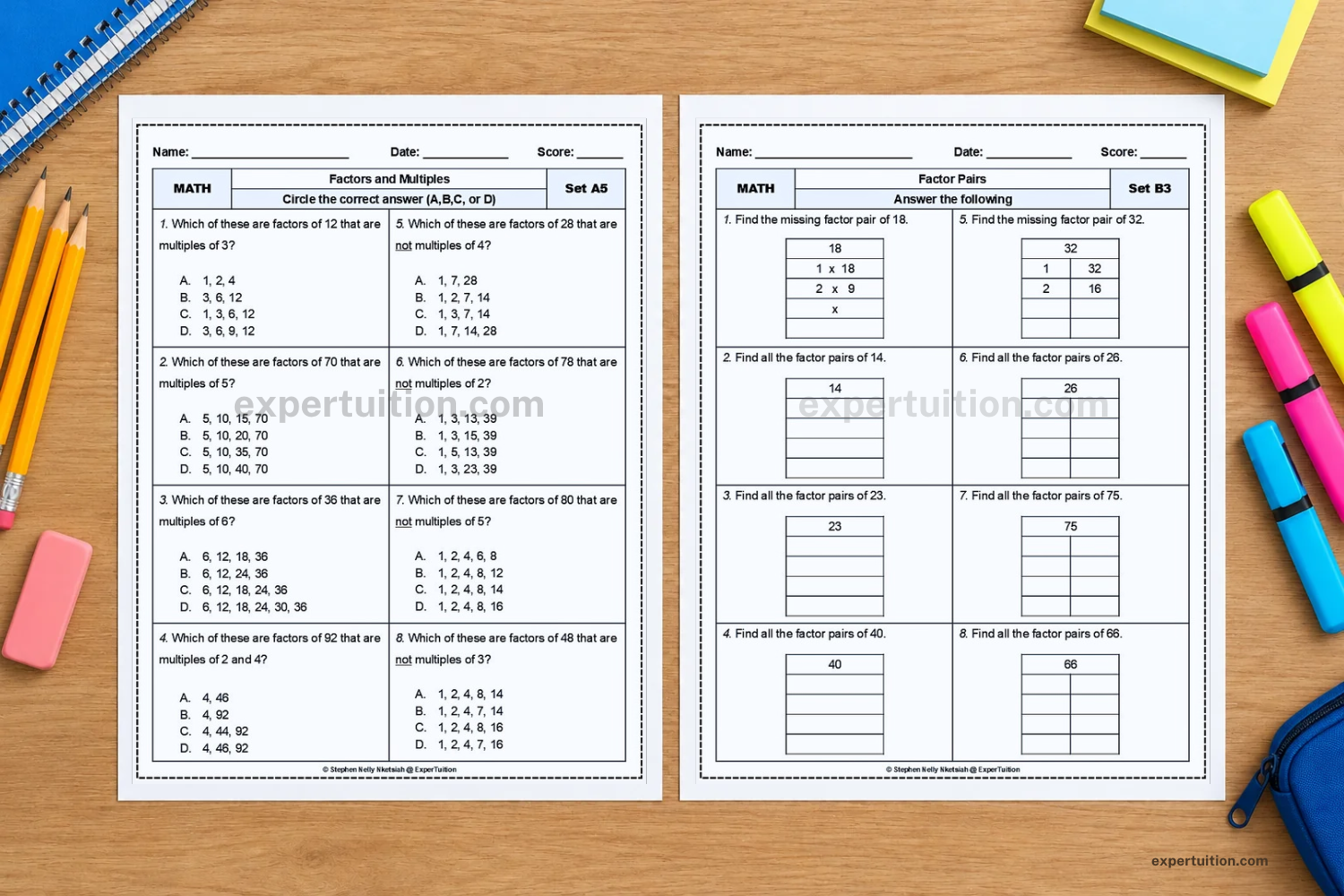
For additional practice with this skill, use Factors and Multiples Worksheets. The worksheets provide opportunities to work with factors, multiples, and factor pairs.
Guide Students to Find Factor Pairs Systematically
After students have explored arrays, help them organize their findings into factor pairs. A factor pair is a pair of whole numbers that can be multiplied to produce a given number.
Use 24 as an example. Start with 1 and ask students which number multiplied by 1 gives 24. Record the pair 1 and 24.
Continue checking the possible factors in order:
| Multiplication equation | Factor pair |
|---|---|
| 1 × 24 = 24 | 1 and 24 |
| 2 × 12 = 24 | 2 and 12 |
| 3 × 8 = 24 | 3 and 8 |
| 4 × 6 = 24 | 4 and 6 |
Show students how to organize their work in a factor-pair chart or T-chart. This makes it easier to track the pairs they have found and identify when they have reached the end.
Emphasize the importance of checking systematically rather than guessing. Students can begin with 1 and test consecutive whole numbers to see whether each divides the given number evenly. For 24, the next possible factor after 4 is 5. Since 5 × 5 = 25, which is greater than 24, no new factor pairs remain. Any additional pairs would simply reverse pairs already found. This gives students a clear stopping point.
Give students other numbers to investigate, including numbers with several factor pairs and numbers with fewer pairs. Ask them to explain how they know their lists are complete.
The Factors and Multiples collection offers additional resources for practicing these related skills.
Teach Multiples Through Multiplication Patterns
After students have explored factors, shift the focus to multiples. Use multiplication patterns and skip-counting to help them recognize how multiples are generated and how they appear in number sequences.
Use Skip-Counting to Build Multiples
Begin with a familiar multiplication fact. Ask students to count by 3s:
3, 6, 9, 12, 15, 18, 21, 24, 27, 30
Connect the sequence to multiplication:
3 × 1 = 3
3 × 2 = 6
3 × 3 = 9
3 × 4 = 12
Explain that each product is a multiple of 3.
Repeat the activity with other one-digit numbers, such as 2, 4, 5, and 6. Ask students to identify the multiplication pattern and explain how each new number is related to the number they are counting by.
Move beyond reciting sequences by giving students a number and asking whether it is a multiple of a particular one-digit number.
For example, ask whether 28 is a multiple of 4. Have students use multiplication or division to check:
4 × 7 = 28
28 ÷ 4 = 7
Since the quotient is a whole number, 28 is a multiple of 4.
Give students examples that do not produce whole-number quotients as well. For example, 26 is not a multiple of 4 because 26 ÷ 4 = 6 R2, not a whole-number quotient. This helps them distinguish multiples from numbers that are not multiples of a given number.
Use Number Grids to Explore Multiplication Patterns
A hundred chart provides a useful visual tool for investigating multiples.
Give students a hundred chart and ask them to shade the multiples of 2, 3, 4, or 5 in different colors. Have them observe the patterns that appear.
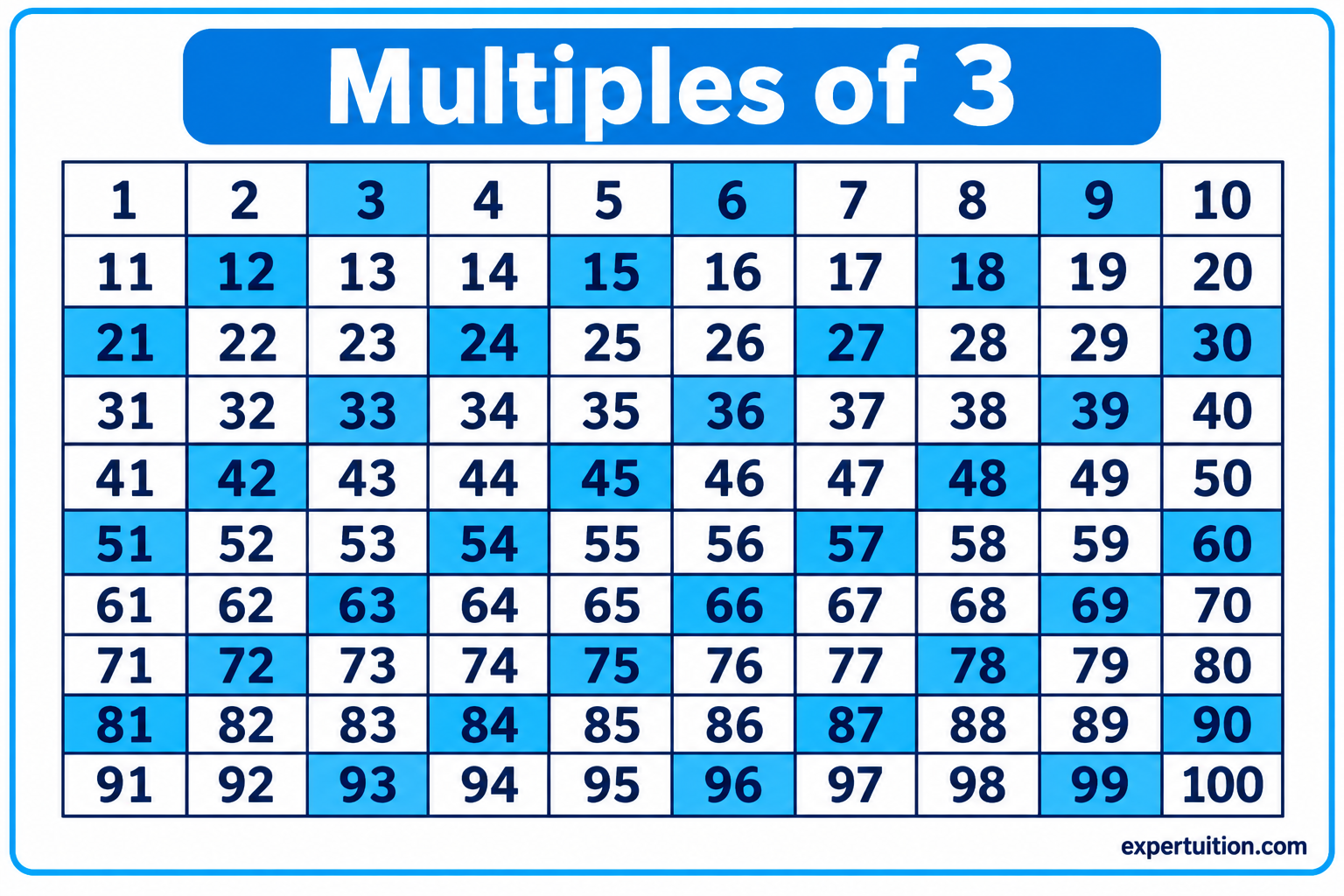
For example:
- Multiples of 2 appear in the even-numbered positions.
- Multiples of 5 end in 0 or 5.
- Multiples of 10 end in 0.
- The final digits of multiples of 3 cycle through a repeating sequence: 3, 6, 9, 2, 5, 8, 1, 4, 7, and 0.
Unlike multiples of 2, 5, and 10, the final digit alone does not determine whether a number is a multiple of 3.
Ask students to observe this final-digit pattern and investigate how the multiples of 3 are distributed across the hundred chart. Have them explain what they notice and how the multiplication sequence relates to the highlighted numbers. Encourage them to investigate why the final-digit pattern repeats rather than simply memorize the sequence.
You can also give students a partially completed number grid and ask them to identify the rule used to shade the numbers. This encourages them to recognize patterns rather than simply follow a counting sequence.
Help Students Distinguish Factors from Multiples
Students sometimes confuse factors and multiples because both involve multiplication. Address this distinction directly.
Use one number, such as 6, to compare the two ideas.
The factor pairs of 24 include:
1 and 24
2 and 12
3 and 8
4 and 6
The multiples of 6 include:
6, 12, 18, 24, 30, 36, …
Point out that 6 is a factor of 24 because 24 ÷ 6 = 4. At the same time, 24 is a multiple of 6 because 6 × 4 = 24.
Have students compare examples and explain the relationship from both directions. Use questions such as:
- Is 4 a factor of 24? How do you know?
- Is 24 a multiple of 4? Explain.
- Is 30 a factor of 6, or is 30 a multiple of 6?
- Can a number be both a factor and a multiple in different relationships?
A simple comparison chart can help students organize their thinking. Continue using multiplication and division equations so they can justify their answers.
Connect Factor Pairs to Prime and Composite Numbers
Students are ready to investigate prime and composite numbers once they can find factor pairs with confidence. The number of factors a whole number has provides the basis for this classification.
Have Students Investigate Factor Pairs Before Classifying Numbers
Give students several numbers and ask them to find all their factor pairs using factor-pair charts or their knowledge of multiplication facts.
Choose examples such as 7, 10, 13, 15, and 18.
As students record their findings, ask them to compare the number of factor pairs for each number. Some numbers have only one factor pair, while others have more than one.
For example:
- 7 has the factor pair 1 and 7.
- 10 has the factor pairs 1 and 10, and 2 and 5.
- 13 has the factor pair 1 and 13.
- 15 has the factor pairs 1 and 15, and 3 and 5.
- 18 has the factor pairs 1 and 18, 2 and 9, and 3 and 6.
Ask students what they notice about the numbers with only one factor pair compared with those that have more than one.
Let them explain their observations before introducing the classification terms. This gives the new vocabulary a clear connection to the factor-pair work they have already completed.
Introduce Prime and Composite Classification
Explain that a prime number is a whole number greater than 1 that has exactly two factors: 1 and itself. A composite number is a whole number greater than 1 that has more than two factors.
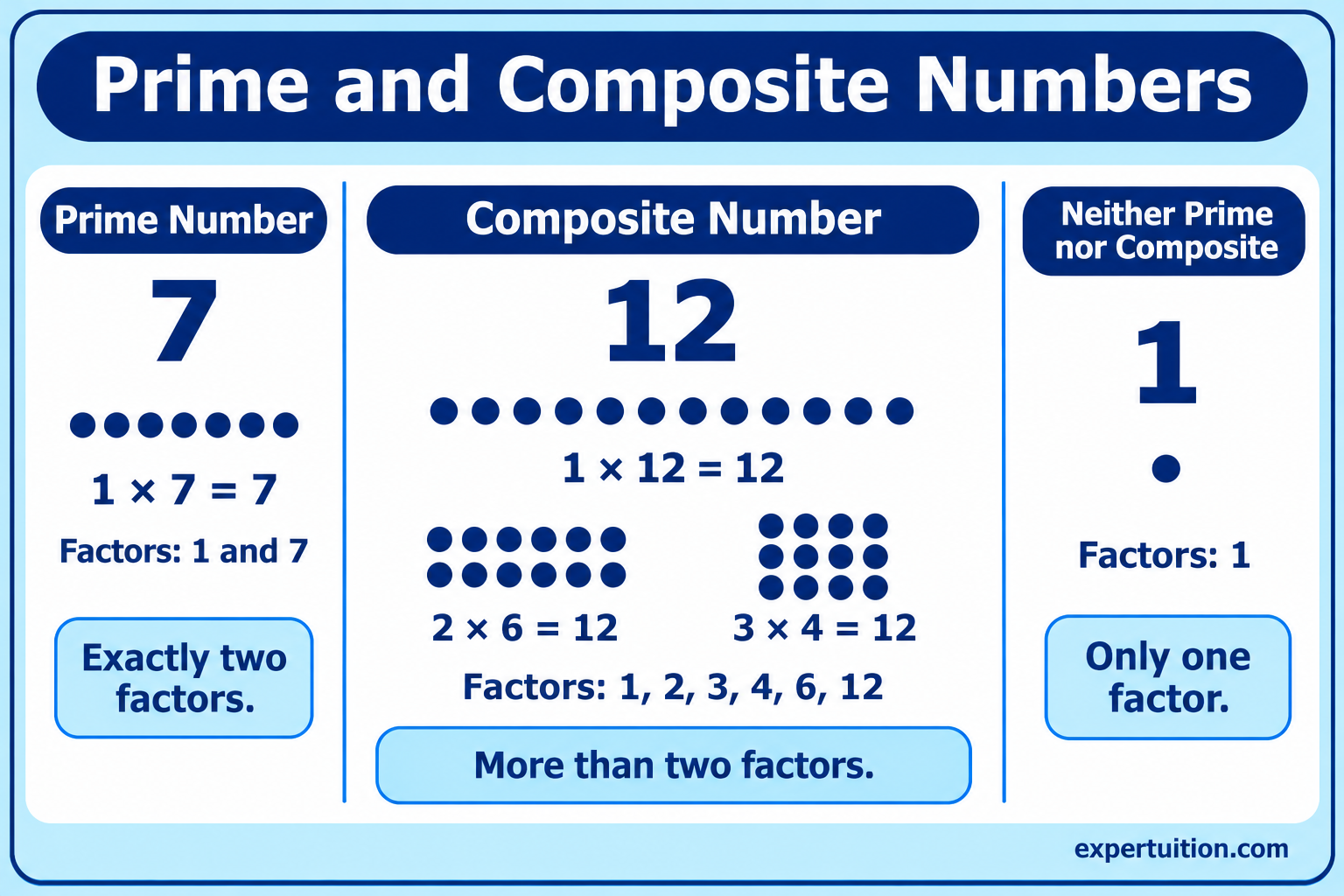
Return to the examples students investigated.
The number 7 is prime because its only factors are 1 and 7. The number 10 is composite because it has four factors: 1, 2, 5, and 10.
Use arrays to reinforce the distinction. A prime number has only one factor pair: 1 and the number itself. Its array can be represented as 1 row with the number of objects in that row. Rotating the array does not create a new factor pair. A composite number has at least one additional factor pair using numbers other than 1 and itself.
Be sure to address the number 1. It has only one factor, so it is neither prime nor composite. Students should understand that prime numbers have exactly two factors, not just one.
Use several examples and ask students to justify each classification by referring to the factors they found. Avoid allowing them to classify numbers based only on whether they look even, odd, small, or large.
Develop Prime and Composite Number Reasoning
Once students understand the classification, give them opportunities to apply it to different numbers, explain their decisions, and recognize patterns.
Use Arrays and Charts to Support Classification
Move students from building physical arrays to using drawings and factor charts to classify numbers. They should gradually become able to identify prime and composite numbers without needing to build every arrangement with counters.
For example, compare 11 and 12.
The number 11 has only one factor pair: 1 and 11. It is prime because it has exactly two factors.
The number 12 has three factor pairs:
1 × 12
2 × 6
3 × 4
It is composite because it has more than two factors.
A hundred chart can also help students investigate numbers from 1 to 100. Have students identify numbers that have only two factors and those that have more than two. Encourage them to explain how their factor-pair findings support their classifications.
Use Sorting Activities and Number Riddles
Sorting activities give students opportunities to compare numbers and explain their reasoning.
Prepare number cards containing a mixture of prime and composite numbers. Include 1 as a separate case. Ask students to sort the cards into three groups:
- Prime numbers
- Composite numbers
- Neither prime nor composite
After sorting, have students select a few numbers and explain why each belongs in its group. Require them to use factor pairs or multiplication equations to support their decisions.
Number riddles provide another way to develop reasoning. For example:
- I am a number greater than 1. My only factors are 1 and 13. What number am I?
- I have factor pairs 1 and 18, 2 and 9, and 3 and 6. Am I prime or composite?
- I am an odd number with more than two factors. What could I be?
Have students create their own riddles for classmates to solve. This requires them to think carefully about the relationships between numbers and communicate their reasoning clearly.
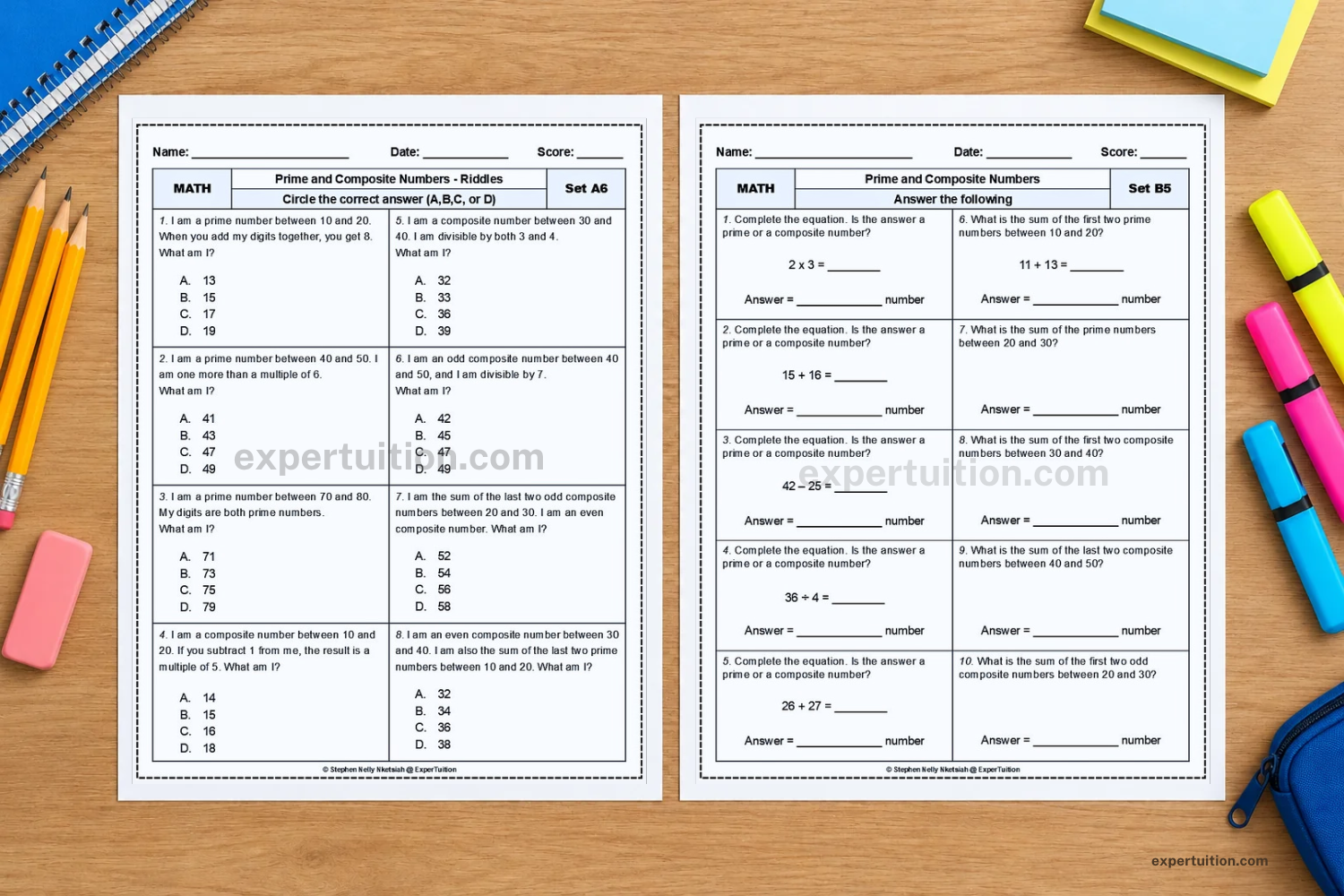
For additional practice identifying and classifying numbers, use Prime and Composite Numbers Worksheets. The resource provides multiple-choice and open-ended practice, including number riddles.
Address Common Difficulties
Students may understand the basic procedures but still make mistakes when finding factors, identifying multiples, or classifying numbers. Watch how they approach each task so you can identify the misunderstanding behind an incorrect answer.
Confusing factors and multiples: A student may list multiples when asked to find factors, or assume the two terms mean the same thing. This suggests they need to revisit the relationship between multiplication and division. Use an equation such as 4 × 6 = 24 to show that 4 and 6 are factors of 24, while 24 is a multiple of both.
Missing factor pairs: A student may overlook possible combinations when finding all the factors of a number. This may indicate that they are guessing rather than checking systematically. Have them use a factor-pair chart and test possible factors in order.
Assuming every odd number is prime: A student may classify odd numbers as prime without checking their factors. Use examples such as 9, 15, and 21 to show that odd numbers can also be composite. Ask the student to identify their factor pairs before deciding.
Assuming every even number is composite: A student may overlook the exception of 2. Compare the factors of 2 with those of 4, 6, and 8 to show why 2 is prime while the other examples are composite.
Classifying 1 as prime: A student may think 1 is prime because it has no factors other than itself. Reinforce the defining requirement: a prime number must have exactly two factors. Since 1 has only one factor, it is neither prime nor composite.
Stopping after finding one factor pair: A student may assume that finding a single pair is enough to classify a number. Ask them to check for additional pairs before making a decision. A number is composite if it has more than two factors.
Use these observations to decide whether students need to revisit a concept, practice a procedure, or explain the relationship in a different way.
Provide Guided Practice and Build Independent Application
Move students from teacher-supported examples to independent work as they become more confident with the concepts.
Begin with a few numbers that students can investigate together. Model how to identify factor pairs, recognize multiples, and use the results to classify numbers.
Gradually reduce the support. Give students numbers to investigate independently, then ask them to explain their answers to a partner. Encourage them to use arrays, factor-pair charts, multiplication facts, or division equations when needed.
Vary the tasks so students apply the ideas in different ways:
- Find all factor pairs for a given whole number.
- Identify whether a number is a multiple of a given one-digit number.
- Complete missing factor pairs.
- Sort numbers into prime, composite, and neither.
- Explain why a number is prime or composite.
- Solve number riddles using factors and multiples.
Include questions that require students to explain their reasoning, not just provide an answer. For example, instead of asking whether 35 is composite, ask students to show how they know. They might identify the factor pairs 1 and 35, and 5 and 7, then explain why the number is composite.
For a wider range of practice across factors, multiples, and prime and composite numbers, you can use the Factors, Multiples, Prime and Composite Numbers Worksheets bundle.
Adjust the level of support according to students’ needs. Some may still benefit from counters and arrays, while others may be ready to work with larger numbers within the grade-level range and justify their answers using equations.
Use Student Reasoning to Assess Understanding and Plan Next Steps
Use assessment to gather evidence of what students can do independently and what they can explain. The goal is to determine their level of understanding, identify readiness to progress, and plan appropriate next steps.
Use short formative checks throughout instruction. Ask students to find the factor pairs of a number, identify a multiple of a given one-digit number, or explain why a number is prime or composite. Exit tickets can help you identify which students are ready to move forward and which need additional support.
Listen to students’ explanations during partner work and class discussions. A student who can identify 12 as composite and explain that it has more than two factors demonstrates an understanding of the classification. However, if the student cannot find all the factor pairs independently, further practice with systematic factor searches may be needed. Look for whether students can move beyond identifying answers to explaining and applying the relationships.
Use their responses to decide what to revisit:
- Return to equal groups and multiplication and division relationships when students struggle to identify factors.
- Use factor-pair charts when students omit possible pairs.
- Revisit skip-counting and multiplication patterns when students have difficulty identifying multiples.
- Compare examples and non-examples when students confuse prime and composite numbers.
- Provide more independent reasoning tasks when students can classify numbers but need to explain their decisions.
The Grade 4 expectation in 4.OA.B.4 includes finding factor pairs for whole numbers from 1 to 100, recognizing multiples, determining whether a number is a multiple of a given one-digit number, and identifying prime and composite numbers. Use these expectations to check whether students can apply the connected skills, not just complete isolated exercises.
For a closer look at the mathematical ideas behind these skills, see Factors, Multiples, Prime and Composite Numbers. You can also consult Grade 4 Operations and Algebraic Thinking: A Guide to All 4.OA Standards for the broader grade-level expectations.
When students can find factor pairs systematically, recognize multiples, classify numbers accurately, and explain their reasoning, they are developing the understanding expected in this area of Grade 4 Math. Use the evidence from their work to determine when to provide more practice, when to revisit an earlier idea, and when they are ready to apply these relationships with greater independence.