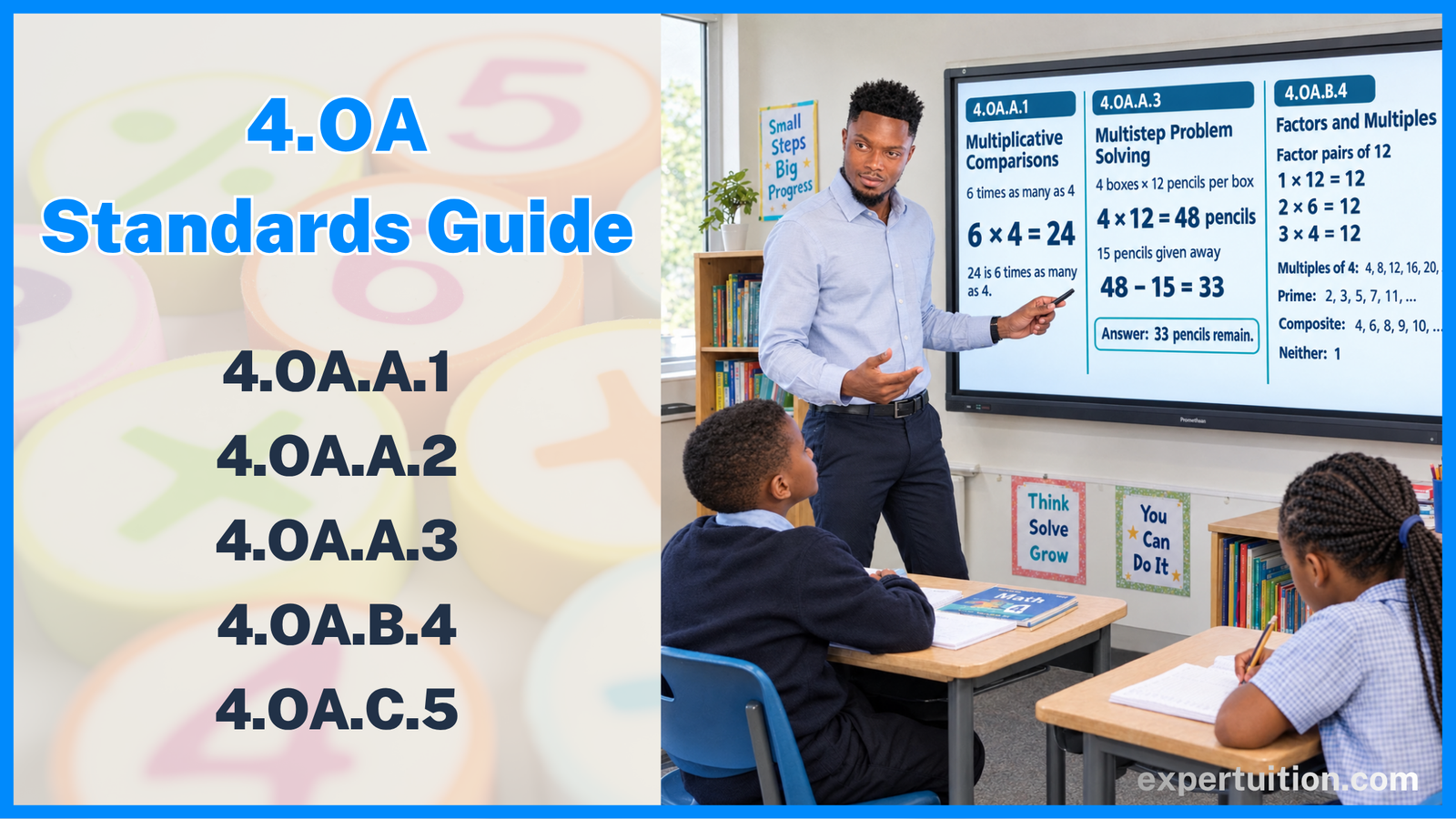
This guide covers all five Grade 4 Operations and Algebraic Thinking (4.OA) standards, explains each standard, highlights common student difficulties, and connects teachers with ExperTuition resources for targeted math practice.
Understanding Grade 4 Operations and Algebraic Thinking
The Grade 4 Operations and Algebraic Thinking domain (4.OA) covers five Common Core State Standards that develop students’ understanding of mathematical relationships, problem-solving, number properties, and patterns. Students learn to interpret multiplication as a comparison, solve multistep word problems, identify factors and multiples, classify prime and composite numbers, and generate and analyze number and shape patterns.
Standards 4.OA.A.1–4.OA.A.3 focus on multiplicative comparisons and problem-solving, 4.OA.B.4 addresses factors, multiples, and prime and composite numbers, and 4.OA.C.5 focuses on patterns. Together, they help students represent relationships with equations, choose appropriate operations, interpret results, and explain their reasoning.
This guide breaks down each standard with worked examples, common student misconceptions, practical teaching tips, and relevant ExperTuition resources to help teachers target specific learning needs.
Grade 4 Operations and Algebraic Thinking Standards at a Glance
| Standard | Focus | What Students Need to Understand |
|---|---|---|
| 4.OA.A.1 | Multiplicative comparisons | Interpret multiplication equations as comparisons and represent verbal comparisons using equations. |
| 4.OA.A.2 | Multiplicative comparison word problems | Solve comparison problems using multiplication and division, including problems with different unknown quantities. |
| 4.OA.A.3 | Multistep word problems | Solve whole-number problems involving the four operations, interpret remainders, write equations with an unknown, and check whether answers are reasonable. |
| 4.OA.B.4 | Factors, multiples, prime and composite numbers | Find factor pairs for numbers from 1 to 100, identify multiples, determine whether a number is a multiple of a given one-digit number, and classify prime and composite numbers. |
| 4.OA.C.5 | Number and shape patterns | Generate patterns from given rules and identify features that are not immediately obvious from the rules. |
4.OA.A.1: Understanding and Representing Multiplicative Comparisons
Standard 4.OA.A.1 requires students to interpret multiplication equations as comparisons and represent verbal multiplicative comparisons using equations.
A multiplicative comparison describes how many times as much or as many one quantity is as another. Students need to identify the compared quantity, the reference quantity, and the multiplier.
Consider the equation:
It can represent both statements:
- 24 is 6 times as many as 4.
- 24 is 4 times as many as 6.
Both are correct because multiplication is commutative. In the first comparison, 24 is the compared quantity, 4 is the reference quantity, and 6 is the multiplier.
Representing a Multiplicative Comparison with an Equation
Example: A red bead collection has 6 times as many beads as a blue collection of 4 beads. How many red beads are there?
Let represent the number of red beads.
Answer: 24 red beads.
The equation represents six equal groups of four beads.
Students should also represent comparisons when the multiplier is unknown. If there are 24 red beads and 4 blue beads, then , so .
Common Student Misconceptions
Students may confuse multiplicative comparisons with additive comparisons, interpreting “6 times as many” as adding 6. They may also misidentify the reference quantity or calculate correctly without explaining what the numbers represent.
Teaching Tips
Use drawings, equal groups, and equations together.
For example, ask students to draw three groups of five objects and write .
Contrast these statements:
- 3 more than 5:
- 3 times as many as 5:
Ask students to explain how the relationships differ. Encourage them to label the quantities in their equations so the numbers represent meaningful relationships rather than calculations alone.
Recommended Resources
Strengthen students’ understanding of multiplicative relationships by connecting verbal comparisons, equations, and numerical representations.
4.OA.A.2: Solving Word Problems Involving Multiplicative Comparisons
Standard 4.OA.A.2 requires students to solve multiplicative comparison problems using multiplication and division. Students should represent these problems with drawings and equations, including symbols for unknown quantities.
The key is identifying what is unknown: the compared quantity, the reference quantity, or the multiplier. The relationship remains multiplicative, but the unknown determines which operation is useful.
Example 1: Finding the Compared Quantity
One classroom has 6 tables. Another has 3 times as many. How many tables does the second classroom have?
Let represent the number of tables.
Answer: 18 tables.
Example 2: Finding the Reference Quantity
A large box contains 28 crayons, 4 times as many as a small box. How many crayons are in the small box?
Let represent the number of crayons in the small box.
Answer: 7 crayons.
Example 3: Finding the Multiplier
A garden has 24 tomato plants and 6 pepper plants. How many times as many tomato plants are there?
Let represent the multiplier.
Answer: 4 times as many tomato plants.
These examples show why students must understand the relationship between quantities instead of choosing an operation based only on familiar words.
Distinguishing Multiplicative and Additive Comparisons
Compare these statements:
- Shelf A has 6 more books than Shelf B.
- Shelf A has 6 times as many books as Shelf B.
If Shelf B has 8 books, Shelf A has 14 in the first situation () and 48 in the second ().
The first describes a difference; the second describes a multiplicative relationship.
Common Student Misconceptions
Students may assume that “times as many” always means multiplying the two given numbers. They may also confuse the compared and reference quantities or choose an operation before identifying the unknown.
Teaching Tips
Have students identify the quantities, state what is unknown, and represent the relationship with an equation or bar model.
Include problems with different unknowns. Ask students to explain why their operation fits the relationship and how the inverse operation can check the answer.
Recommended Resources
Help students identify the unknown quantity and select an operation that matches the relationship.
4.OA.A.3: Solving Multistep Word Problems
Standard 4.OA.A.3 requires students to solve multistep word problems involving whole numbers and the four operations: addition, subtraction, multiplication, and division.
Students must represent problems using equations with a letter for the unknown, interpret remainders in context, and check whether answers are reasonable using mental computation and estimation, including rounding.
A multistep problem involves two or more connected calculations. Students must identify relevant information, determine which intermediate quantities to find, and use those results to solve the problem.
Example 1: Combining Multiplication and Subtraction
A teacher has 8 boxes of 24 pencils and gives away 75 pencils. How many remain?
First, find the total:
Then subtract the pencils given away:
Answer: 117 pencils remain.
Example 2: Writing an Equation with an Unknown
A library receives 125 books and then has 480. How many books did it have originally?
Let represent the original number of books.
Answer: 355 books.
The letter represents the unknown quantity. Students should understand how the equation connects the original amount, the books received, and the final total.
Example 3: Interpreting a Remainder
A teacher distributes 157 pencils equally among 4 classrooms. How many does each classroom receive, and how many remain?
Answer: Each classroom receives 39 pencils, and 1 pencil remains.
The meaning of a remainder depends on the context. If 157 students travel in buses that each hold 4 students, 39 buses would leave one student without a seat, so 40 buses are needed.
Students should explain what the remainder means instead of applying the same rule to every problem.
Assessing Whether an Answer Is Reasonable
In the pencil problem, is close to . After giving away 75 pencils, a little more than 100 should remain. The answer of 117 is reasonable.
Estimation does not replace accurate calculation. It helps students judge whether an answer is plausible and spot possible errors.
Common Student Misconceptions
Students may:
- Use only one operation when several are needed.
- Perform calculations in an order that does not match the problem.
- Use an incorrect intermediate result.
- Write an equation that does not represent the unknown.
- Ignore a remainder or fail to explain its meaning.
- Accept an answer without checking whether it is reasonable.
- Include irrelevant information in their calculations.
Teaching Tips
Before calculating, ask students what the problem is asking and how they plan to solve it.
Encourage them to organize information, identify the unknown, sequence the calculations, explain intermediate results, interpret remainders, and estimate to check their answers.
Use different combinations of the four operations so students learn to analyze each situation rather than rely on memorized steps. Reviewing incorrect answers can reveal whether the difficulty lies in understanding the problem, choosing operations, calculating, or interpreting the result.
Recommended Resources
- Multi-Step Word Problems Worksheets – Set 1
- Multi-Step Word Problems Task Cards – Set 1
- Multi-Step Word Problems Worksheets & Task Cards Bundle
- All ExperTuition Multi-Step Word Problems Resources
Give students opportunities to connect operations, organize information, and work through multistep problems with greater confidence.
4.OA.B.4: Understanding Factors, Multiples, Prime and Composite Numbers
Standard 4.OA.B.4 requires students to find factor pairs for whole numbers from 1 to 100, recognize that a whole number is a multiple of each of its factors, determine whether a number from 1 to 100 is a multiple of a given one-digit number, and identify prime and composite numbers.
These concepts strengthen students’ understanding of multiplication and division and prepare them for later work with equivalent fractions and common multiples.
Part 1: Factors, Factor Pairs, and Multiples
A factor divides a whole number evenly, with no remainder. A factor pair consists of two whole numbers whose product equals the given number.
For example, the factor pairs of 12 are:
The positive factors of 12 are 1, 2, 3, 4, 6, and 12.
A multiple is the product of a given number and a whole number. The first six positive multiples of 6 are 6, 12, 18, 24, 30, and 36.
Since , 6 is a factor of 36, and 36 is a multiple of 6.
Students should also determine whether a number is a multiple of a given one-digit number. For example, 36 is a multiple of 6, but 38 is not because no whole number multiplied by 6 produces 38.
Finding Factor Pairs Systematically
To find all factor pairs of 24, test whole numbers in increasing order:
Once the pairs begin repeating in reverse order, there are no additional pairs. The positive factors of 24 are 1, 2, 3, 4, 6, 8, 12, and 24.
Common Student Misconceptions
Students may confuse factors with multiples, omit factor pairs, record the same pair twice, or assume that every number greater than a given number is its multiple.
Some also decide whether a number is a multiple without checking whether it can be expressed as a whole-number product.
Teaching Tips
Use multiplication facts, arrays, and equal groups to connect factors and products.
For example, 12 objects can be arranged in 1 row of 12, 2 rows of 6, or 3 rows of 4. Each arrangement represents a factor pair.
Ask students:
- Which whole numbers multiply to make 24?
- What numbers can be produced by multiplying 6 by a whole number?
The first question focuses on factors of 24; the second focuses on multiples of 6. Have students record pairs systematically and verify them by multiplication.
Recommended Resources
Strengthen students’ understanding of multiplication and division through focused work with factor pairs and multiples.
Part 2: Prime and Composite Numbers
A prime number is a whole number greater than 1 with exactly two positive factors: 1 and itself. A composite number is a whole number greater than 1 with more than two positive factors.
For example:
- 7 is prime: its only positive factors are 1 and 7.
- 12 is composite: its positive factors are 1, 2, 3, 4, 6, and 12.
- 9 is composite: its positive factors are 1, 3, and 9.
- 2 is prime: its only positive factors are 1 and 2.
- 1 is neither prime nor composite: it has only one positive factor.
The number of factors determines whether a number is prime or composite. Odd and even classifications alone are not enough.
Why Prime and Composite Numbers Matter
A prime number has exactly one positive factor pair when order is disregarded: 1 and the number itself. A composite number has at least one additional factor pair.
For example, 7 objects form only one rectangular array, , so 7 is prime. Twelve objects form arrays of , , and , so 12 is composite.
Common Student Misconceptions
Students may assume that all odd numbers are prime or that all even numbers are composite. However, 9 is odd and composite, while 2 is even and prime.
Another common misconception is classifying 1 as prime because it is divisible by itself. A prime number must have exactly two positive factors.
Teaching Tips
Have students list a number’s factor pairs before classifying it. Arrays can help them see whether a number can form rectangular arrangements beyond 1 row and the number itself.
Include numbers such as 2, 9, 15, 17, and 21 to show that oddness and evenness do not determine whether a number is prime. Emphasize that 1 is neither prime nor composite.
Recommended Resource
Help students use factor relationships to classify numbers and explain why a number is prime or composite.
4.OA.C.5: Understanding Number and Shape Patterns
Standard 4.OA.C.5 requires students to generate number or shape patterns that follow a given rule and identify features of the resulting patterns that are not immediately obvious from the rule itself.
Students must do more than continue a sequence: they should apply the rule consistently, generate terms or figures, and explain what they notice.
Part 1: Number Patterns and Input-Output Tables
A number pattern is a sequence that follows a rule.
Consider this pattern:
1, 4, 7, 10, 13, …
The rule is to start at 1 and add 3. The next terms are 16, 19, and 22.
Students should also identify features that are not stated directly in the rule. Here, the numbers alternate between odd and even. Adding an odd number to an odd number produces an even number; adding an odd number to an even number produces an odd number.
This alternating feature emerges as students generate the pattern. It is not explicitly stated in the rule to add 3.
Using Input-Output Tables to Explore Rules
Input-output tables pair each input with an output according to a rule.
Consider the rule multiply the input by 3.
| Input | Rule | Output |
|---|---|---|
| 1 | 3 | |
| 2 | 6 | |
| 3 | 9 | |
| 4 | 12 | |
| 5 | 15 |
As the input increases by 1, the output increases by 3. The outputs are also all multiples of 3, a feature students can discover by examining the table.
Common Student Misconceptions
Students may apply a rule inconsistently, overlook features that emerge across a sequence, confuse inputs with outputs, or apply the rule to only some rows.
Teaching Tips
Have students state the rule, generate several terms, and verify that each follows it. Ask:
- What changes from one term to the next?
- What stays the same?
- Does the rule work for every term?
- What do you notice about the pattern?
- Is there a feature that was not stated directly in the rule?
Use input-output tables to make relationships easier to compare. Encourage students to explain both how they generated the terms and what they discovered.
Recommended Resources
- Growing and Shrinking Number Patterns Worksheets
- Input-Output Tables Worksheets
- All ExperTuition Number and Shape Patterns Resources
Help students recognize how numbers change, apply rules consistently, and explain the relationships they discover.
Part 2: Shape Patterns
Shape patterns follow visual rules. They may repeat a unit, grow by adding shapes, or shrink by removing them. Students should identify the rule, generate the next figure, and explain how the arrangement changes.
Repeating Shape Patterns
Consider this sequence:
○, □, △, ○, □, △, …
The repeating unit is circle, square, triangle. The next three shapes are ○, □, △.
The key is recognizing the repeating structure rather than memorizing the entire sequence.
Growing Shape Patterns
A sequence contains 2, 4, 6, and 8 squares in Figures 1–4. The rule is to add 2 squares each time, so the next figure contains 10 squares.
- Figure 1: □ □
- Figure 2: □ □ □ □
- Figure 3: □ □ □ □ □ □
- Figure 4: □ □ □ □ □ □ □ □
- Figure 5: □ □ □ □ □ □ □ □ □ □
Students should explain how the number of squares changes and how the rule determines the next figure.
Shrinking Shape Patterns
Consider the sequence:
- Figure 1: □ □ □ □ □ □ □ □ □ □ □ □
- Figure 2: □ □ □ □ □ □ □ □ □
- Figure 3: □ □ □ □ □ □
- Figure 4: □ □ □
The rule is to remove 3 squares each time. Students can apply the rule to find the next term and explain the decrease.
Identifying Features That Are Not Immediately Obvious
A growing shape pattern might add two squares to each figure while keeping the number of triangles unchanged.
- Figure 1: △ □ □
- Figure 2: △ □ □ □ □
- Figure 3: △ □ □ □ □ □ □
Students should identify both the growth rule and the feature that remains constant. In this example, the number of squares increases by 2 each time while the number of triangles stays at 1.
Observing what changes and what stays the same helps students understand how patterns are organized.
Common Student Misconceptions
Students may guess the next shape without identifying a consistent rule, focus on one feature while overlooking another, or draw the next figure without explaining why it fits the pattern.
Teaching Tips
Ask students to describe the rule before drawing the next figure. Have them compare consecutive figures and identify which shapes are added, removed, repeated, or unchanged.
Use drawings, manipulatives, or colored shapes to make changes visible. Include repeating, growing, and shrinking patterns, and ask students to justify their answers using the rule.
Recommended Resources
Give students opportunities to analyze visual patterns, apply rules consistently, and explain how shapes change from one figure to the next.
How the Five 4.OA Standards Work Together
The five Operations and Algebraic Thinking standards address different skills but share an emphasis on understanding relationships and explaining mathematical reasoning.
- 4.OA.A.1: Interpret multiplication equations as comparisons and represent verbal comparisons using equations.
- 4.OA.A.2: Solve multiplicative comparison word problems using multiplication and division.
- 4.OA.A.3: Solve multistep word problems, interpret remainders, represent unknowns with equations, and check answers for reasonableness.
- 4.OA.B.4: Find factors and multiples and classify prime and composite numbers.
- 4.OA.C.5: Generate patterns from rules and identify features that emerge from them.
These connections help teachers identify what students need to practice. A student who struggles with multiplicative comparisons may need to identify the relationship between quantities before choosing an operation. A student who cannot find factor pairs may benefit from reviewing multiplication facts, arrays, and equal groups.
Similarly, a student who can continue a number pattern but cannot explain the rule may need practice describing how successive terms are related and identifying features that emerge from the sequence.
The standards also reinforce the value of representing mathematical ideas in different ways. Equations describe relationships between quantities, arrays reveal factor pairs, and number or shape patterns make rules visible.
Examining the reasoning behind an incorrect answer helps teachers choose practice that addresses the specific difficulty rather than simply assigning more problems of the same type.
Final Thoughts
When students struggle with Operations and Algebraic Thinking, identifying the mathematical relationship behind the difficulty helps teachers determine what needs more practice.
Explore the ExperTuition Operations and Algebraic Thinking Collection for worksheets and activities that support the 4th Grade 4.OA standards.