Learn how to teach multi-digit multiplication in Grades 4–5 using partial products, area model multiplication, and the standard algorithm. Compare how the strategies work and connect, learn when to use each one, and find practical ways to address common multiplication difficulties.
Helping Students Make Sense of Multiplication
Teaching multi-digit multiplication involves more than showing students how to multiply digits and record the answers. Students need to understand how place value affects each calculation, why a number can be broken into smaller parts, and how different strategies can represent the same multiplication problem.
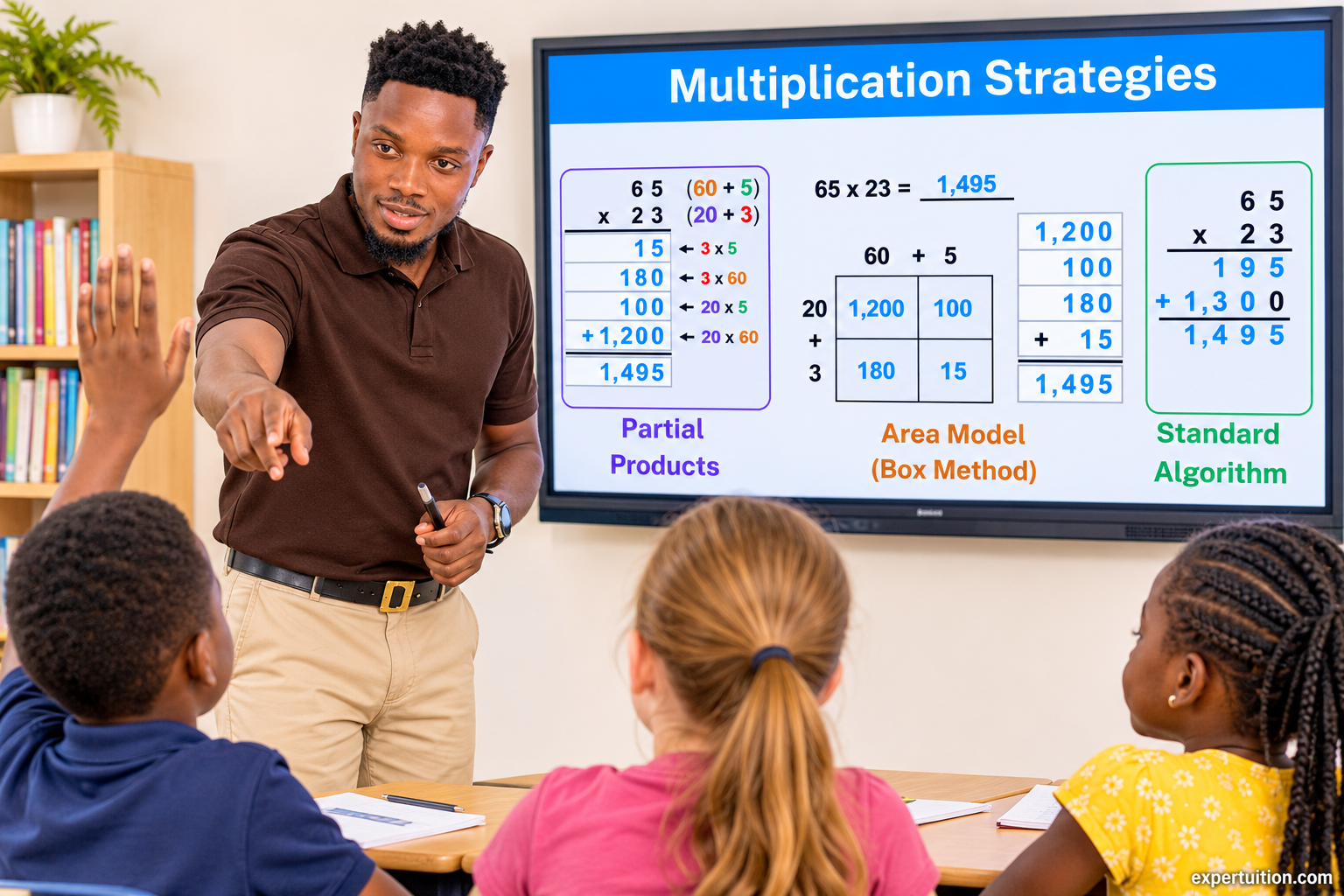
In Grades 4–5, students use strategies such as partial products, area model multiplication, and the standard algorithm to multiply multi-digit whole numbers. Although these methods organize the calculations differently, they rely on the same mathematical relationships. Each strategy involves multiplying place-value parts and combining the resulting products.
Three Multiplication Strategies and What They Help Students Understand
The following examples use the same problem, 65 × 23, to show how each strategy organizes the calculation. Each method gives a product of 1,495, but the written work looks different.
Partial Products Multiplication
The partial products method involves breaking each factor into its place-value parts, multiplying the parts separately, and adding the resulting products.
For 65 × 23, students decompose the factors:
- 65 = 60 + 5
- 23 = 20 + 3
They then calculate the four partial products:
- 3 × 5 = 15
- 3 × 60 = 180
- 20 × 5 = 100
- 20 × 60 = 1,200
They add the partial products:
15 + 180 + 100 + 1,200 = 1,495
Therefore, 65 × 23 = 1,495.
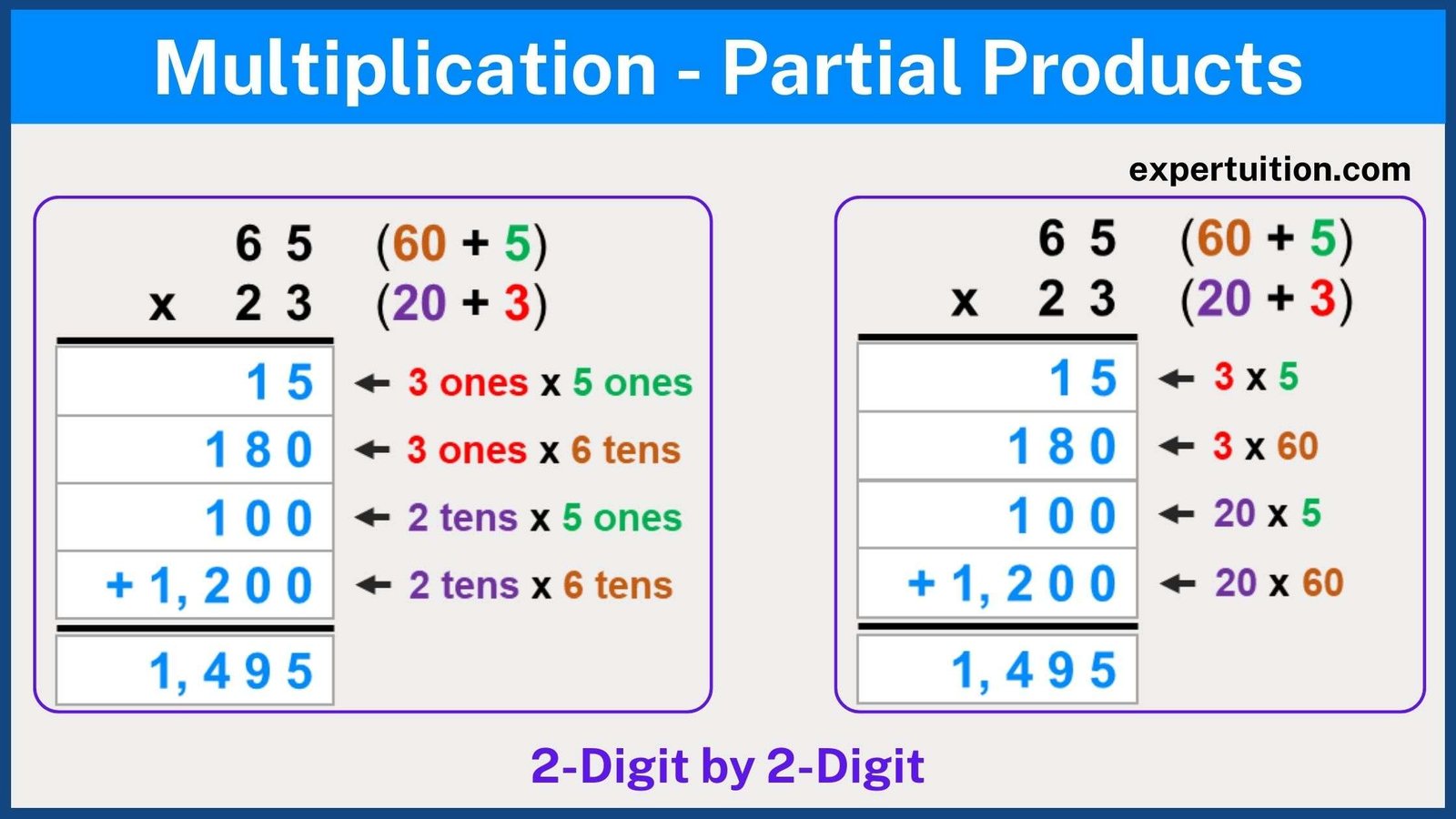
This strategy makes the separate place-value calculations visible. Students can see how multiplying the tens and ones in each factor produces four smaller products that combine to give the total product.
For a fuller explanation and more worked examples, see The Partial Products Multiplication Method: How It Works. For additional practice, explore the Partial Products Multiplication Worksheets collection.
Area Model Multiplication
Area model multiplication uses a rectangle divided into smaller sections to represent the multiplication. Students write each factor in expanded form along the sides of the rectangle. Each section represents the product of one part from each factor.
For 65 × 23, students write:
- 65 = 60 + 5
- 23 = 20 + 3
They divide the rectangle into two rows and two columns. The tens and ones of each factor label the rows and columns.
The four sections represent these products:
- 60 × 20 = 1,200
- 60 × 3 = 180
- 5 × 20 = 100
- 5 × 3 = 15
Students add the areas of the four sections:
1,200 + 180 + 100 + 15 = 1,495
Therefore, 65 × 23 = 1,495.

The rectangular layout makes the four partial products visible and shows how they combine to give the total area and product. Students can see how the sections represent the same place-value calculations used in the partial products method.
For a fuller explanation and more worked examples, see The Area Model Multiplication Method: How It Works. For additional practice, explore the Area Model Multiplication Worksheets collection.
Standard Algorithm Multiplication
The standard algorithm, also known as traditional or long multiplication, organizes the calculation into a compact written procedure. Students multiply by each digit of the multiplier, working from right to left and keeping the place value of each digit in mind.
For 65 × 23, students first multiply 65 by the ones digit, 3:
- 3 × 5 = 15. Write 5 in the ones place and regroup 1 ten.
- 3 × 6 tens = 18 tens. Add the regrouped ten to get 19 tens.
- The first partial product is 195.
Next, students multiply 65 by the tens digit, 2, which represents 20:
- 2 × 5 = 10. Write 0 in the ones place and regroup 1 ten.
- 2 × 6 tens = 12 tens. Add the regrouped ten to get 13 tens.
- The calculation gives 130. Since the 2 represents 20, the second partial product is 1,300.
Finally, students add the two partial products:
195 + 1,300 = 1,495
Therefore, 65 × 23 = 1,495.
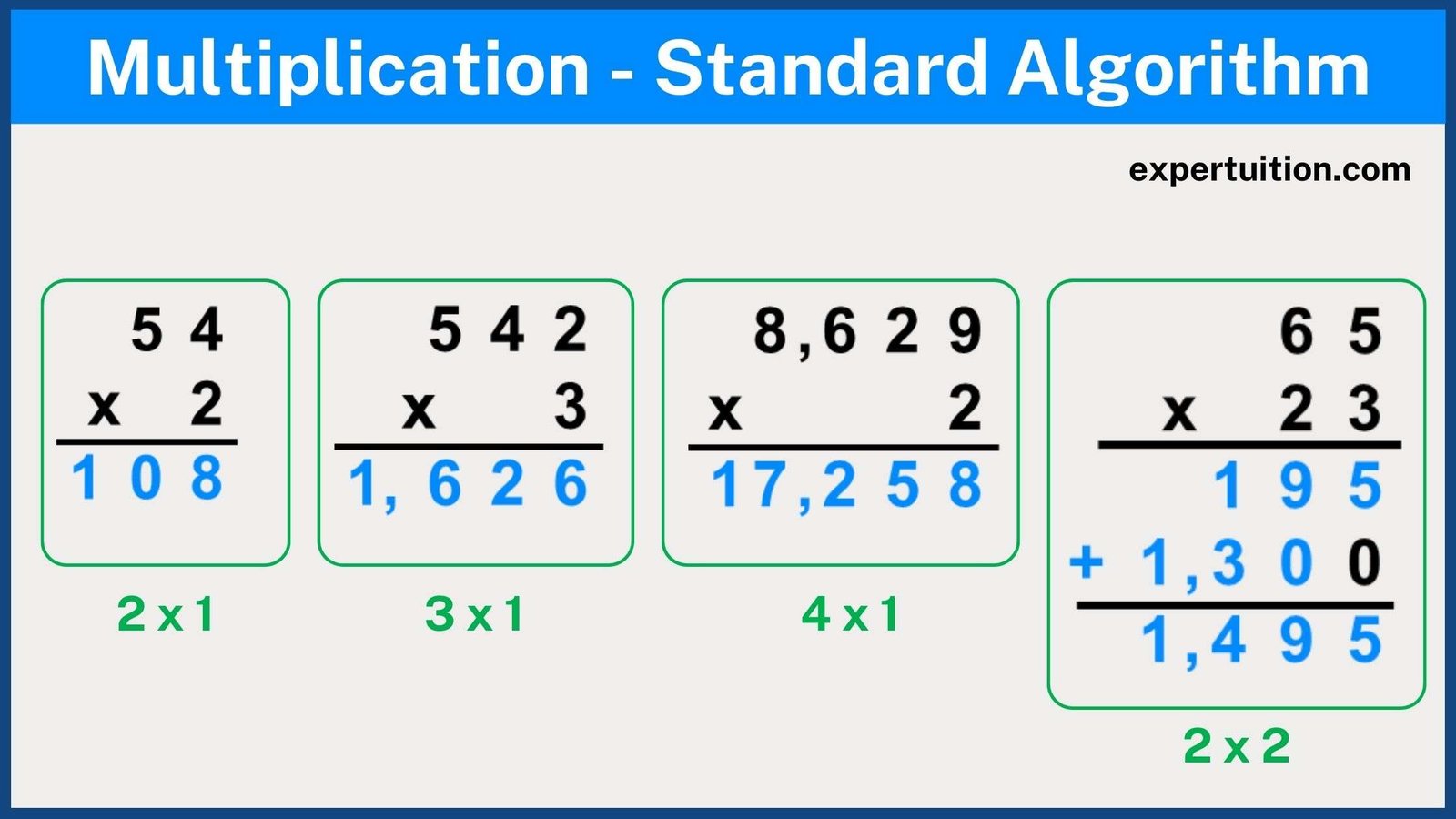
This method gives students a structured way to record multi-digit multiplication. Its compact layout requires careful attention to regrouping and place value, particularly when recording the second partial product.
For a fuller explanation and more worked examples, see The Standard Algorithm Multiplication Method: How It Works. For additional practice, explore the Standard Algorithm Multiplication Worksheets collection.
How Multiplication Instruction Progresses from Grade 4 to Grade 5
Grade 4 and Grade 5 have related but distinct expectations for multi-digit multiplication.
Under Common Core Standard 4.NBT.B.5, Grade 4 students multiply whole numbers of up to four digits by one-digit numbers and multiply two two-digit numbers using place-value strategies and properties of operations. They illustrate and explain their calculations using equations, rectangular arrays, and/or area models. Area models and partial products help students decompose factors, calculate the resulting products, and explain how those products combine.
Under Common Core Standard 5.NBT.B.5, Grade 5 students develop fluency multiplying multi-digit whole numbers using the standard algorithm. They build on their earlier understanding by recognizing how the algorithm organizes the same place-value calculations in a more compact format.
This progression connects the mathematical understanding developed in Grade 4 with the fluency expected in Grade 5. It does not require every student to follow one rigid sequence, but students should understand the place-value reasoning behind the procedures they use.
How the Three Multiplication Strategies Are Connected
Although the three strategies use different layouts, they rely on the same place-value calculations. Students decompose the factors, multiply the parts, and combine the products to find the answer.
| Strategy | How students build the product | How it connects to the other strategies |
|---|---|---|
| Partial products | Calculate the products of the place-value parts separately and add them. | Shows the separate calculations numerically. |
| Area model | Represent each place-value product in a section of a rectangle and add the areas. | Shows the same partial products visually. |
| Standard algorithm | Organize the multiplication into rows, with each row representing the product of the multiplicand and one place-value part of the multiplier. | Records the same place-value products in a more compact format. |
Two connections are particularly useful when comparing these strategies.
Partial Products and Area Model Multiplication
Both methods show the products obtained by multiplying the tens and ones of each factor. In the area model, the four products appear inside the sections of a rectangle. In the partial products method, students record those products as separate calculations.
For 65 × 23, both methods represent:
- 60 × 20 = 1,200
- 60 × 3 = 180
- 5 × 20 = 100
- 5 × 3 = 15
The main difference is how students organize and display the calculations. The area model provides a visual representation, while partial products present the calculations numerically.

Partial Products and the Standard Algorithm
The standard algorithm also uses the same place-value products, but it groups them according to the digits of the multiplier.
For 65 × 23, the first row represents multiplying 65 by 3:
15 + 180 = 195
The second row represents multiplying 65 by 20:
100 + 1,200 = 1,300
Adding the two rows gives:
195 + 1,300 = 1,495
The standard algorithm combines the partial products within each row rather than writing all four separately. Comparing the methods helps students recognize that the compact written procedure represents the same calculations they have already seen in the other strategies.
How to Choose and Teach a Multiplication Strategy
The strategy you introduce should match what students need to understand and the level of support they need. Rather than presenting the three methods as unrelated procedures, connect each one to the mathematical ideas students are learning.
Use Visual Models to Build Understanding
Introduce area model multiplication when students need to see how the parts of each factor contribute to the total product. The rectangular sections help them organize the calculations and connect multiplication with the area of a rectangle.
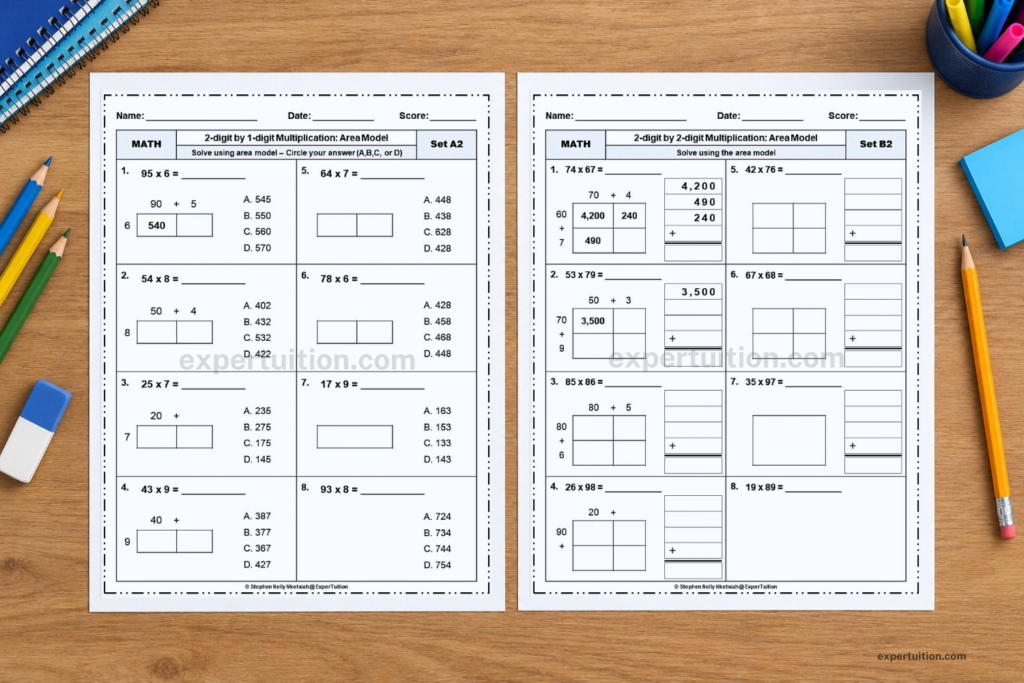
Ask students to identify what each section represents and explain how the four products combine to give the total. This helps them connect the visual representation to the numerical calculations.
Use Partial Products to Make Place-Value Calculations Visible
Use partial products when students need to work directly with the separate products created by decomposing the factors.
Ask students to explain what each partial product represents and why all four products are needed when multiplying two two-digit numbers. Their explanations can reveal whether they understand the value of the tens and ones in each factor.
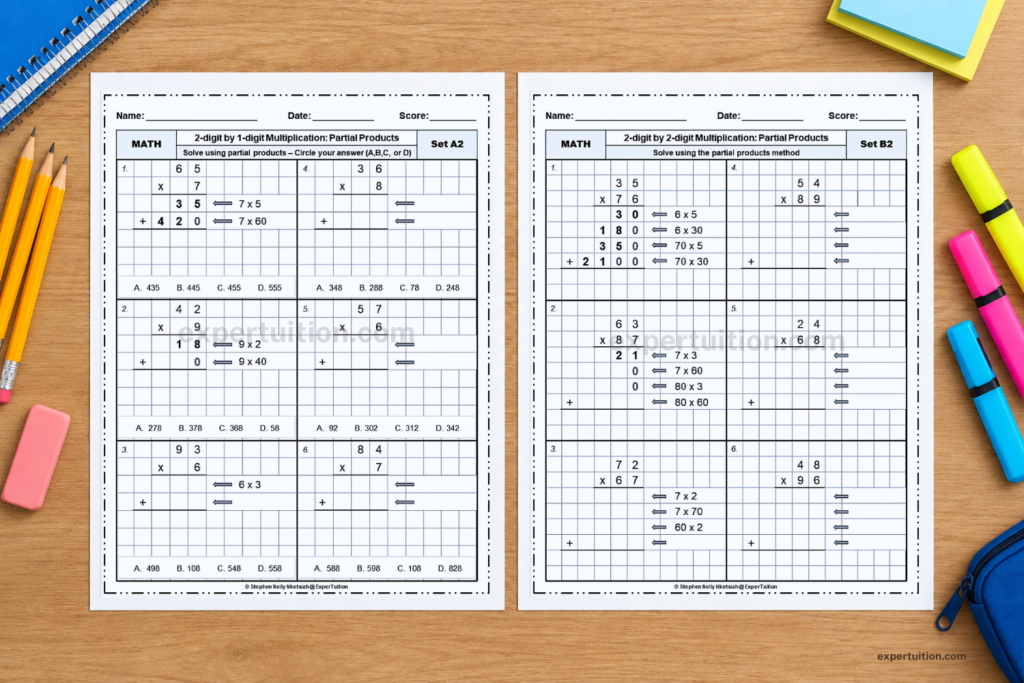
Use the Standard Algorithm to Organize Calculations
The standard algorithm provides a compact way to record multi-digit multiplication. Introduce it when students can connect its written steps to the place-value products they have worked with in other strategies.
Focus on the meaning of regrouping and the value represented by each row. Students should understand why the second partial product begins in the tens place when multiplying by a tens digit.
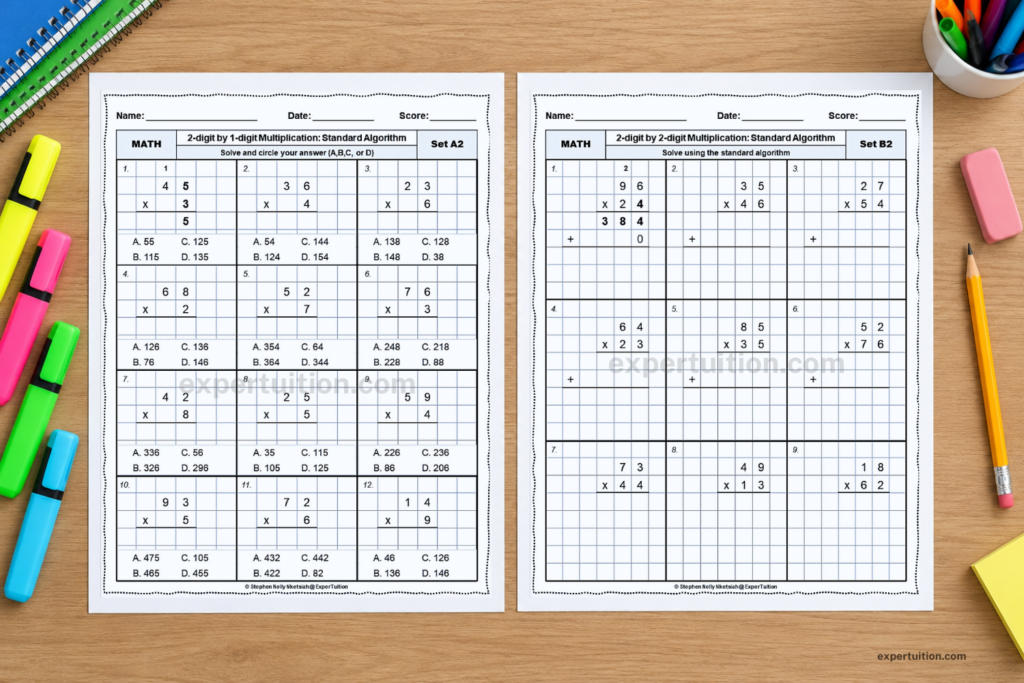
Compare Methods Instead of Teaching Them in Isolation
After students have worked with individual strategies, give them the same multiplication problem to solve in two different ways. For example, ask them to solve 65 × 23 using partial products and the area model.
Use questions such as:
- What does each partial product represent?
- How does the area model show the same calculations?
- Which products appear in both methods?
- How does the standard algorithm organize these products?
- Why do all three methods give the same answer?
Comparing solutions helps students explain their reasoning and recognize that different written methods can represent the same multiplication.
Common Multiplication Difficulties and How to Address Them
Students may understand basic multiplication but still make errors when working with multi-digit numbers. Difficulties with place value, decomposing factors, calculating partial products, regrouping, and recording the written procedure can affect their answers. Identifying the reason behind an error helps you decide what to reteach.
Understanding Place Value When Multiplying
Students may treat the digits in a factor as though they represent their face values rather than their actual place values.
For example, in 65 × 23, the 6 represents 60, and the 2 represents 20. Multiplying 6 by 2 instead of 60 by 20 leads to an incorrect partial product.
Use expanded forms, place-value charts, or area models to show what each digit represents before students begin multiplying.
Decomposing Factors Correctly
Students may break apart a factor incorrectly or forget to include one of its place-value parts.
For example, when decomposing 65, students should use 60 + 5, not 6 + 5. Ask them to write each factor in expanded form before calculating. This reinforces the value of each digit and helps them identify the parts needed for the multiplication.
Calculating and Adding Partial Products
Students may calculate one of the partial products incorrectly or make an addition error when combining them.
For 65 × 23, omitting 100 or 180 would leave out part of the multiplication. Ask students to match each partial product to the corresponding parts of the two factors. They can also check the addition separately after confirming that all four products are included.
Understanding Regrouping in the Standard Algorithm
Students may forget to add a regrouped digit to the next calculation or add it in the wrong place.
For example, when calculating 3 × 5 = 15 in 65 × 23, the 1 represents 1 ten, not 1 one. It must be added to the 18 tens obtained from 3 × 60.
Use place-value language to explain what the regrouped digit represents. This helps students understand the calculation instead of treating regrouping as an instruction to move a small digit.
Recording the Second Partial Product in the Correct Place
Students may begin the second row of the standard algorithm in the ones column because they forget that the multiplier digit represents tens.
In 65 × 23, the 2 represents 20. Therefore, the second partial product is 1,300, not 130 or 13,000. Explain why the row begins in the tens place and connect it to the calculation 65 × 20.
These difficulties can appear across different multiplication strategies, although the written work may look different. When reviewing student work, look for the mathematical misunderstanding behind the error before deciding which part of the method to reteach.
Helping Students Check Their Multiplication Answers
Students should learn to check their products rather than rely only on the calculation steps. Estimation and the relationship between multiplication and division provide useful ways to check an answer.
For example, before solving 65 × 23, students can round the factors:
65 ≈ 70
23 ≈ 20
70 × 20 = 1,400
The exact product, 1,495, is reasonably close to the estimate.
Students can also use division to check the product:
1,495 ÷ 23 = 65
Or:
1,495 ÷ 65 = 23
If the division gives the other factor, the multiplication answer is consistent with the inverse relationship between the two operations. Estimation also helps students identify products that are far from a reasonable range.
Moving from Understanding to Independent Practice
Students need opportunities to see a multiplication strategy modeled, work through examples with support, and apply what they have learned independently. A gradual progression helps them develop confidence while keeping the focus on the reasoning behind the calculations.
- Model the strategy. Demonstrate the method and explain what each part of the calculation represents. Use place-value language and connect the steps to the multiplication being performed.
- Solve problems together. Work through examples with students. Ask them to explain how they decomposed the factors, identify the partial products, and describe how they combined them.
- Compare representations. Solve the same problem using different strategies. Discuss how the layouts differ and why the methods produce the same product.
- Provide independent practice. Give students problems that match the skills and number sizes they are learning. Include opportunities to use place-value strategies, area models, partial products, and the standard algorithm as appropriate.
- Review errors and provide targeted support. Examine students’ calculations to identify whether they need more work with place value, decomposing factors, partial products, regrouping, or the written procedure.
Choose practice materials based on the skills students need to strengthen. Students who struggle to organize place-value calculations may benefit from area model or partial products worksheets. Those who are developing fluency with the standard algorithm need practice that includes both regrouping and non-regrouping problems.
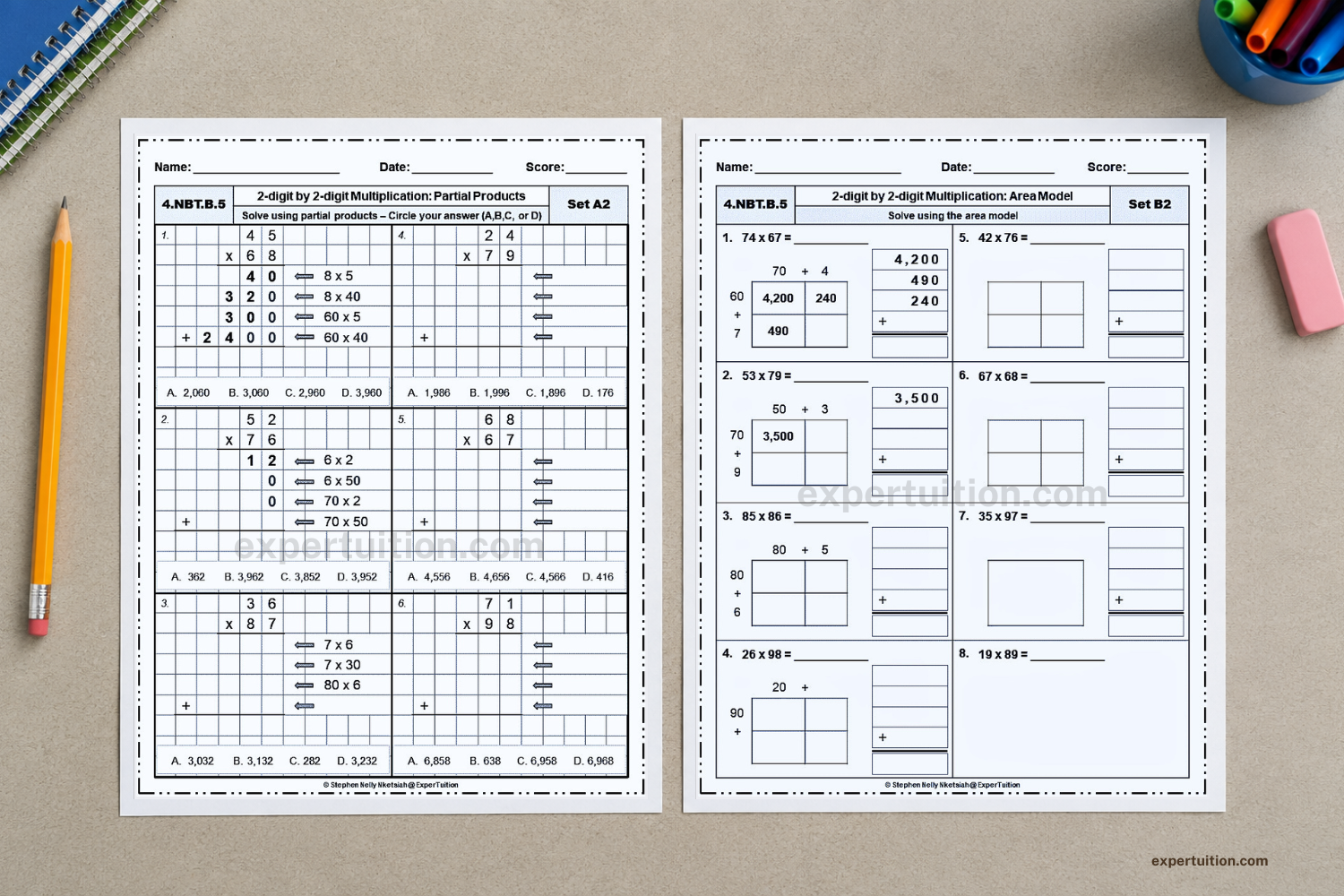
For help comparing individual worksheet sets and bundles by method and other features, see Choosing Multiplication Worksheets and Practice Resources for Grades 4–5.
Final Thoughts on Teaching Multiplication
Students need to understand both how to multiply multi-digit numbers and why the calculations work. Partial products, area model multiplication, and the standard algorithm provide different ways to organize the same place-value calculations.
Model the strategies, compare their representations, and use students’ work to decide what to teach next. When students can explain what the partial products represent and recognize how the methods connect, they are better prepared to multiply accurately and make sense of the procedures they use.