
Understand factors, multiples, prime numbers, and composite numbers through clear explanations, factor pairs, and worked examples. Learn how these number concepts relate and how to identify prime and composite numbers.
What Are Factors?
Factors are positive whole numbers that divide another positive whole number evenly, leaving no remainder. They also represent the numbers that can be multiplied together to produce a given number. Understanding factors begins with recognizing these multiplication and division relationships.
For example, 12 can be written as 1 × 12, 2 × 6, and 3 × 4. Each multiplication sentence shows a pair of factors of 12. The numbers 1, 2, 3, 4, 6, and 12 are all factors of 12 because each divides 12 evenly.
Every positive whole number greater than 1 has at least two factors: 1 and itself. The number 1 is the only positive whole number with just one factor.
For a closer look at the Grade 4 expectations for this topic, see the Grade 4 Operations and Algebraic Thinking Standards.
Understanding Factor Pairs
A factor pair consists of two positive whole numbers that multiply to give a particular product.
For example, the factor pairs of 12 are:
- 1 × 12 = 12
- 2 × 6 = 12
- 3 × 4 = 12
Therefore, the factor pairs of 12 are (1, 12), (2, 6), and (3, 4).

Each pair represents a different multiplication relationship that produces 12. The individual numbers in these pairs make up the complete list of factors: 1, 2, 3, 4, 6, and 12.
Factor pairs can be found systematically by starting with 1 and testing consecutive whole numbers. For each number that divides the given number evenly, record the matching factor pair. Stop when the first number in a pair would be greater than the second, because the pairs would then repeat in reverse order.
Consider the factor pairs of 24:
| Factor pair | Multiplication sentence |
|---|---|
| (1, 24) | 1 × 24 = 24 |
| (2, 12) | 2 × 12 = 24 |
| (3, 8) | 3 × 8 = 24 |
| (4, 6) | 4 × 6 = 24 |
The next possible pair would reverse an earlier pair, so there are no more distinct factor pairs.
Some numbers also have a factor pair containing the same number twice. For example, 36 = 6 × 6. This happens with perfect squares, which are numbers that can be expressed as a whole number multiplied by itself.
How to Find All the Factors of a Number
To find all the factors of a whole number, identify every factor pair and then list each individual factor once.
For example, consider 18.
Start by finding the multiplication pairs that produce 18:
- 1 × 18 = 18
- 2 × 9 = 18
- 3 × 6 = 18
These are all the factor pairs of 18.
Combining the numbers in the pairs gives the complete list:
Factors of 18: 1, 2, 3, 6, 9, 18.
Division provides another way to check whether a number is a factor. Divide 18 by each possible factor. For example, 18 ÷ 3 = 6, so 3 is a factor of 18. However, 18 ÷ 5 = 3 remainder 3, so 5 is not a factor.
A number is a factor only when the division produces a whole-number quotient with no remainder.
Finding factor pairs organizes the search and helps ensure that no factors are missed or listed more than once.
What Are Multiples?
A multiple is the product of a given whole number and another whole number. Multiples are found by multiplying a number by 0, 1, 2, 3, and so on.
For example, the multiples of 4 include:
- 4 × 0 = 0
- 4 × 1 = 4
- 4 × 2 = 8
- 4 × 3 = 12
- 4 × 4 = 16
- 4 × 5 = 20
The multiples of 4 are 0, 4, 8, 12, 16, 20, and so on. The positive multiples begin with 4.
Multiplication and repeated addition show the same pattern. Starting with 4, add another 4 to get the next positive multiple:
4, 8, 12, 16, 20, 24, 28, …
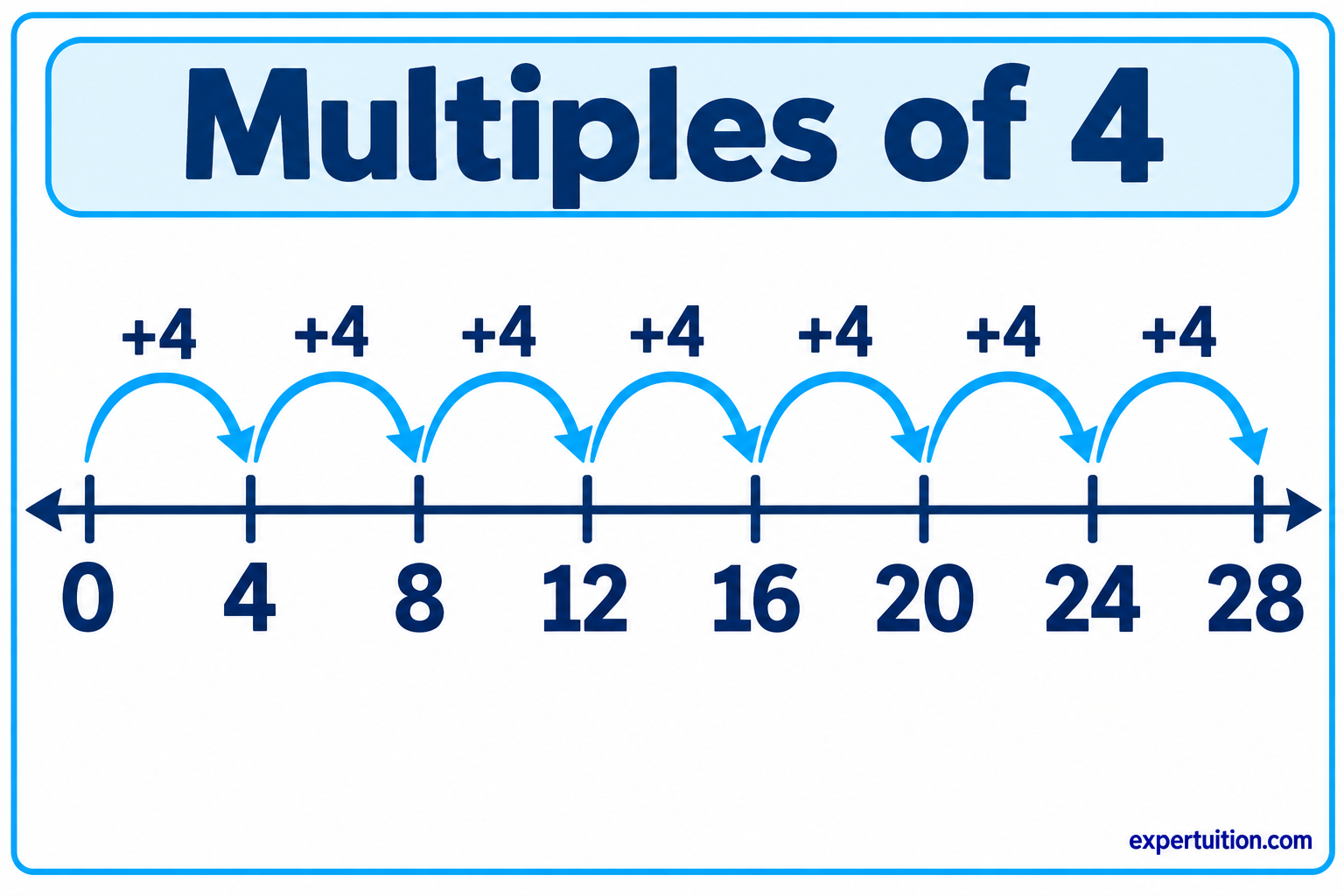
Unlike factors, multiples continue indefinitely. A positive whole number has a limited number of positive factors but infinitely many positive multiples.
How to Determine Whether a Number Is a Multiple of Another Number
A number is a multiple of another number when dividing it by that number produces a whole-number quotient with no remainder.
For example, is 42 a multiple of 6?
Divide 42 by 6:
42 ÷ 6 = 7
Because the quotient is a whole number and there is no remainder, 42 is a multiple of 6.
Now consider 43:
43 ÷ 6 = 7 remainder 1
Since the division leaves a remainder, 43 is not a multiple of 6.
Multiplication can also confirm the relationship. Since 6 × 7 = 42, 42 is a multiple of 6. However, no whole number multiplied by 6 produces 43.
The same reasoning works with other numbers:
- 35 is a multiple of 5 because 5 × 7 = 35.
- 48 is a multiple of 8 because 8 × 6 = 48.
- 50 is not a multiple of 6 because 50 ÷ 6 leaves a remainder of 2.
Both multiplication and division can determine whether one whole number is a multiple of another.
How Are Factors and Multiples Related?
Factors and multiples describe two sides of the same multiplication relationship. Factors are the numbers multiplied to produce a product, while multiples are the products obtained through multiplication.
Consider:
3 × 4 = 12
In this multiplication sentence:
- 3 and 4 are factors of 12.
- 12 is a multiple of 3 and 4.
The relationship works with other numbers as well. Since 5 × 6 = 30, both 5 and 6 are factors of 30, while 30 is a multiple of both numbers.
The main difference is what each concept describes.
| Factors | Multiples |
|---|---|
| Divide a given number evenly. | Are produced by multiplying a given number by whole numbers. |
| Form a limited set for a positive whole number. | Continue indefinitely. |
| Include 1 and the number itself. | Include the number itself among the positive multiples. |
| Example: Factors of 12 are 1, 2, 3, 4, 6, and 12. | Example: Positive multiples of 12 are 12, 24, 36, 48, and so on. |
For example, 4 is a factor of 20 because 20 ÷ 4 = 5. At the same time, 20 is a multiple of 4 because 4 × 5 = 20.
The numbers have not changed. Their descriptions depend on their relationship with each other.
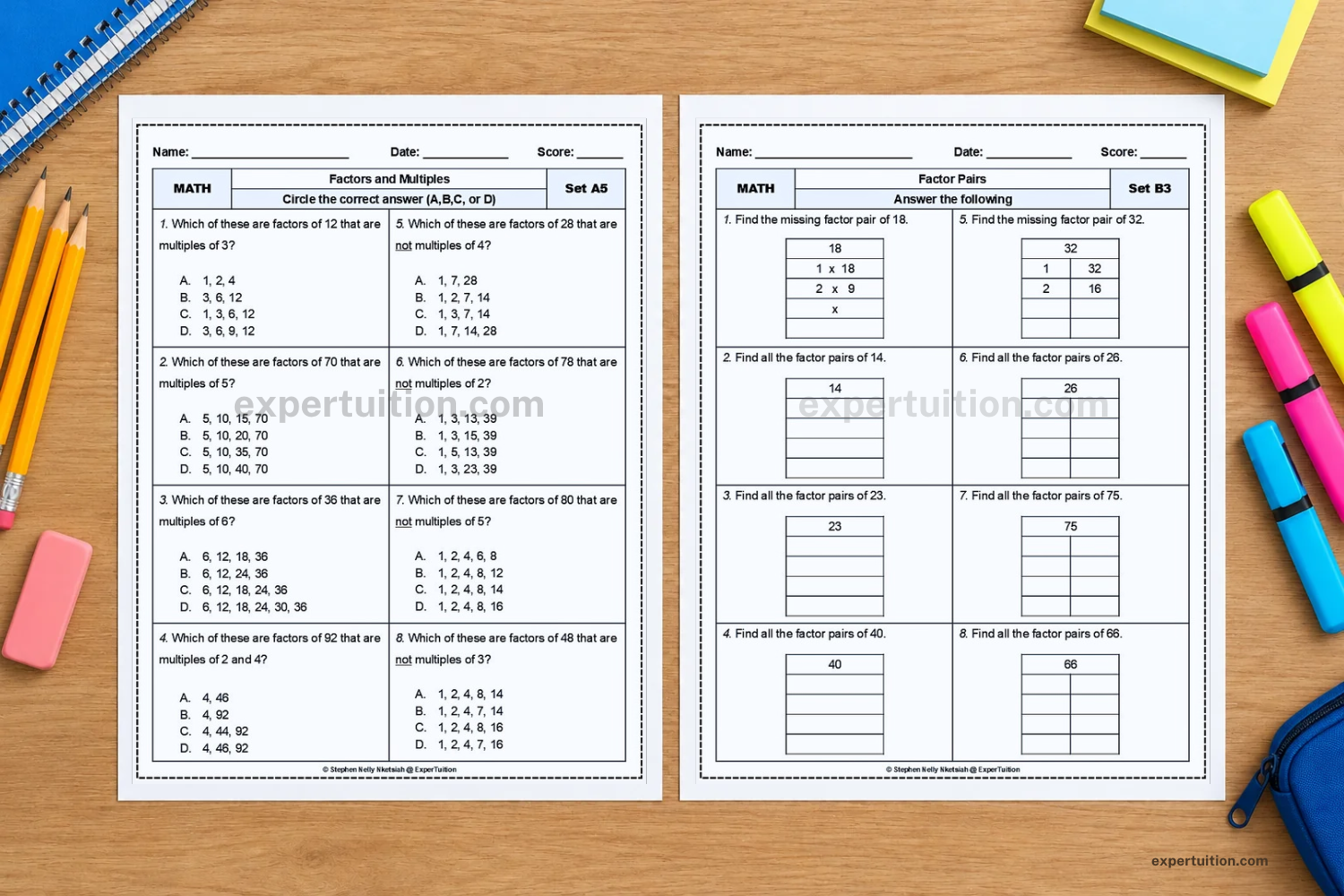
For additional practice finding factors and working with multiples, explore these Factors and Multiples Worksheets.
What Are Prime and Composite Numbers?
Prime and composite numbers are classifications of whole numbers greater than 1. To classify a number, examine how many positive factors it has. The following sections explain the two classifications and show examples of each.
What Are Prime Numbers?
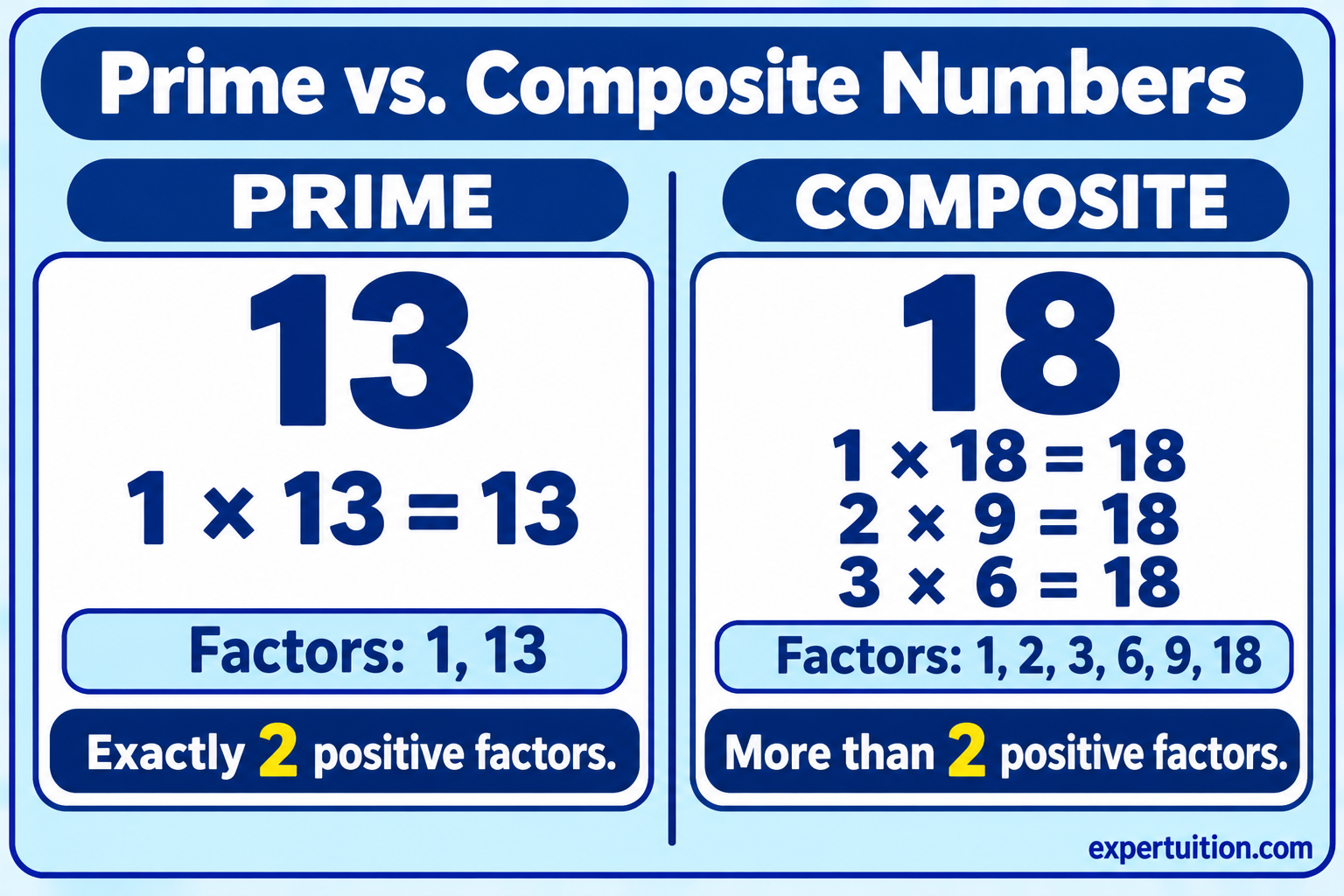
A prime number is a whole number greater than 1 that has exactly two positive factors: 1 and itself.
Consider these examples:
| Prime number | Factors |
|---|---|
| 2 | 1, 2 |
| 5 | 1, 5 |
| 7 | 1, 7 |
| 11 | 1, 11 |
| 13 | 1, 13 |
Each number has exactly two factors. There are no other whole numbers that divide any of them evenly.
For example, 13 is prime because its only positive factors are 1 and 13. No other whole number divides it evenly.
2 is the only even prime number. Every other even whole number greater than 2 is divisible by both 2 and itself, giving it more than two factors.
For instance, 10 has the factors 1, 2, 5, and 10. Therefore, it is composite rather than prime.
What Are Composite Numbers?
A composite number is a whole number greater than 1 that has more than two positive factors.
Unlike prime numbers, composite numbers have at least one factor besides 1 and the number itself.
Consider these examples:
| Composite number | Factors |
|---|---|
| 4 | 1, 2, 4 |
| 9 | 1, 3, 9 |
| 10 | 1, 2, 5, 10 |
| 12 | 1, 2, 3, 4, 6, 12 |
| 15 | 1, 3, 5, 15 |
Each number has more than two factors, which makes it composite.
For example, 9 has three factors: 1, 3, and 9. Since 3 divides 9 evenly, the number has an additional factor besides 1 and itself.
Composite numbers can be even or odd. Every even whole number greater than 2 is composite, but odd numbers can also be composite.
For example, 15 is odd, but it has four factors: 1, 3, 5, and 15. Therefore, it is composite.
Why Is 1 Neither Prime Nor Composite?
The number 1 is neither prime nor composite because it has exactly one positive factor: itself.
A prime number must have exactly two positive factors, while a composite number must have more than two. Since 1 has only one factor, it meets neither definition.
The number 0 is also neither prime nor composite. Prime and composite classifications apply only to whole numbers greater than 1.
This distinction matters because not every whole number is prime or composite.
How to Identify Prime and Composite Numbers
Identifying prime and composite numbers involves finding their factors and counting how many they have.
- Exactly two positive factors: Prime.
- More than two positive factors: Composite.
- Exactly one positive factor: Neither prime nor composite.
Factor pairs make this process easier because each pair reveals two factors. A number with only the pair (1, itself) is prime. A number with additional factor pairs is composite.
Identifying a Prime Number
Consider the number 17.
To determine whether it is prime or composite, look for its factor pairs.
The first factor pair is:
1 × 17 = 17
Next, check whether any whole number from 2 through 16 divides 17 evenly. None does.
Therefore, the only factors of 17 are 1 and 17.
Since 17 has exactly two positive factors, 17 is a prime number.
Identifying a Composite Number
Now consider 18.
Find its factor pairs:
- 1 × 18 = 18
- 2 × 9 = 18
- 3 × 6 = 18
These pairs give six different factors:
1, 2, 3, 6, 9, 18.
Since 18 has more than two positive factors, 18 is a composite number.
The same process works for any whole number greater than 1. Finding its factor pairs reveals whether it has only two factors or additional factors.
Recognizing Prime Numbers from 1 to 100
The prime numbers from 1 to 100 are:
2, 3, 5, 7, 11, 13, 17, 19, 23, 29, 31, 37, 41, 43, 47, 53, 59, 61, 67, 71, 73, 79, 83, 89, 97.
There are 25 prime numbers in this range.
A number chart can make these numbers easier to recognize. When examining the numbers from 1 to 100, remember that:
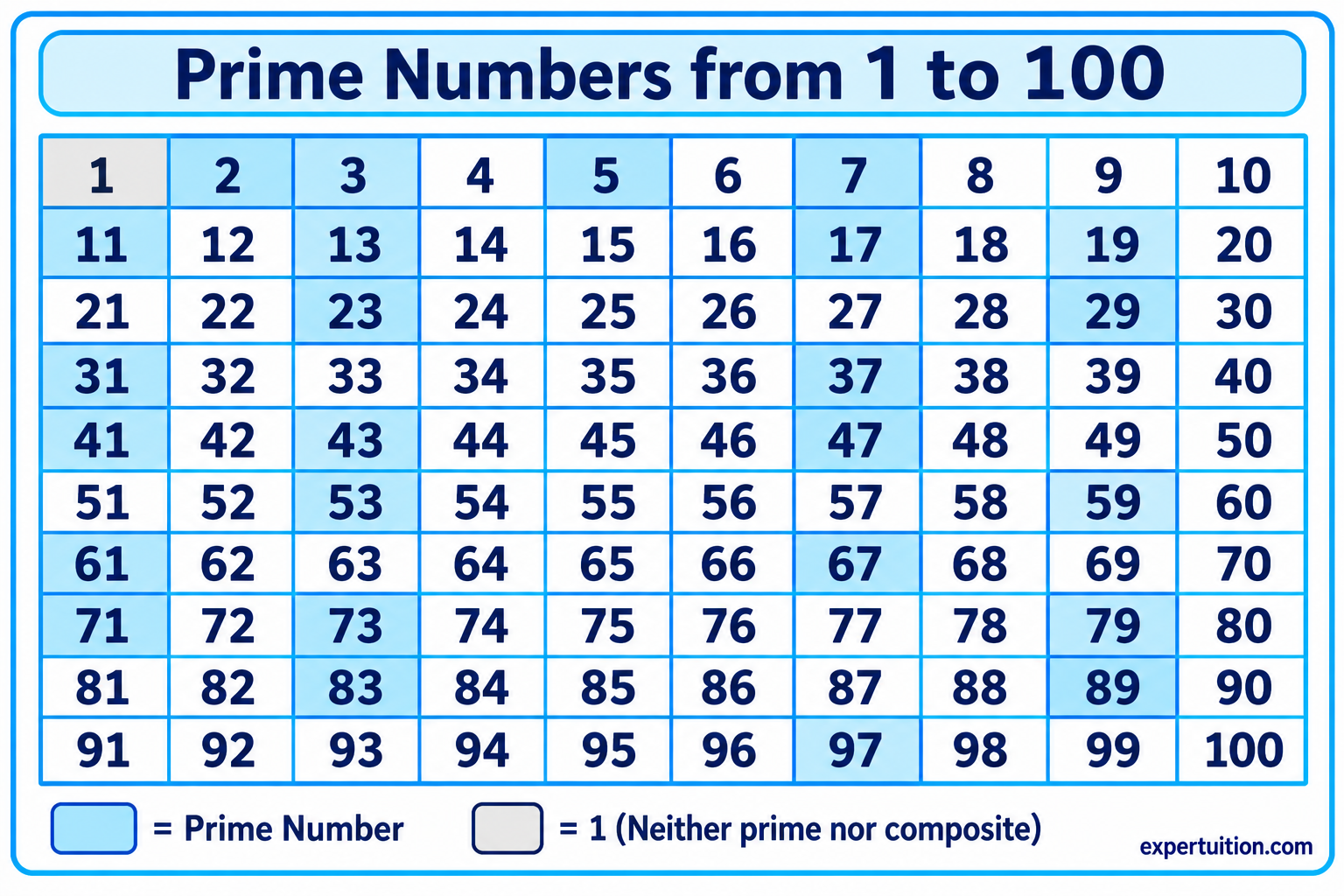
- 1 is neither prime nor composite.
- 2 is the only even prime number.
- Every other even number greater than 2 is composite.
- An odd number is not automatically prime. For example, 9, 15, 21, and 25 are composite because they have factors other than 1 and themselves.
The factors of a number provide the final test. A number is prime only when its complete factor list contains exactly two numbers: 1 and itself.
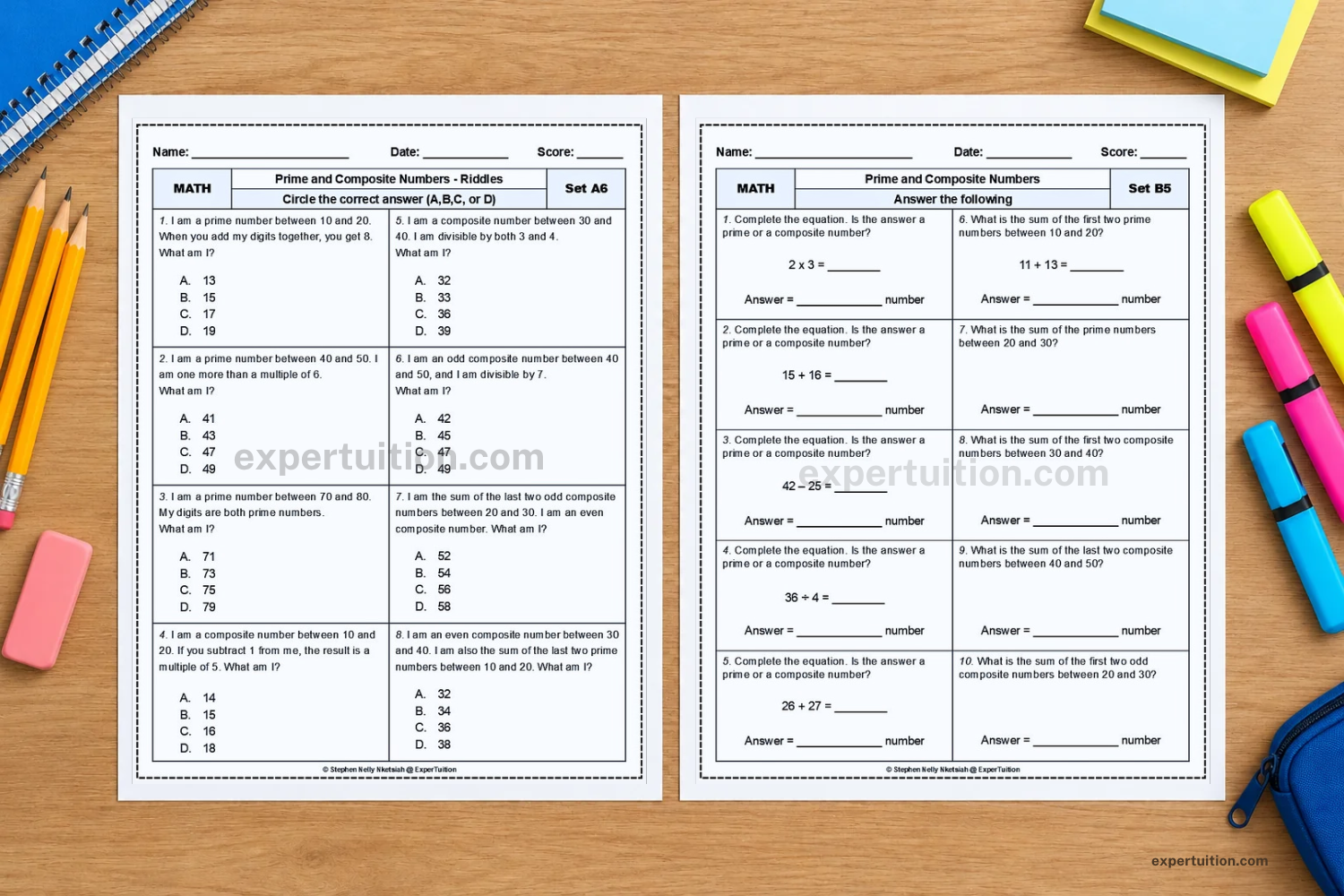
For practice in identifying and classifying these numbers, explore the Prime and Composite Numbers Worksheets.
How Factors, Multiples, Prime and Composite Numbers Fit Together
Factors, multiples, prime numbers, and composite numbers are connected through multiplication and division. Factors reveal how a number can be formed, multiples show the products of multiplication, and the number of factors determines whether a whole number is prime or composite.
Consider the number 12.
Factor pairs of 12:
- 1 × 12 = 12
- 2 × 6 = 12
- 3 × 4 = 12
Factors of 12: 1, 2, 3, 4, 6, 12.
Multiples of 12: 0, 12, 24, 36, 48, 60, and so on.
Classification: 12 is composite because it has more than two positive factors.
The same multiplication relationships explain why a number can be a factor of another number and why that other number is a multiple of it.
Prime and composite classification also depends on these factor relationships. A prime number has no factors other than 1 and itself, while a composite number has additional factors.
These relationships provide a foundation for other number concepts, including common factors and common multiples. When comparing two or more numbers, common factors are factors they share, while common multiples are multiples they have in common.
For more practice with these connected concepts, explore the Factors and Multiples resource collection and the Factors, Multiples, Prime and Composite Numbers Worksheets Bundle.
Understanding how factors, multiples, prime numbers, and composite numbers relate makes it easier to recognize number patterns and work with whole numbers. Each concept builds on the same multiplication and division relationships, providing a stronger foundation for more advanced Math.