Learn how to teach Math word problems in Grades 3–5 using a five-step problem-solving approach. Find practical teaching strategies and worked examples to help students understand problems, recognize mathematical relationships, choose appropriate operations, solve one-step and multi-step problems, and explain their reasoning.
Help Students Understand the Problem Before Solving It
Students often begin calculating as soon as they see numbers in a word problem. But choosing the right operation requires more than spotting numbers or familiar words. Students need to understand what is happening in the problem and what they are being asked to find before deciding how to solve it.
Once students understand a problem, they need to recognize the mathematical relationships, represent their thinking in different ways, and explain their reasoning. In Grades 3–5, develop these skills gradually, starting with one-step problems before introducing multi-step problems and giving students more responsibility for solving them independently.
Build Word-Problem Skills Across Grades 3–5
Students encounter different levels of mathematical complexity in word problems as they progress through Grades 3–5.
Third graders solve one-step and two-step problems involving the four operations with whole numbers.
By Grade 4, students continue solving one-step and multi-step problems, including those involving multi-digit whole-number calculations, multiplicative comparisons, measurement conversions, and fractions.
The focus shifts further in Grade 5 to word problems involving addition and subtraction of fractions with unlike denominators, multiplication of fractions, division involving unit fractions and whole numbers, and operations with decimals to hundredths.
Teach Students a Five-Step Approach to Solving Word Problems
Before students begin calculating, they need a clear process for understanding and solving word problems. Teach them to follow five steps: understand the problem, identify the information, plan the solution, solve the problem, and check and answer.
Step 1: Understand the Problem
Model how to read a problem carefully and explain the situation in their own words. Students should understand what is happening before deciding which operation to use.
For example:
A school library has 125 storybooks. The librarian receives 48 more books. How many storybooks does the library have now?
Ask students:
- What is happening in the problem?
- What information are we given?
- What do we need to find?
- What happens to the number of books?
Students should recognize that the library already has 125 books and receives 48 additional books.
Retelling the problem helps students focus on the situation rather than immediately searching for numbers or operation clues.
Step 2: Identify the Information
Teach students to distinguish between the information provided and the quantity they need to find. They should also recognize that not every number in a word problem is necessarily needed to solve it.
Students can organize the information using a simple table, notes, or a diagram.
For the library problem:
| Information | Quantity |
|---|---|
| Books already in the library | 125 |
| Additional books received | 48 |
| Total books | Unknown |
This makes the relationship between the quantities easier to understand.
Consider another example:
A school has 8 classrooms with 24 students in each classroom. The school also has 12 teachers. How many students are there altogether?
The number of teachers is not needed to solve the problem.
Ask students to explain why certain information is relevant and why other details can be ignored. This develops their ability to interpret problems instead of automatically using every number.
Step 3: Plan the Solution
Before calculating, students should consider what the problem requires them to find and how the quantities are related.
Teach them to:
- Determine what needs to be calculated.
- Recognize the mathematical relationships between the quantities.
- Choose the appropriate operation or combination of operations.
- Decide whether a drawing, diagram, table, or equation would help.
Understanding the mathematical relationship is essential when choosing an operation. Students should consider the entire situation rather than rely on individual words as clues.
Step 4: Solve the Problem
Once students have a plan, they can carry out the calculations.
Encourage them to:
- Follow the planned order of operations.
- Show their calculations clearly.
- Keep track of intermediate answers when solving multi-step problems.
- Include the appropriate units.
For multi-step problems, students should understand what each calculation represents and how its result helps them complete the solution.
Step 5: Check and Answer
After calculating, students should check their work and make sure their answer addresses the original question.
Teach them to:
- Check their calculations.
- Consider whether the answer is reasonable.
- Use estimation or an inverse operation where appropriate.
- State the answer clearly in the context of the problem.
Checking helps students recognize calculation errors and identify answers that do not make sense in the original situation.
Teach Students to Recognize Mathematical Relationships
One of the most important skills in word-problem instruction is recognizing the relationship between quantities.
Students should understand what is happening mathematically before deciding which operation to use. Avoid teaching them to associate individual keywords with specific operations. Words such as more, less, each, and left can appear in different mathematical situations.
Instead, teach the structures behind the problems.
Addition and Subtraction Situations
Addition and subtraction problems may involve combining quantities, separating amounts, finding differences, or determining an unknown starting or remaining quantity.
Consider these examples:
Combining quantities
A classroom has 126 fiction books and 84 nonfiction books. How many books are there altogether?
Students combine two known quantities:
126 + 84 = 210
Finding a difference
A school collected 350 cans for a food drive. Another school collected 275 cans. How many more cans did the first school collect?
Students compare the two quantities:
350 − 275 = 75
Finding an unknown starting amount
A library had some books. After receiving 45 more, it had 180 books. How many books did it have before?
Students work backward from the final amount:
180 − 45 = 135
These examples show that the same operation can be used in different problem situations and that the position of the unknown quantity matters.
Multiplication and Division Situations
Multiplication and division problems often involve equal groups, arrays, comparisons, and equal sharing.
Consider these examples:
Equal groups
A teacher arranges 8 tables with 6 students at each table. How many students are seated altogether?
8 × 6 = 48
Equal sharing
A teacher distributes 48 pencils equally among 8 classrooms. How many pencils does each classroom receive?
48 ÷ 8 = 6
Finding the number of groups
A teacher has 48 pencils and places 6 pencils in each container. How many containers are needed?
48 ÷ 6 = 8
Students should recognize the difference between finding the number in each group and finding the number of groups.
Use Comparison Problems to Develop Reasoning
Comparison problems can be particularly challenging because students must understand how two quantities relate.
For example:
Liam has 24 stickers. Mia has 3 times as many stickers as Liam. How many stickers does Mia have?
Students need to understand that Mia’s amount consists of three groups of 24.
3 × 24 = 72
Now consider:
Mia has 72 stickers, which is 3 times as many as Liam has. How many stickers does Liam have?
The relationship is the same, but the unknown quantity has changed.
72 ÷ 3 = 24
Discussing problems with different unknown quantities helps students develop a deeper understanding of mathematical relationships.
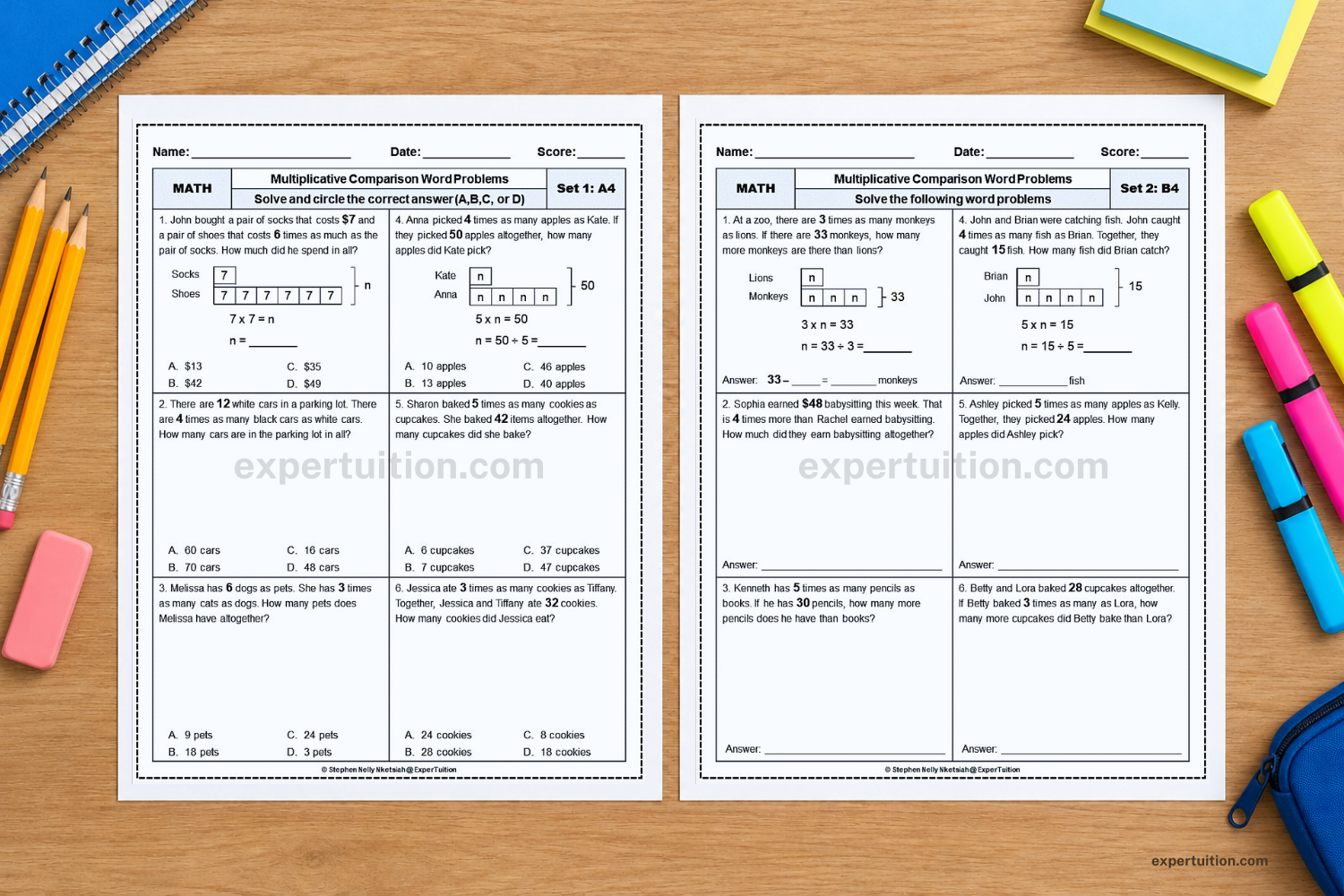
For additional practice, explore the Multiplicative Comparison Problems collection. It includes worksheets and task cards covering different unknown quantities in multiplicative comparison problems.
Model How to Solve One-Step and Multi-Step Word Problems
Students need to see how mathematical reasoning leads to a solution. Model the thinking process explicitly, explaining why each operation is appropriate.
Teach One-Step Word Problems First
A one-step word problem requires one operation to find the answer.
Problem: A school purchases 7 boxes of pencils. Each box contains 36 pencils. How many pencils does the school purchase altogether?
Understand the Problem: We need to find the total number of pencils in the 7 boxes.
Identify the Information:
- Number of boxes: 7
- Pencils in each box: 36
- Total number of pencils: Unknown
Plan the Solution: There are 7 equal groups of 36 pencils. We can multiply to find the total.
Solve the Problem:
7 × 36 = 252
Check and Answer: Divide the total number of pencils by the number of boxes to check the result.
252 ÷ 7 = 36
The calculation confirms that each box contains 36 pencils.
Answer: The school purchases 252 pencils altogether.
Use think-alouds to explain these decisions. Rather than simply announcing the operation, describe how the information in the problem leads to it.
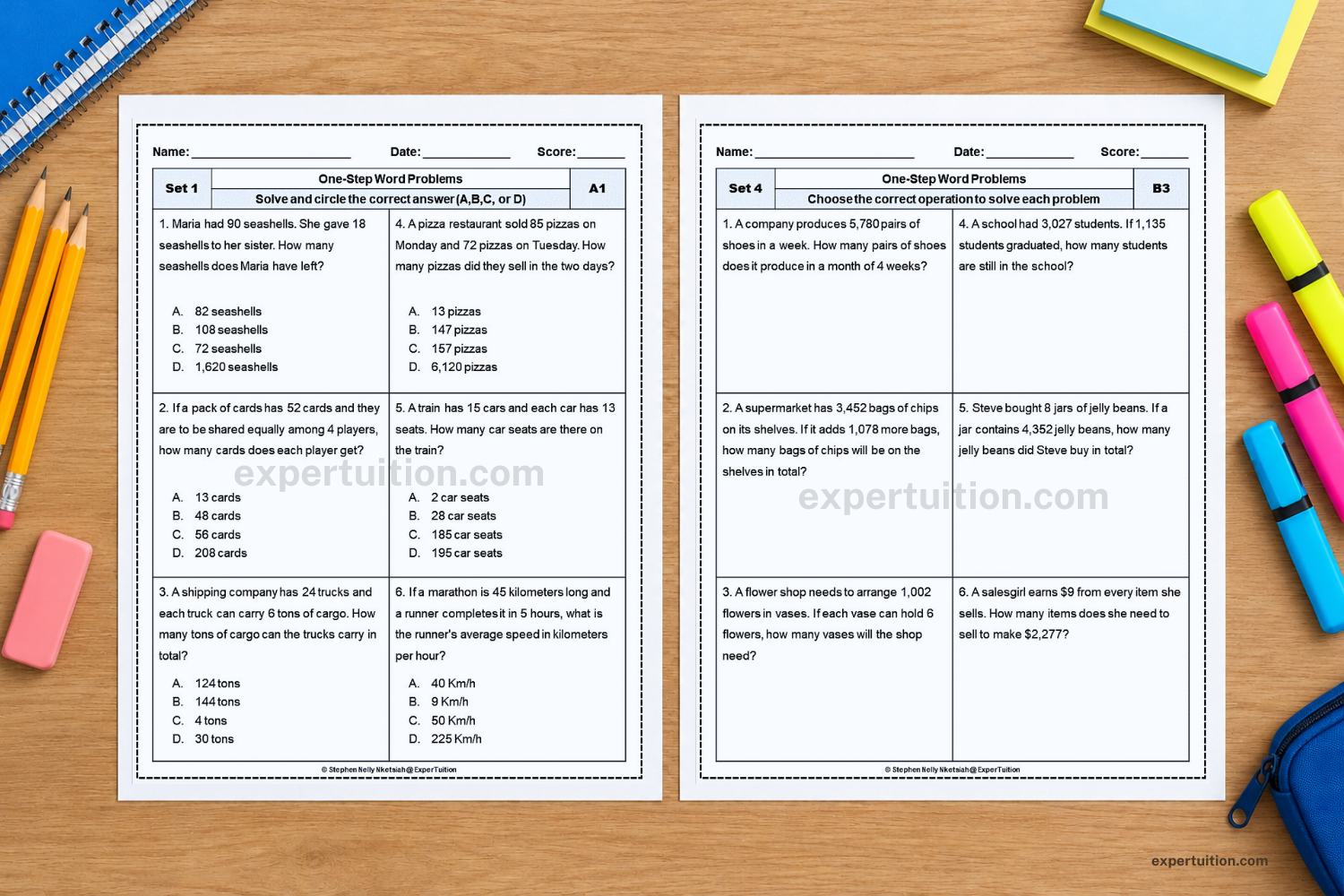
For additional practice covering all four operations, browse the One-Step Word Problems collection. It includes worksheets and task cards for different one-step problem types.
Progress to Multi-Step Word Problems
Once students can interpret and solve different types of one-step problems, introduce problems that require more than one calculation.
Problem: A school purchases 8 boxes of pencils. Each box contains 24 pencils. The teachers distribute 135 pencils to students. How many pencils remain?
Understand the Problem: We need to find how many pencils remain after the teachers distribute 135 pencils.
Identify the Information:
- Number of boxes: 8
- Pencils in each box: 24
- Pencils distributed: 135
- Pencils remaining: Unknown
Plan the Solution: First, multiply to find the total number of pencils purchased. Then subtract the number distributed to find how many remain.
Solve the Problem:
Find the total number of pencils:
8 × 24 = 192
Subtract the number distributed:
192 − 135 = 57
Check and Answer: The school purchased 192 pencils and distributed 135. Adding the 57 remaining pencils to the 135 distributed pencils gives the original total.
135 + 57 = 192
Answer: 57 pencils remain.
Students should understand why multiplication comes first and subtraction follows. The sequence comes from the events and relationships in the problem, not from a rule that multiplication must always precede subtraction.
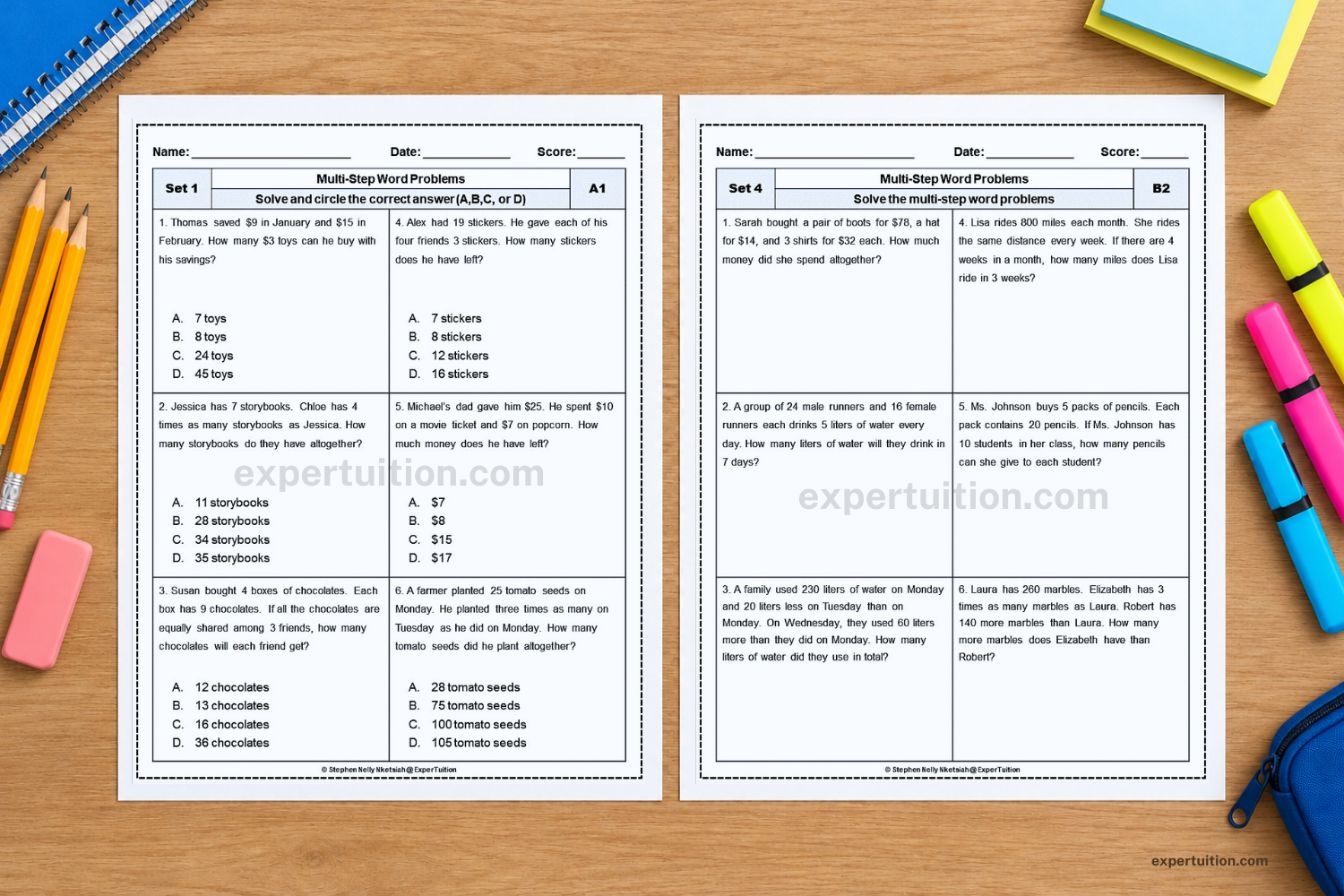
For additional practice, explore the Multi-Step Word Problems Worksheets & Task Cards Bundle or browse the Multi-Step Word Problems collection for individual worksheets, task cards, and bundles.
Teach Students to Connect the Steps
A common difficulty with multi-step problems is knowing how one calculation leads to the next.
Encourage students to explain what each intermediate answer represents and how it helps them answer the original question. After completing a calculation, ask:
- What does this result tell us?
- How does it help us solve the problem?
- What do we still need to find?
Students can use equations, written explanations, or diagrams to show these connections.
Gradually introduce problems involving different combinations of operations, including problems where students must work backward or consider more than one possible solution approach.
Use Visual Models to Develop Understanding
Visual representations help students organize information and understand relationships that may be difficult to interpret from words alone.
The goal is not to make students draw something for every problem. It is to help them choose a representation that makes the mathematical situation clearer.
Drawings and Diagrams
Simple drawings can help students visualize quantities, groups, and changes.
For example, when solving a problem involving 4 groups of 6, students can draw four groups and place six objects in each group.
This is particularly useful when introducing multiplication and division situations or helping students understand unfamiliar problem structures.
Bar Models
Bar models help students represent relationships between quantities. They are particularly useful for comparison problems, part-whole relationships, and multi-step problems.
For example:
A school has 120 boys and 95 girls. How many more boys than girls are there?
Students can represent the two quantities using bars of different lengths and identify the difference.
The model makes it clear that subtraction is needed to find the difference between the quantities. Bar models can also help students identify unknown quantities and organize the steps in more complex problems.
Number Lines
Number lines help students visualize addition, subtraction, and the relationships between numbers.
For example:
An athlete has completed 275 meters of a 500-meter race. How many meters remain?
Students can identify the distance from 275 to 500.
This representation supports mental strategies and helps students understand subtraction as finding the distance between two quantities.
Tables and Equations
Tables help students organize information when a problem involves repeated groups, patterns, or several related quantities. Equations provide a concise way to represent mathematical relationships.
For example:
A store packs 6 oranges in each bag. How many oranges are needed to fill 9 bags?
Students can organize the information in a table or write:
9 × 6 = 54
Encourage students to connect their representations to the original problem. A diagram or equation is most useful when students can explain what its numbers and parts represent.
Scaffold Instruction, Differentiate, and Assess Student Progress
Students need support when learning new problem-solving strategies, but the goal is to help them become increasingly independent. Use a gradual progression from teacher modeling to independent practice, adjusting the level of support to students’ needs.
Provide Guided Practice
After modeling, work through similar problems with students. Ask questions that encourage them to explain their thinking:
- What is happening in this problem?
- Which quantities are related?
- What do we need to find?
- How could we represent the situation?
- Why is this operation appropriate?
Allow students to suggest different approaches and explain their choices.
Adjust Support to Students’ Needs
Students do not all develop word-problem-solving skills at the same pace. Some may need help interpreting problems, while others are ready for more challenging situations.
For students who need additional support:
- Begin with shorter problems that contain familiar vocabulary.
- Read problems aloud when reading difficulties make it harder for students to understand the problem.
- Introduce unfamiliar terms before presenting a problem.
- Use drawings, diagrams, and bar models to make relationships visible.
- Provide prompts that help students identify known and unknown quantities.
- Allow students to explain their reasoning verbally before writing equations.
As students become more confident, gradually remove these supports.
You can also adjust the numerical complexity. Begin with numbers that allow students to focus on understanding the problem structure before introducing more demanding calculations.
For example, start with:
There are 4 boxes with 6 books in each box. How many books are there altogether?
Then increase the numerical complexity while keeping the underlying relationship familiar. This helps distinguish difficulties with computation from difficulties with interpreting the problem.
For students who are ready for greater challenges, try:
- Presenting problems with missing information and asking what else they need to know.
- Asking students to create word problems from given equations.
- Providing problems with extra information that must be evaluated.
- Asking students to solve the same problem using different methods.
- Introducing multi-step problems with less familiar situations.
- Asking students to explain whether another student’s solution is correct.
Gradually Build Independent Problem Solvers
A useful progression is:
- Teacher modeling: Demonstrate how to understand, represent, and solve a problem.
- Guided practice: Solve problems together, discussing each decision.
- Partner practice: Have students work together and explain their reasoning.
- Independent practice: Give students opportunities to solve problems without step-by-step assistance.
Encourage students to use different solution methods. One student might use a bar model, while another writes an equation or uses a number line. Comparing these approaches helps students understand that problem-solving does not always require one fixed procedure.
Assess Understanding During Instruction
Assessment does not need to be a separate activity after every lesson. Observe students during discussions, guided practice, partner work, and independent assignments.
Look for evidence that they can:
- Explain what a problem describes.
- Identify relevant and irrelevant information.
- Recognize the mathematical relationship.
- Select an appropriate operation.
- Represent the situation using a model or equation.
- Complete all necessary steps.
- Explain and check their answers.
Use exit tickets, classroom discussions, and short assessments to identify areas that need further instruction.
When a student makes an error, examine the reasoning behind it. A calculation mistake requires a different response from misunderstanding the problem structure. Include unfamiliar problem types in assessments to see whether students can apply their understanding beyond problems they have practiced repeatedly.
Address Common Word-Problem Mistakes
Mistakes provide useful information about what students understand and where they need additional instruction. Rather than simply correcting an incorrect answer, ask students to explain how they approached the problem.
Choosing Operations Based on Keywords
Students may assume that words such as altogether, more, left, or each always indicate a particular operation. However, these words do not determine the operation on their own.
For example:
John has 45 marbles. He has 12 more marbles than Peter. How many marbles does Peter have?
Although the problem contains the word more, students need to subtract:
45 − 12 = 33
Teach students to focus on the relationship between quantities instead of relying on isolated words.
Solving Only Part of a Multi-Step Problem
A student may correctly calculate the total number of items but forget to subtract the number used or distributed.
Encourage students to return to the original question after each calculation. Ask: Does this answer solve the problem, or does another step remain?
Ignoring Whether an Answer Makes Sense
Students should develop the habit of checking their answers against the original situation.
Ask them to estimate, use the inverse operation where appropriate, or explain why the answer is reasonable. The answer should make sense in the context of the problem, not just in the calculation.
Provide Meaningful Word-Problem Practice
Students need regular opportunities to apply what they learn. Practice should reinforce understanding rather than encourage students to memorize procedures.
Use Mixed Word Problems
After teaching individual problem types, introduce mixed practice.
Include addition, subtraction, multiplication, division, and multi-step problems in the same activity. Students must identify the mathematical relationship and decide how to solve each problem rather than relying on a section heading or the order in which problems appear.
For additional practice, see my One-Step Word Problems collection, which includes worksheets with problems involving all four operations and requires students to choose the appropriate operation for each problem. My Multi-Step Word Problems collection includes worksheets with problems involving all six possible combinations of two operations.
Incorporate Worksheets and Task Cards
Worksheets provide opportunities for independent practice, while task cards allow students to work through problems in small groups, at Math centers, or during partner activities.
Choose resources that include different problem structures and levels of difficulty. Open-ended questions are particularly useful because students must show their work and explain their reasoning rather than simply select an answer.
For practice covering both one-step and multi-step problems, explore the One-Step & Multi-Step Word Problems Worksheets & Task Cards Bundle. The bundle includes 8 worksheet products and 8 task-card products, with 64 worksheet pages and 384 task cards.
If you prefer worksheets without task cards, choose the One-Step & Multi-Step Word Problems Worksheets Bundle, which contains 64 worksheets covering both types of problems.
For a wider selection of practice materials, browse the Word Problems collection, which includes one-step, multi-step, comparison, measurement, and themed word-problem resources.
Use Themed Problems to Maintain Variety
Familiar contexts can make word problems more accessible and provide opportunities to apply Math skills in different situations.
For example, students might solve problems involving classroom supplies, sports, shopping, seasonal activities, or school events. The context should support the mathematical objective rather than distract from it.
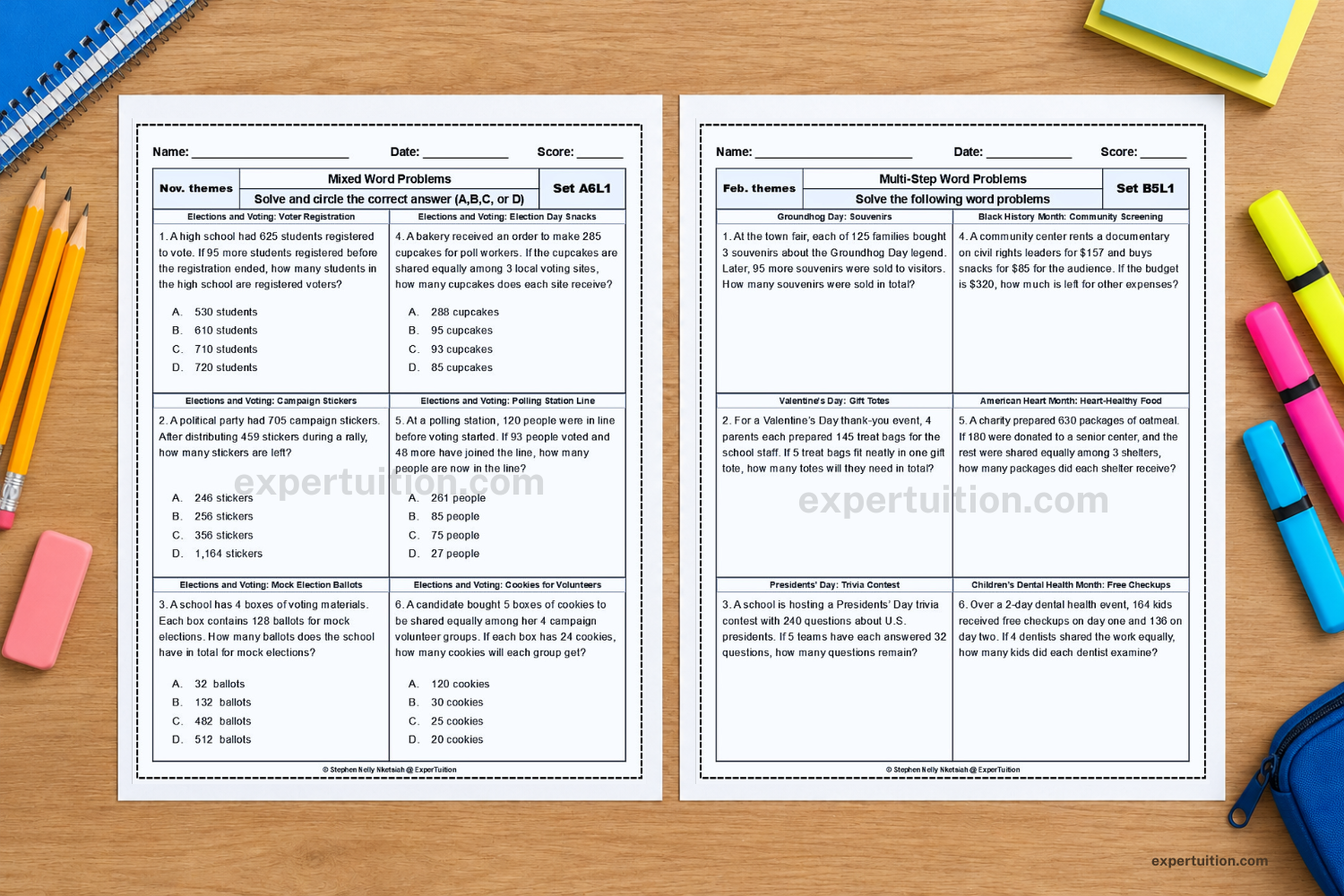
The Monthly-Themed Word Problems collection offers worksheets and task cards with different monthly themes. These resources include one-step and multi-step problems involving all four operations.
Help Students Become Confident Word-Problem Solvers
Teaching word problems starts with helping students understand what a problem describes before deciding how to solve it. They need opportunities to recognize mathematical relationships, choose a suitable approach, and explain their reasoning.
Give students time to work through different types of problems. Begin with one-step problems, introduce multi-step problems as their understanding develops, and encourage them to explain the decisions they make along the way.
The aim is for students to do more than identify an operation and calculate an answer. They should be able to explain why their approach works and use what they have learned when they encounter a problem they have not seen before.