Learn how to teach division in Grades 4–5 using partial quotients, area model division, traditional long division, and the box method. Compare how the four strategies work and connect, see when to use each one, and find practical ways to help students work through difficulties with place value, multiples, and remainders.
Helping Students Make Sense of Division
Teaching multi-digit division involves more than showing students a sequence of steps. Students need to understand what division represents, how multiplication and subtraction help them solve problems, and why different strategies can produce the same quotient.
In Grades 4–5, students use strategies such as partial quotients, area model division, traditional long division, and the box method to solve multi-digit problems. Although these methods organize the calculations differently, they rely on the same mathematical ideas, including multiplication, subtraction, and place value.
Grade 4 students divide up to four-digit numbers by one-digit divisors. In Grade 5, they extend this work to two-digit divisors. Understanding how the strategies work and connect helps teachers guide students beyond memorizing procedures.
Four Division Strategies and What They Help Students Understand
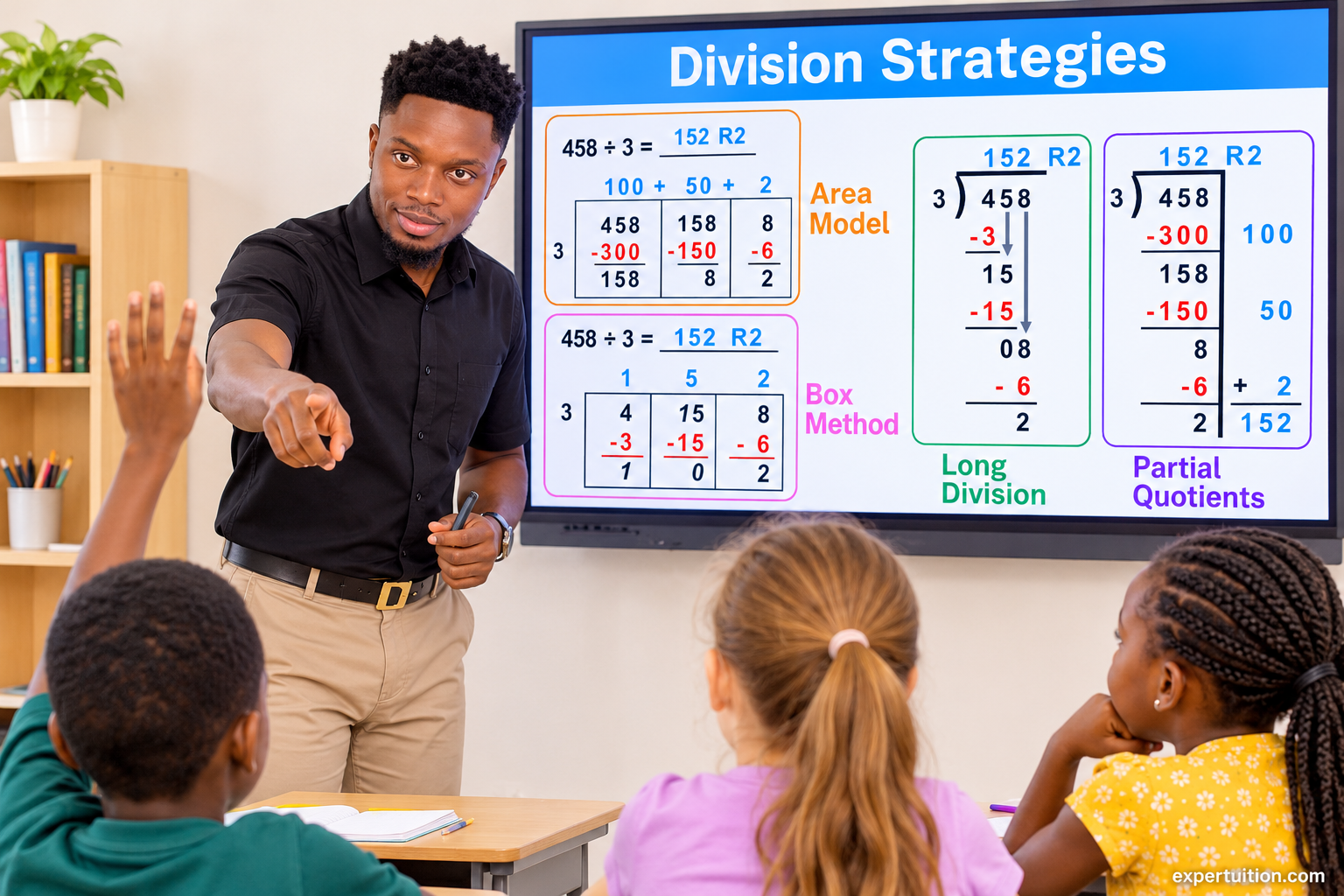
The following examples use the same problem, 458 ÷ 3, to show how each strategy organizes the calculation. Each method gives a quotient of 152 with a remainder of 2, but the written work looks different.
Partial quotients
The partial quotients method involves subtracting convenient multiples of the divisor from the dividend while recording the corresponding partial quotients. Students build the quotient in parts, then add those parts to find the final quotient.
For 458 ÷ 3, students might use these multiples:
- 3 × 100 = 300; 458 − 300 = 158
- 3 × 50 = 150; 158 − 150 = 8
- 3 × 2 = 6; 8 − 6 = 2
They add the partial quotients:
100 + 50 + 2 = 152
The remainder is 2, so the answer is 152 R 2.
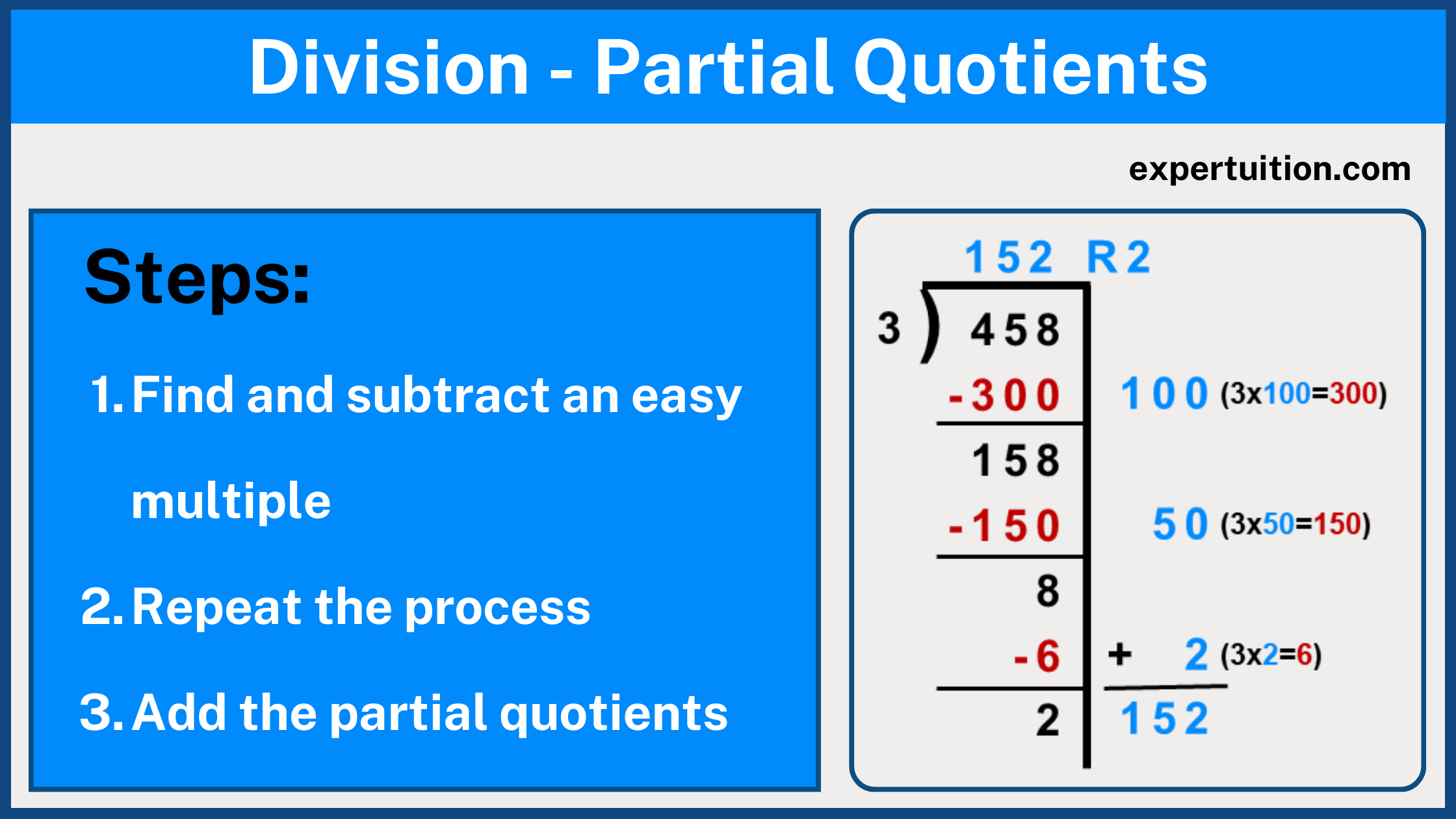
Students can choose different convenient multiples, provided each multiple does not exceed the amount remaining at that stage. This strategy helps them connect multiplication with division and develop flexibility when working with multiples. They can also see how the amounts they subtract contribute to the final quotient.
For a fuller explanation and more worked examples, see Partial Quotients Division: How It Works. The partial quotients division worksheet collection includes additional practice with this strategy.
Area model division
Area model division uses a rectangle divided into columns to organize the calculation. Students write the divisor to the left of the rectangle. Inside each column, they record the current amount being divided. Above the amount, they write a partial quotient, and beneath it, they record the product to subtract. The difference becomes the amount for the next column.
For 458 ÷ 3, students can use the same multiples as in the partial-quotients example:
- First column: Record 458, a partial quotient of 100, and a product of 300. Subtract 300, leaving 158.
- Second column: Record 158, a partial quotient of 50, and a product of 150. Subtract 150, leaving 8.
- Third column: Record 8, a partial quotient of 2, and a product of 6. Subtract 6, leaving 2.
The partial quotients are:
100 + 50 + 2 = 152
The answer is 152 R 2.

The rectangular layout makes the current amount, partial quotient, product, and difference visible in each column. Students can follow how the amount remaining changes and how each partial quotient contributes to the final answer. It also helps them see how multiplication and subtraction work together at each stage of division.
For a fuller explanation and worked examples, see Area Model Division: How It Works as a Visual Division Method. The area model division worksheet collection provides additional practice with this visual approach.
Traditional long division
Traditional long division organizes the calculation using a repeated sequence of divide, multiply, subtract, and bring down. Students work through the dividend one digit at a time, recording each quotient digit above the calculation.
For 458 ÷ 3, students follow these steps:
- 4 ÷ 3 = 1, with 1 remaining.
- Bring down 5 to make 15. 15 ÷ 3 = 5, with 0 remaining.
- Bring down 8. 8 ÷ 3 = 2, with 2 remaining.
The quotient is 152 R 2.

This method gives students a compact written procedure for multi-digit division. Its consistent layout helps them organize each stage of the calculation and see how the quotient is built through the repeated steps.
For a step-by-step explanation and worked examples, see The Traditional Long Division Method: How It Works Step by Step. The long division worksheet collection offers additional practice with the traditional written method.
Box method division
The box method combines the rectangular layout of area model division with the calculation steps of traditional long division. Students organize the dividend into columns and work through each column using divide, multiply, subtract, and bring up.
For 458 ÷ 3, students follow these steps:
- 4 ÷ 3 = 1, with 1 remaining.
- Bring up the remainder and place it in front of 5 to make 15. 15 ÷ 3 = 5, with 0 remaining.
- Bring up the remainder 0 and place it in front of 8 to make 08, which is still 8. 8 ÷ 3 = 2, with 2 remaining.
The quotient is 152 R 2.
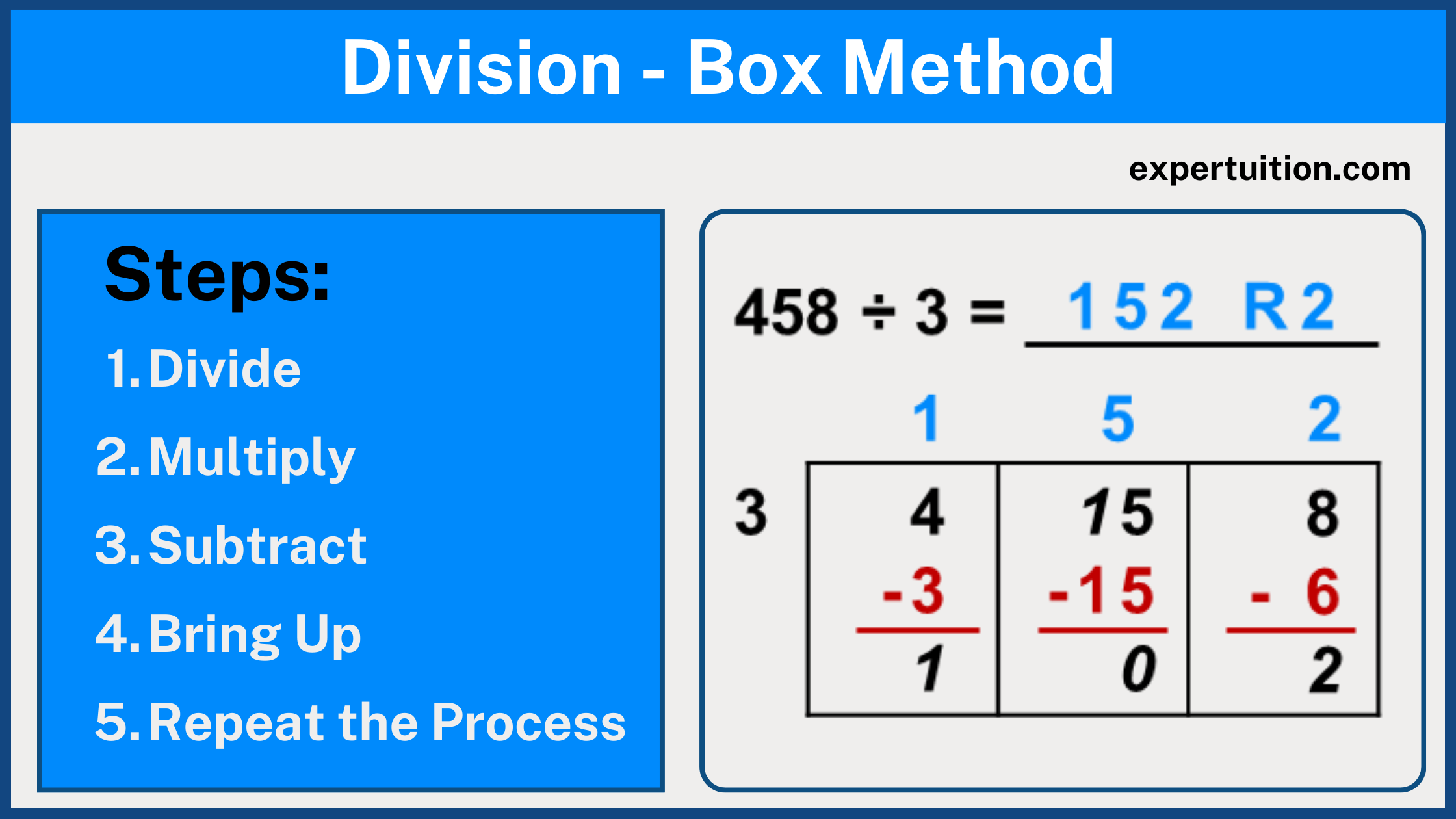
The rectangular columns help students keep each stage of the calculation organized and see how the remainder becomes part of the next amount to divide.
For a fuller explanation and worked examples, see Box Method Division: How It Works as a Visual Approach to Long Division. The box method division worksheet collection includes additional practice with this approach.
How the Four Division Strategies Are Connected
Although the four strategies use different layouts, they rely on the same mathematical relationships. Students use multiplication to identify groups of the divisor, subtraction to find what remains, and place value to keep quotient digits in their correct positions.
| Strategy | How students build the quotient | How it connects to the other strategies |
|---|---|---|
| Partial quotients | Subtract manageable multiples of the divisor and add the corresponding partial quotients. | Shares the use of multiples, subtraction, and partial quotients with area model division. |
| Area model | Record the current amount, partial quotient, product, and difference in successive rectangular columns. | Uses the same multiples and subtraction process as partial quotients, but organizes the calculations in rectangular columns. |
| Traditional long division | Divide one place-value amount at a time, bringing down the next dividend digit beside the current remainder. | Shares the divide, multiply, and subtract sequence with the box method, but brings down the next dividend digit rather than bringing up the remainder. |
| Box method | Work through place-value columns by dividing, multiplying, subtracting, and bringing up the remainder. | Combines the rectangular column layout of area model division with the divide, multiply, and subtract procedure used in traditional long division. |
How the Strategies Use the Same Mathematical Ideas
Two connections are particularly useful when comparing these strategies.
Partial quotients and area model division both involve subtracting multiples of the divisor and adding the corresponding partial quotients. Their main difference is the layout: the partial quotients method uses a subtraction format, with the partial quotients recorded to the right, while area model division organizes the amounts and calculations in rectangular columns.

Traditional long division and the box method both use divide, multiply, and subtract, but they organize the remainder differently.
In 458 ÷ 3, dividing 4 hundreds by 3 leaves 1 hundred. That hundred is regrouped as 10 tens.
In traditional long division, students bring down the 5 tens beside the remainder to make 15 tens. In the box method, they bring the remainder up into the tens column and combine it with the 5 tens to make 15 tens.
Both methods represent the same place-value calculation, but their written layouts show the process differently. Comparing them helps students recognize how different written procedures can represent the same mathematical relationships.
How to Choose and Teach a Division Strategy
The strategy you introduce should match what students need to understand and the level of support they need. Rather than presenting all four methods as unrelated procedures, connect each one to the mathematical ideas students are learning.
Use visual models to build understanding
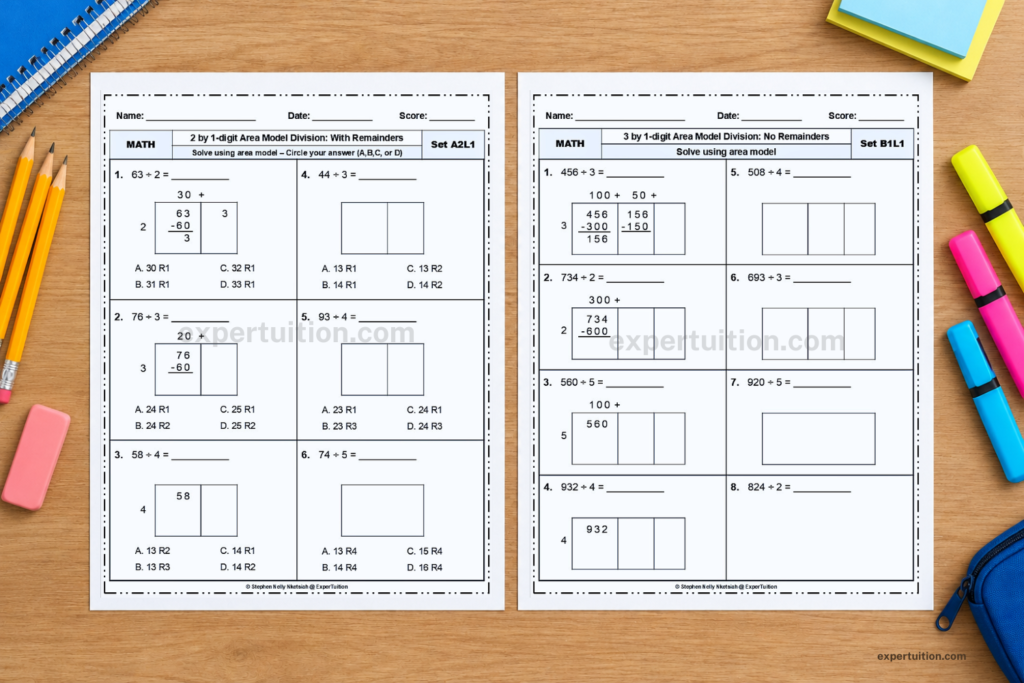
Introduce area model division when students need to see how the current amount, product, and difference relate to one another. The rectangular columns give them a visual structure for organizing the calculation.
Ask students to explain what each column shows and how the amount remaining changes. This helps them connect multiplication and subtraction to the division process.
Use partial quotients to develop flexible thinking
Use partial quotients when students need opportunities to work with multiples in different ways. They can subtract larger or smaller convenient multiples and combine the partial quotients to find the quotient.
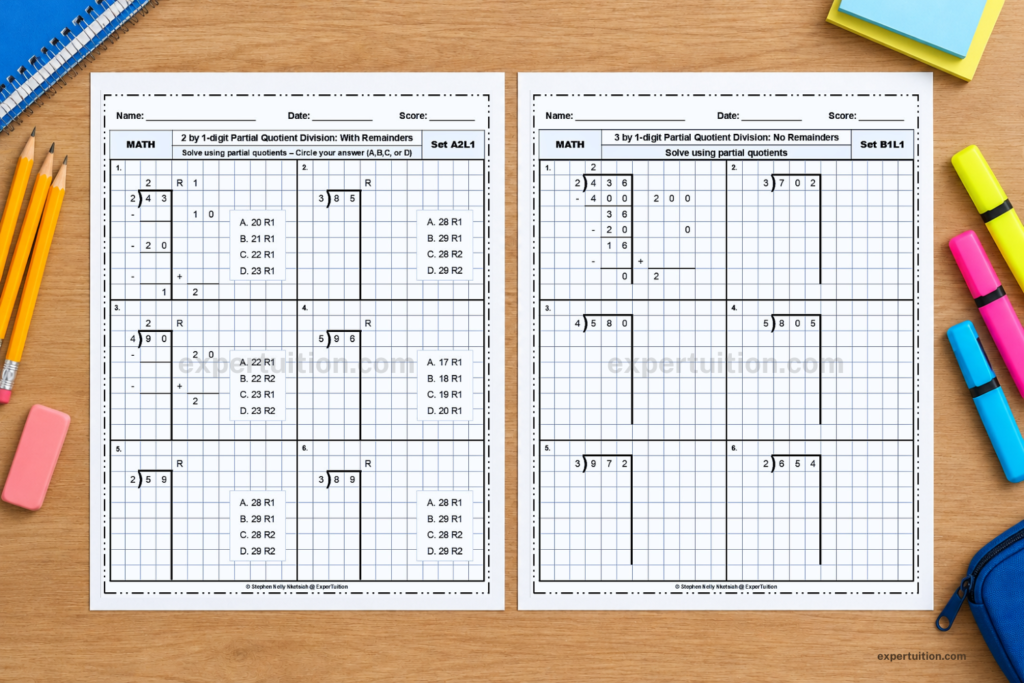
Ask students why they chose particular multiples and whether another combination would also work. Their explanations help reveal how well they understand the relationship between multiplication and division.
Use structured layouts to organize calculations
Traditional long division and the box method give students structured ways to record multi-digit division. Both involve dividing, multiplying, and subtracting, but their layouts handle the remainder differently.
When teaching these methods, focus on place value. Students should be able to explain why they bring down the next digit in traditional long division or bring up the remainder in the box method.
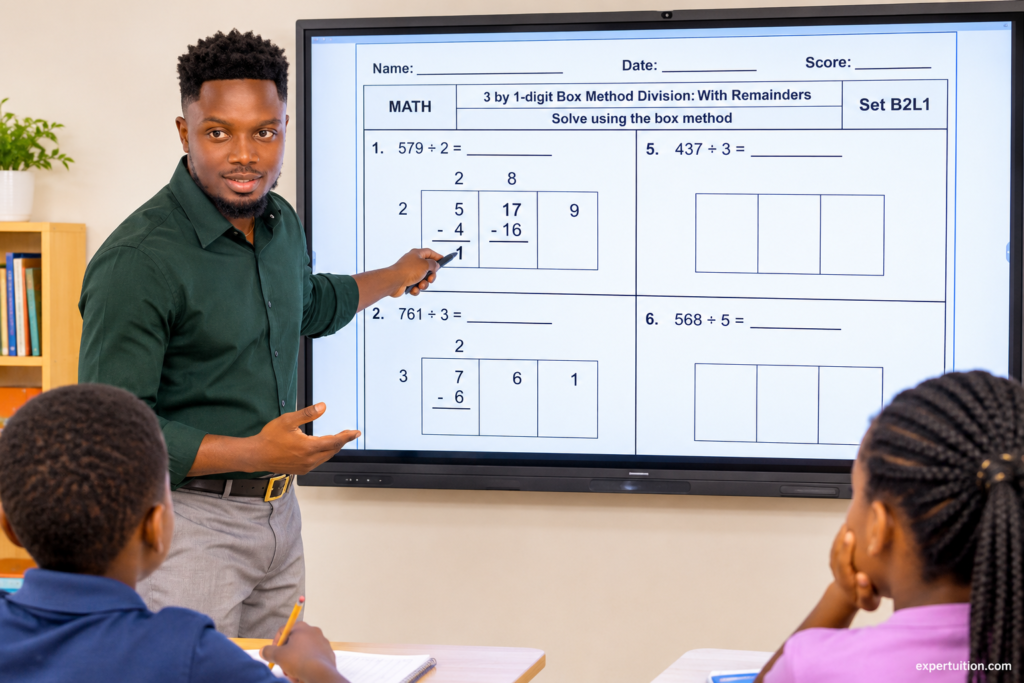
Compare methods instead of teaching them in isolation
After students have worked with individual strategies, give them the same division problem to solve in two different ways. For example, ask them to solve 458 ÷ 3 using partial quotients and area model division.
Use questions such as:
- What do the partial quotients represent in each method?
- How does each layout show the amount remaining?
- Where do you see multiplication and subtraction?
- How do both methods arrive at the same quotient?
Comparing solutions helps students explain their reasoning and recognize that different methods can represent the same division process.
Common Division Difficulties and How to Address Them
Students may understand the basic idea of division but still make errors when working with multi-digit numbers. Difficulties with place value, estimation, multiplication and division relationships, remainders, and written procedures can affect how they solve division problems. Identifying the reason behind an error helps you decide what to reteach.
Understanding place value during division
Students may place quotient digits incorrectly or struggle to understand how a remainder is regrouped into the next place-value position.
For example, in 458 ÷ 3, the remaining 1 hundred must be regrouped as 10 tens before combining it with the 5 tens. If students do not understand this relationship, they may struggle to see why the next amount is 15 tens.
Use place-value charts, base-ten blocks, or written examples to show how hundreds, tens, and ones can be regrouped during division.
Estimating and choosing multiples
Students may choose multiples that are too large or too small when using partial quotients or area model division. They may also struggle to determine how many times a divisor fits into an amount when using a written method.
For example, when dividing 158 by 3, students need to choose a multiple of 3 that does not exceed 158. Ask them to estimate first, use known multiplication facts, and check whether the product is reasonable.
Interpreting remainders
Students may find the quotient but misunderstand what the remainder represents. They may also leave a remainder that is equal to or greater than the divisor.
Explain that the remainder is the amount left after forming as many complete groups as possible. It must be smaller than the divisor. Use division problems with and without remainders so students can recognize both outcomes.
Understanding the relationship between multiplication and division
Students may treat division as a separate process and fail to use multiplication to help determine or check a quotient.
Reinforce that multiplication and division are inverse operations. Students can use multiplication facts to determine quotient digits and multiply the divisor by the quotient to check their answers.
Following procedures without understanding the steps
Students may memorize a sequence of steps without understanding why they multiply, subtract, or regroup a remainder.
Ask questions that bring attention to the meaning of each step:
- What does the current remainder represent?
- Why do we subtract the product?
- Why is the next digit brought down in traditional long division?
- Why is the remainder brought up in the box method?
These difficulties can appear across different division strategies, although the written work may look different. When reviewing student work, look for the mathematical misunderstanding behind the error before deciding which part of the method to reteach. A misplaced quotient digit, an unsuitable multiple, or an invalid remainder can point to different misunderstandings and may require different kinds of support.
Helping Students Check Their Division Answers
Students should learn to check division answers rather than rely only on the calculation steps. Multiplication provides a way to confirm the quotient and remainder.
Use this relationship:
Dividend = (Divisor × Quotient) + Remainder
For 458 ÷ 3 = 152 R 2:
458 = (3 × 152) + 2
458 = 456 + 2
thus, 458 = 458
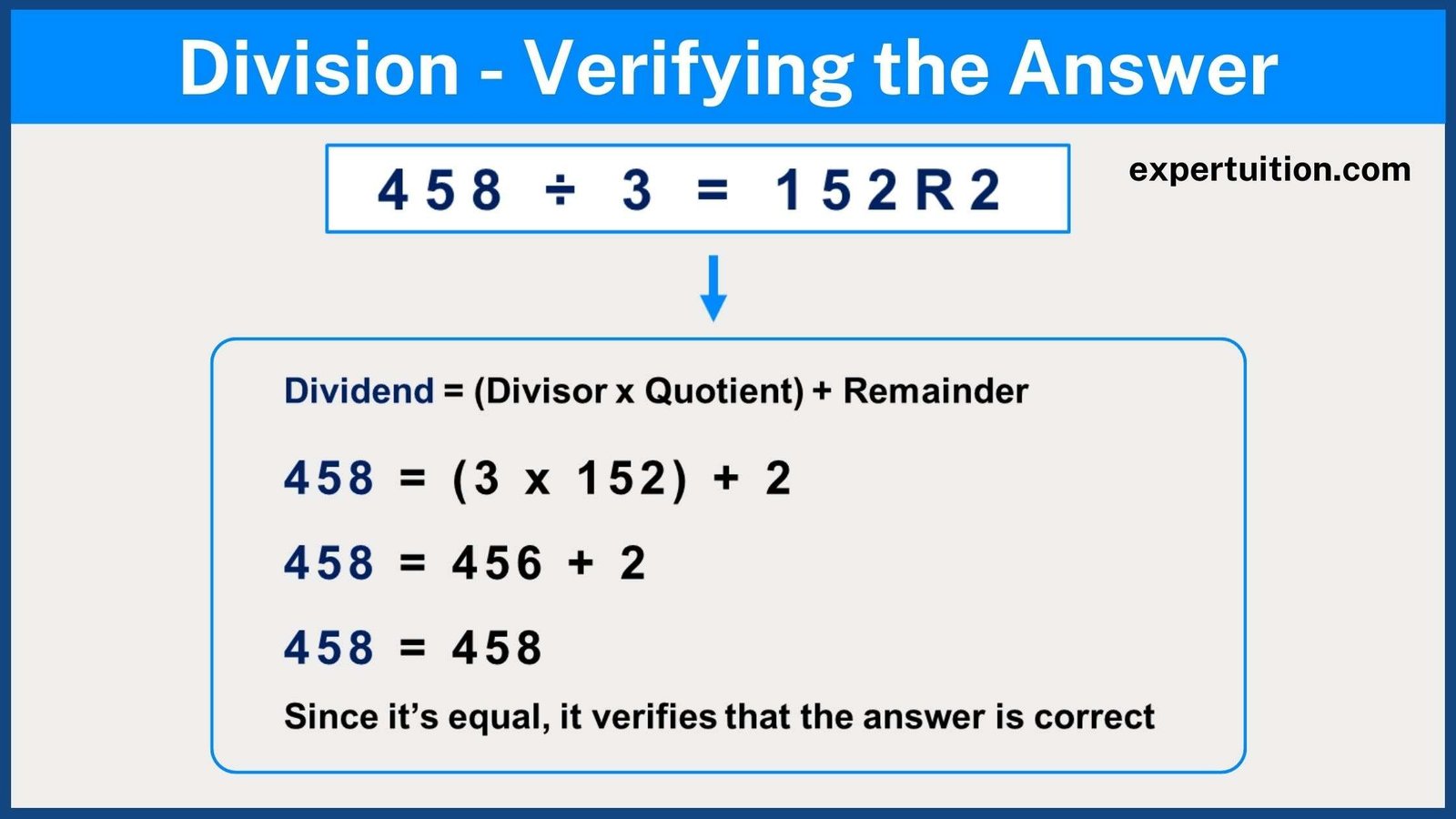
The calculation returns the original dividend, confirming the answer. Students should also check that the remainder is smaller than the divisor. If it is equal to or greater than the divisor, another complete group can still be formed.
Moving from Understanding to Independent Practice
Students need opportunities to see a division strategy modeled, work through examples with support, and apply what they have learned independently. A gradual progression helps them develop confidence while keeping the focus on the reasoning behind the calculations.
- Model the strategy. Demonstrate the method and explain what each step represents. Use place-value language and connect multiplication and subtraction to the division process.
- Solve problems together. Work through examples with students. Ask them to explain their choices, identify the amount remaining, and describe how the quotient is built.
- Compare representations. Solve the same problem using different strategies. Discuss how the layouts differ and why the answers agree.
- Provide independent practice. Give students problems that match the skills and divisor types they are learning. Grade 4 practice generally focuses on one-digit divisors, while Grade 5 extends to two-digit divisors.
- Review errors and provide targeted support. Look at students’ calculations to identify whether they need more work with place value, choosing multiples, remainders, or the written procedure.
Choose practice materials based on the skills students need to strengthen. For example, students who struggle to choose multiples may need more partial-quotients practice, while those who need help organizing calculations may benefit from area model or box method worksheets.
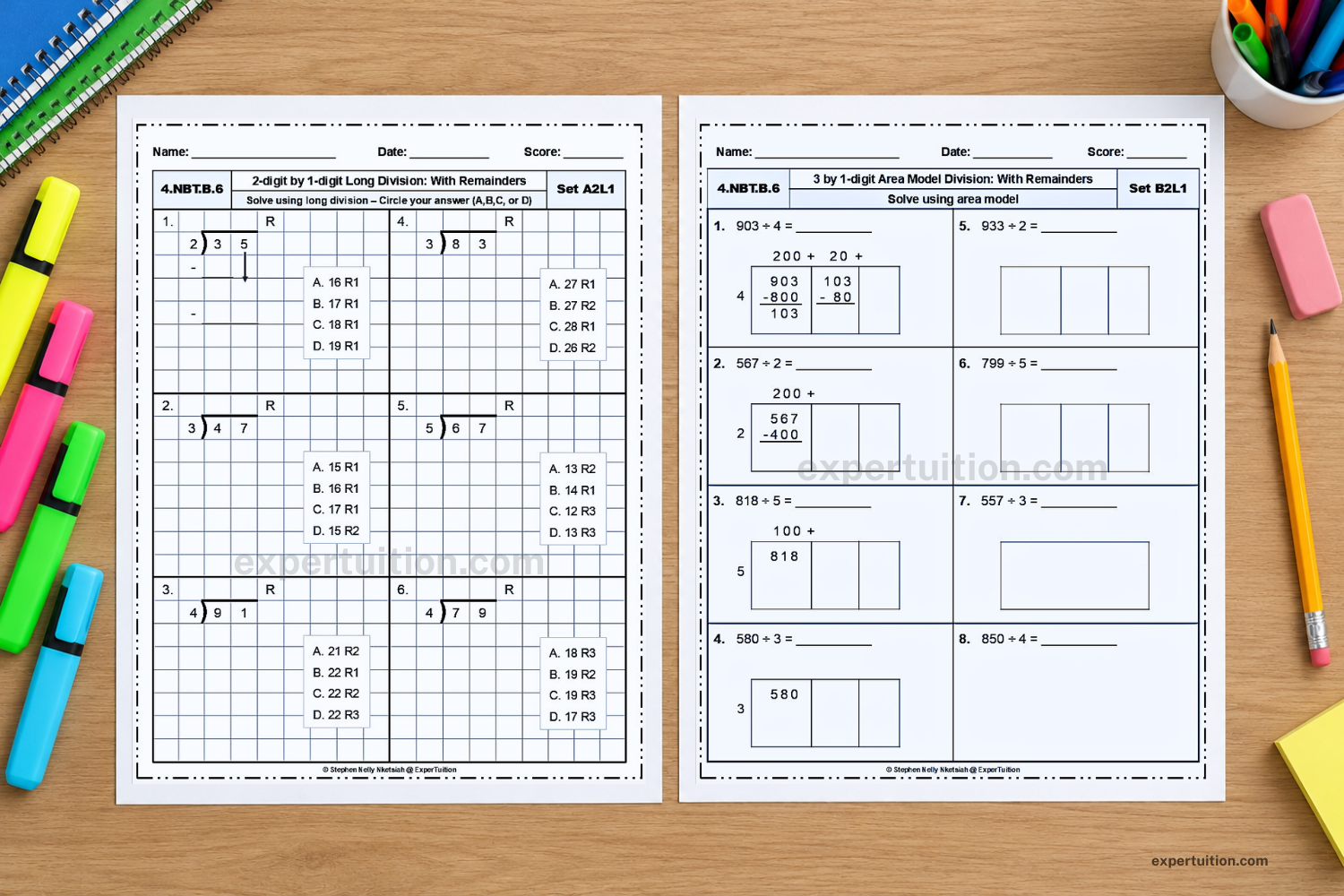
For help comparing individual worksheet sets and bundles by method, dividend size, divisor type, and other features, see Choosing Division Worksheets and Practice Resources for Grades 4–5.
Final Thoughts on Teaching Division
Students need to understand both how to divide and why the calculations work. Partial quotients, area model division, traditional long division, and the box method provide different ways to organize multi-digit division, but they share the same mathematical relationships.
Model the strategies, compare their layouts, and use students’ work to decide what to teach next. When students can explain their calculations and recognize how the methods connect, they are better prepared to solve division problems with understanding.