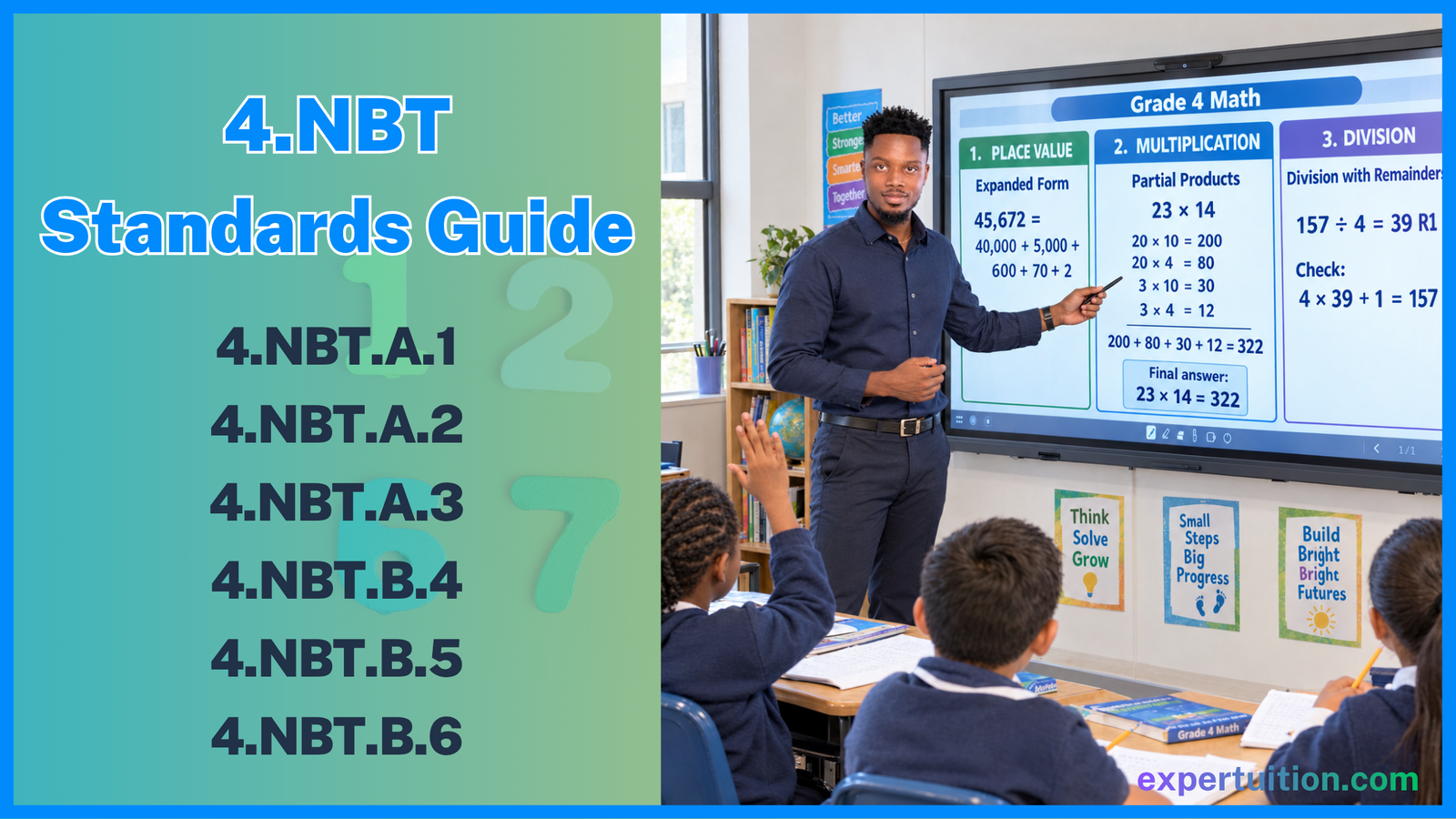
This guide covers all six Grade 4 Number and Operations in Base Ten (4.NBT) standards, explains each standard, highlights common student difficulties, and connects teachers with ExperTuition resources for targeted math practice.
Understanding Grade 4 Number and Operations in Base Ten
Place value helps students make sense of multi-digit numbers and calculations. In fourth grade, students learn how a digit’s position determines its value, how to read, write, and compare whole numbers, and how to apply place-value understanding when rounding and performing arithmetic.
The Grade 4 Number and Operations in Base Ten domain (4.NBT) covers six Common Core State Standards. The first three address place-value relationships, number forms, comparison, and rounding. The remaining three focus on multi-digit addition and subtraction, multiplication, and division.
This guide explains each standard, highlights common student difficulties, and identifies ExperTuition resources teachers can use for targeted practice.
Grade 4 Number and Operations in Base Ten Standards at a Glance
The six 4.NBT standards develop place-value understanding and its application to multi-digit arithmetic.
| Standard | Focus | What Students Need to Understand |
|---|---|---|
| 4.NBT.A.1 | Place-value relationships | A digit in one place represents ten times what it represents in the place immediately to its right. |
| 4.NBT.A.2 | Number forms and comparison | How to read, write, and compare multi-digit whole numbers. |
| 4.NBT.A.3 | Rounding | How to round multi-digit whole numbers to any place using place-value understanding. |
| 4.NBT.B.4 | Addition and subtraction | How to fluently add and subtract multi-digit whole numbers using the standard algorithm. |
| 4.NBT.B.5 | Multiplication | How to multiply whole numbers of up to four digits by one-digit numbers and two two-digit numbers using place-value-based strategies. |
| 4.NBT.B.6 | Division | How to find whole-number quotients and remainders when dividing up to four-digit dividends by one-digit divisors. |
4.NBT.A.1: Understanding Place-Value Relationships
Standard 4.NBT.A.1 requires students to recognize that a digit represents ten times as much in one place as it represents in the place immediately to its right.
Consider the digit 7 in these numbers:
- 700: The 7 represents 700.
- 70: The 7 represents 70.
The value of the 7 in 700 is ten times its value in 70.
700 = 10 × 70
The relationship also works in reverse:
70 = 700 ÷ 10
The digit stays the same, but its value changes with its position. Moving one place to the left makes a digit’s value ten times greater; moving one place to the right makes it one-tenth as much.
Helping Students Understand Place-Value Relationships
Students may recognize that a digit’s value changes with its position but struggle to explain how the values are related.
Use place-value charts and equations to compare adjacent places. For example, ask students how the value of the 6 changes from 600 to 60. Have them explain why 600 is ten times 60, rather than simply stating that the value decreases.
Recommended resource: Place Value Understanding Worksheets for Grade 4
These worksheets provide practice with digit values and place-value relationships.
4.NBT.A.2: Reading, Writing, and Comparing Multi-Digit Numbers
Standard 4.NBT.A.2 covers two skills: writing multi-digit whole numbers in different forms and comparing numbers based on the values of their digits.
Part 1: Standard Form, Word Form, and Expanded Form
Students must read and write multi-digit whole numbers using base-ten numerals, number names, and expanded form.
Consider the number 45,672.
| Form | Example |
|---|---|
| Standard form | 45,672 |
| Word form | Forty-five thousand, six hundred seventy-two |
| Expanded form | 40,000 + 5,000 + 600 + 70 + 2 |
Each form represents the same number. Standard form uses numerals, word form spells out the number, and expanded form shows the value contributed by each digit.
In 45,672, the 4 represents 40,000, the 5 represents 5,000, and the 6 represents 600. Expanded form makes these place values explicit, showing how each part contributes to the total.
Common difficulty: Students may confuse a digit with its value, omit a place in expanded form, or make errors when writing number names as numerals.
Teaching tip: Use a place-value chart to connect each digit to its value. Ask students to explain why the 5 represents 5,000 rather than 5, and how each term in the expanded form contributes to the total.
Recommended resources:
- Standard, Expanded and Word Forms Worksheets — 3 & 4 Digits
- Standard, Expanded and Word Forms Worksheets — 5, 6 & 7 Digits
Part 2: Comparing Multi-Digit Numbers
Students must compare two multi-digit whole numbers using greater than (>), less than (<), and equal to (=).
They should begin with the greatest place value and move from left to right until they find a difference. This works because a difference in a greater place value outweighs any possible differences in the places to its right.
For example:
53,482 > 52,917
Both numbers have 5 in the ten-thousands place. The thousands digits differ: 3 is greater than 2, so 53,482 is greater than 52,917.
Once students find the first place where the digits differ, they can determine which number is greater without comparing the remaining digits.
Common difficulty: Students may compare individual digits without considering their place values or focus on a larger digit farther to the right.
Teaching tip: Give students pairs of numbers with matching digits in the greatest places. Ask them to identify the first place where the numbers differ and explain why that difference determines the comparison.
Recommended resource: Comparing and Ordering Numbers Worksheets, Grades 3–5
4.NBT.A.3: Rounding Multi-Digit Whole Numbers
Standard 4.NBT.A.3 requires students to round multi-digit whole numbers to any place using place-value understanding.
Rounding helps students estimate quantities and check whether calculations are reasonable. Students identify the place to round to, look at the digit immediately to its right, and use that digit to determine whether to round up or down. Understanding the two nearest multiples of the target place helps explain why the rule works.
For example, round 46,281 to the nearest thousand.
- Identify the thousands digit: 6.
- Look at the hundreds digit: 2.
- Since 2 is less than 5, round down.
- The rounded number is 46,000.
The number is closer to 46,000 than to 47,000.
Helping Students Understand Rounding
Students may remember the rounding rule but struggle to explain why a number rounds up or down.
A number line helps students see a number between two benchmarks and identify which benchmark is closer. Ask them to explain their choice using place-value reasoning rather than relying only on the rule about the digit to the right.
Recommended resource: Rounding Whole Numbers Worksheets for Grade 4
These worksheets provide focused practice with rounding to different place values.
4.NBT.B.4: Adding and Subtracting Multi-Digit Whole Numbers
Standard 4.NBT.B.4 requires students to fluently add and subtract multi-digit whole numbers using the standard algorithm.
Students must align digits by place value, calculate accurately, and regroup when necessary. Regrouping works because an amount can be exchanged for an equivalent amount in another place: one hundred equals ten tens, and one ten equals ten ones. These exchanges preserve the number’s value while allowing students to calculate within each place.
Building Accuracy and Fluency
Common errors include misaligning digits, forgetting to regroup, and failing to account for a regrouped amount. Some students can follow the algorithm but struggle to explain what the digits represent.
Model the standard algorithm and ask students to explain the value of the digits at each step. Include problems with and without regrouping, and use estimation to check whether answers are reasonable. Rounding the numbers before calculating gives students an approximate answer they can compare with their final result.
Recommended resources:
These worksheets provide practice with multi-digit addition and subtraction, with and without regrouping.
4.NBT.B.5: Multiplying Multi-Digit Whole Numbers
Standard 4.NBT.B.5 requires students to multiply whole numbers of up to four digits by one-digit numbers and multiply two two-digit numbers.
Students use strategies based on place value and the properties of operations. They must also be able to illustrate and explain their calculations using equations, arrays, and/or area models.
Understanding Partial Products
Consider 23 × 14.
Break each factor into its place-value parts:
23 = 20 + 3
14 = 10 + 4
The distributive property allows the multiplication to be broken into four smaller products:
23 × 14 = (20 + 3) × (10 + 4)
- 20 × 10 = 200
- 20 × 4 = 80
- 3 × 10 = 30
- 3 × 4 = 12
Add the partial products:
200 + 80 + 30 + 12 = 322
Therefore, 23 × 14 = 322.
An area model displays the four products in separate sections, while partial products show the calculations numerically. Both approaches show how a multiplication problem can be broken into smaller products and then combined. This helps students understand how place value and the distributive property work together.
Choosing Multiplication Practice
Choose practice that matches the strategy being taught and the numbers students are ready to work with. Ask students to explain how the partial products combine to give the total product.
Recommended resources:
- Area Model Multiplication Worksheets
- Partial Products Multiplication Worksheets
- All ExperTuition Multiplication Resources
4.NBT.B.6: Dividing Multi-Digit Whole Numbers
Standard 4.NBT.B.6 requires students to find whole-number quotients and remainders when dividing dividends of up to four digits by one-digit divisors.
Students use place value, properties of operations, and the relationship between multiplication and division. They must also be able to illustrate and explain their calculations using equations, arrays, and/or area models.
Several methods can support division instruction: area model division, the box method, partial quotients, and traditional long division. These are teaching strategies rather than separate requirements of the standard, and each organizes the calculation differently.
Area model division uses a rectangle divided into sections representing multiples of the divisor. Each section accounts for part of the dividend, and the corresponding partial quotients show how many groups of the divisor have been accounted for. The model makes the parts of the calculation visible.
The box method combines a visual layout with steps similar to traditional long division. Students write the dividend’s digits in separate columns, then divide, multiply, and subtract in each column. Instead of bringing down the next digit, they bring up the remainder and place it before the next digit to continue the calculation.
Partial quotients involve subtracting convenient multiples of the divisor and adding the partial quotients to find the final quotient. Students can choose multiples they understand instead of following a fixed sequence of quotient digits.
Traditional long division uses the familiar sequence of dividing, multiplying, subtracting, and bringing down the next digit. Each step helps determine the next quotient digit while keeping track of the amount remaining.
Understanding Quotients and Remainders
A quotient tells how many times the divisor fits into the dividend, while a remainder represents the amount left over after making as many complete groups as possible.
For example:
157 ÷ 4 = 39 remainder 1
The quotient is 39 because 4 × 39 = 156. One is left over because 157 − 156 = 1.
Students can check the result using the relationship between multiplication and division:
4 × 39 + 1 = 157
A remainder must always be smaller than the divisor. If the remainder were 4 or greater in this example, another group of 4 could be made, so the quotient would not yet be complete.
Helping Students Divide Accurately
Students may struggle to choose useful multiples, keep track of remainders, or place quotient digits correctly. Encourage them to explain what each step represents and check their answers using multiplication.
Recommended division resources:
- Area Model Division Worksheets
- Box Method Division Worksheets
- Partial Quotients Division Worksheets
- Long Division Worksheets
- All ExperTuition Division Resources
For direct alignment with 4.NBT.B.6, choose problems with dividends of up to four digits and one-digit divisors. Resources involving two-digit divisors may support later learning but go beyond the scope of this Grade 4 standard.
How the Six 4.NBT Standards Work Together
The six standards connect place-value understanding to multi-digit arithmetic:
- 4.NBT.A.1: Understand relationships between digit values.
- 4.NBT.A.2: Read, write, and compare numbers using place value.
- 4.NBT.A.3: Apply place-value understanding to rounding.
- 4.NBT.B.4: Use place value when adding and subtracting.
- 4.NBT.B.5: Apply place value and properties of operations to multiplication.
- 4.NBT.B.6: Use place value and the relationship between multiplication and division to divide.
These connections can help teachers identify the source of a student’s difficulty. For example, repeated regrouping errors may indicate that a student needs more practice understanding the relationships between ones, tens, hundreds, and thousands. A student who struggles to compare numbers may need to revisit how a digit’s position determines its value.
Final Thoughts
When students struggle with multi-digit arithmetic, checking their understanding of place value can help identify what needs more practice.
Explore the ExperTuition Number and Operations in Base Ten Collection for worksheets and activities covering the Grade 4 standards.