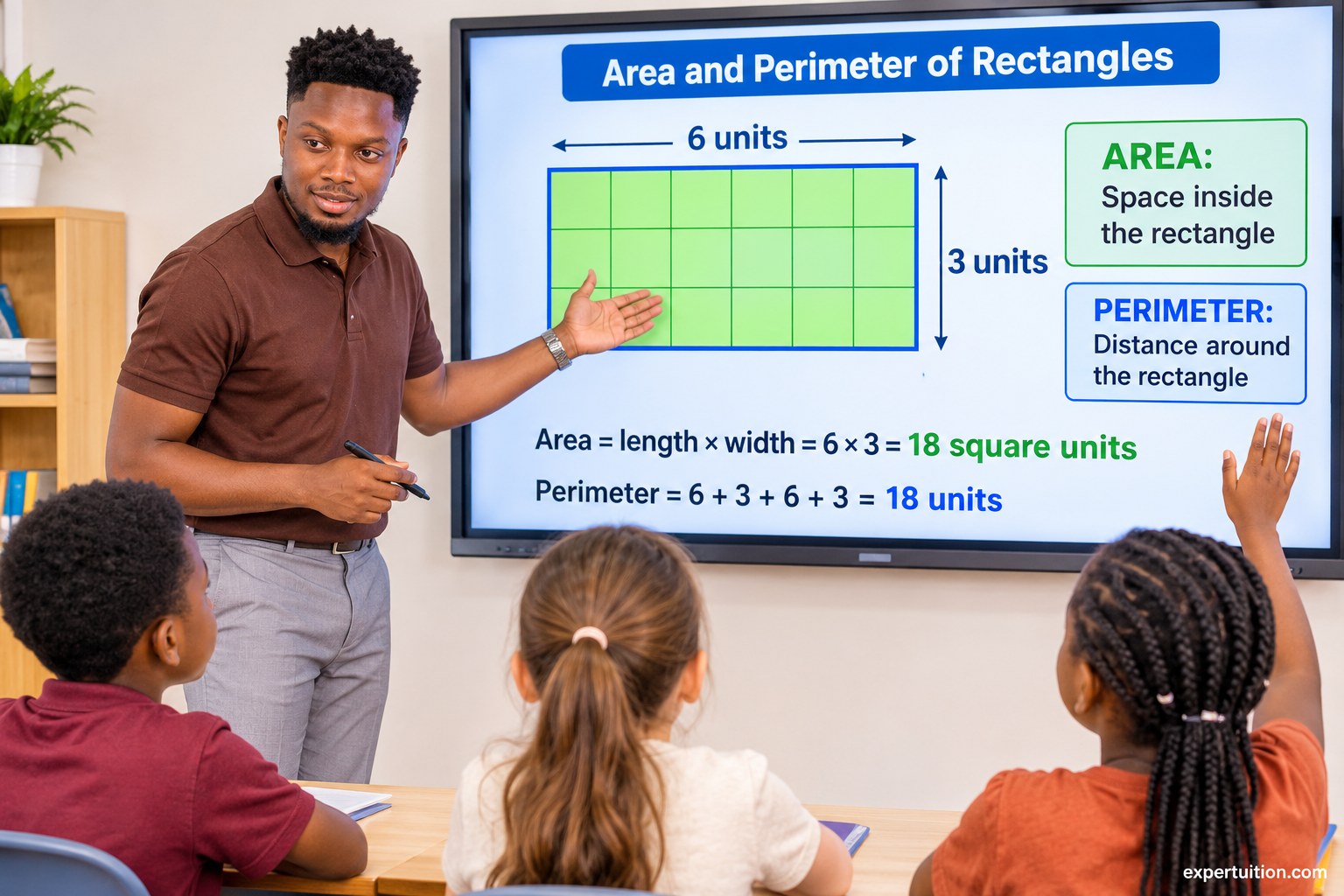
Learn how to find the area and perimeter of rectangles in Grade 4 using formulas, unit-square models, and worked examples. Find missing dimensions, solve real-world word problems, and compare rectangles with the same area or perimeter. See how changes in a rectangle’s dimensions affect both measurements and learn to avoid common calculation mistakes.
What Are Area and Perimeter?
Area and perimeter describe two different measurements of a rectangle. Perimeter measures the distance around the outside of a shape, while area measures the surface covered inside it. Although both measurements depend on a rectangle’s dimensions, they answer different questions.
Consider a rectangular garden. If you want to install a fence around the garden, you need to know its perimeter. If you want to cover the ground with grass, you need to know its area.
A rectangle has four sides and four right angles. Its opposite sides are equal in length. The two dimensions are called length and width. Length usually refers to the longer dimension, while width refers to the shorter one. In a square, which is also a rectangle, the length and width are equal.
The units used for these measurements also differ:
- Perimeter is measured in linear units, such as inches, centimeters, feet, or meters.
- Area is measured in square units, such as square inches, square centimeters, square feet, or square meters.
For example, a rectangle measuring 6 cm by 3 cm has a perimeter expressed in centimeters and an area expressed in square centimeters. The perimeter describes the distance around its boundary, while the area describes the surface inside it.
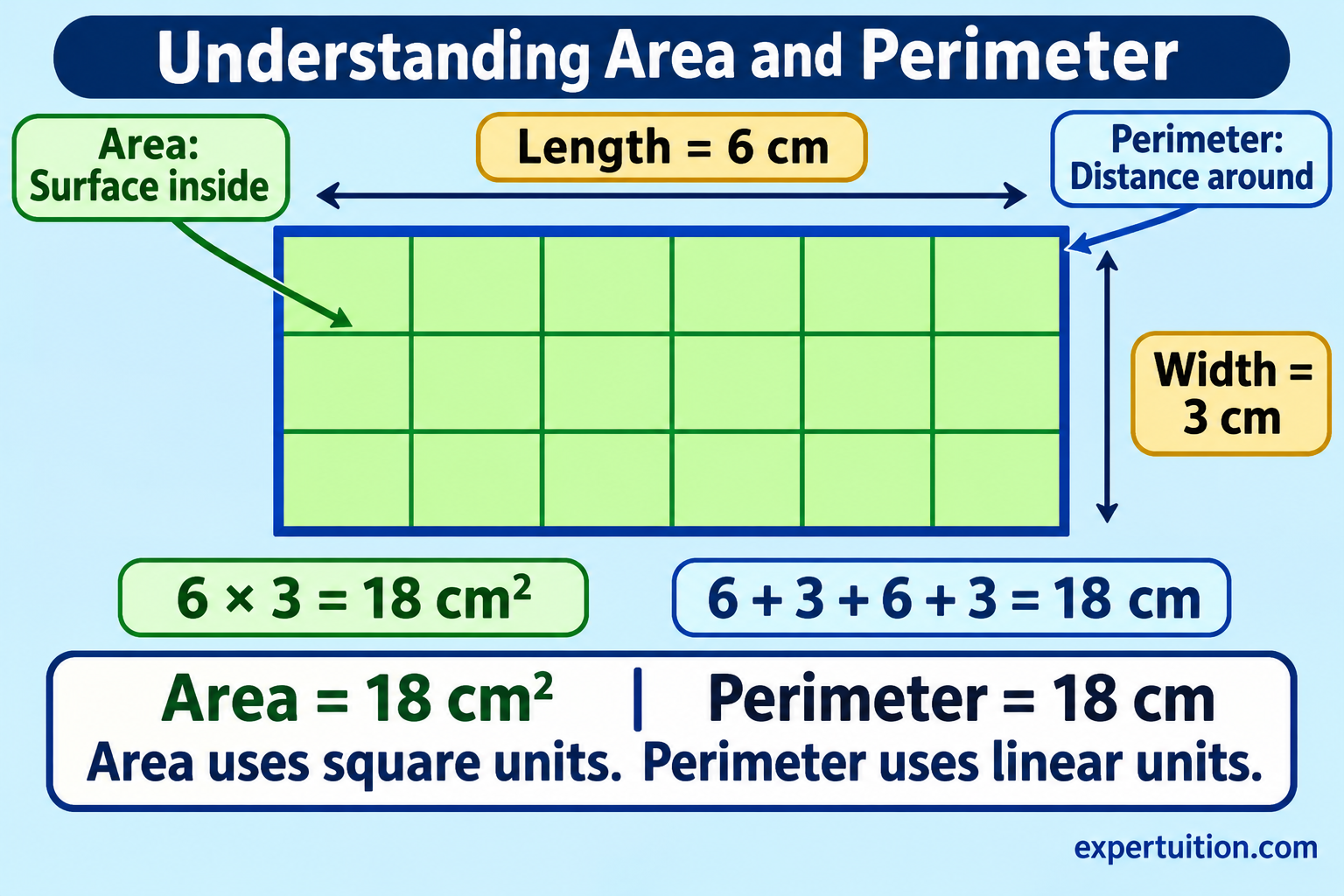
The difference in units reflects what each measurement represents. Perimeter measures a one-dimensional distance, while area measures a two-dimensional surface. A square measuring 1 cm on each side covers 1 square centimeter (1 cm²). This is why area is expressed in square units rather than linear units.
How to Calculate the Perimeter of a Rectangle
To find the perimeter of a rectangle, add the lengths of all four sides. Since opposite sides are equal, you can also use a formula that combines the two pairs of equal sides.
Finding Perimeter by Adding the Four Sides
A rectangle has two equal lengths and two equal widths. To calculate its perimeter, add all four side lengths.
Consider a rectangle with a length of 6 cm and a width of 3 cm.
Its four sides measure:
- 6 cm
- 3 cm
- 6 cm
- 3 cm
Add the side lengths:
6 + 3 + 6 + 3 = 18 cm
The rectangle has a perimeter of 18 cm.
This calculation shows why you cannot find a rectangle’s perimeter by adding its length and width just once. You must account for all four sides.
Because opposite sides are equal, the addition can also be written as:
P = l + w + l + w
Here, P represents perimeter, l represents length, and w represents width. Grouping the equal sides makes it easier to develop the perimeter formula.
Using the Perimeter Formula
Instead of adding all four side lengths separately, you can multiply the length by 2 and the width by 2.
The perimeter formula is:
P = 2l + 2w
The 2l represents the two equal lengths, while 2w represents the two equal widths. Adding these amounts gives the total distance around the rectangle.
For example, a rectangular playground is 12 m long and 5 m wide. Find its perimeter.
Start with the formula:
P = 2l + 2w
Substitute the dimensions:
P = 2(12) + 2(5)
Multiply:
P = 24 + 10
Add:
P = 34 m
The playground has a perimeter of 34 meters.
The two longer sides have a combined length of 24 m, and the two shorter sides have a combined length of 10 m. Together, all four sides measure 34 m.
Notice that the answer uses meters, not square meters. Perimeter measures distance, so its unit is a linear unit.
Finding a Missing Side Length
You can also use a rectangle’s perimeter to find an unknown side length when you know the perimeter and the other dimension.
A rectangle has a perimeter of 30 cm and a width of 5 cm. What is its length?
Step 1: Find the combined length of the two known widths.
5 + 5 = 10 cm
Step 2: Subtract this amount from the total perimeter.
30 − 10 = 20 cm
The two equal lengths must account for the remaining 20 cm.
Step 3: Divide the remaining distance by 2.
20 ÷ 2 = 10 cm
The rectangle’s length is 10 cm. Each of the two equal lengths measures 10 cm.
Check the answer by adding all four sides:
10 + 5 + 10 + 5 = 30 cm
The calculation confirms that the rectangle has the given perimeter.
The key is recognizing that the remaining distance represents two equal sides, not just one. Dividing by 2 gives the length of each side.
How to Calculate the Area of a Rectangle
The area of a rectangle is the number of square units needed to cover its surface without gaps or overlaps. You can find it by multiplying its length by its width.
Understanding how unit squares cover a rectangle makes the area formula easier to explain and apply.
How to Measure Area with Unit Squares
A unit square is a square with side lengths of one unit. Its area is one square unit. For example, a square with side lengths of 1 cm has an area of 1 square centimeter.
To measure the area of a rectangle, imagine covering its surface with equal-sized unit squares. Each square covers one unit of area. Counting all the squares tells you the rectangle’s total area.
Consider a rectangle arranged in 4 rows and 6 columns of unit squares.
Each row contains 6 squares, and there are 4 rows. You can count all the squares by adding the number in each row:
6 + 6 + 6 + 6 = 24
The rectangle covers 24 square units.
Instead of counting every square individually, you can multiply the number of rows by the number of squares in each row:
4 × 6 = 24 square units
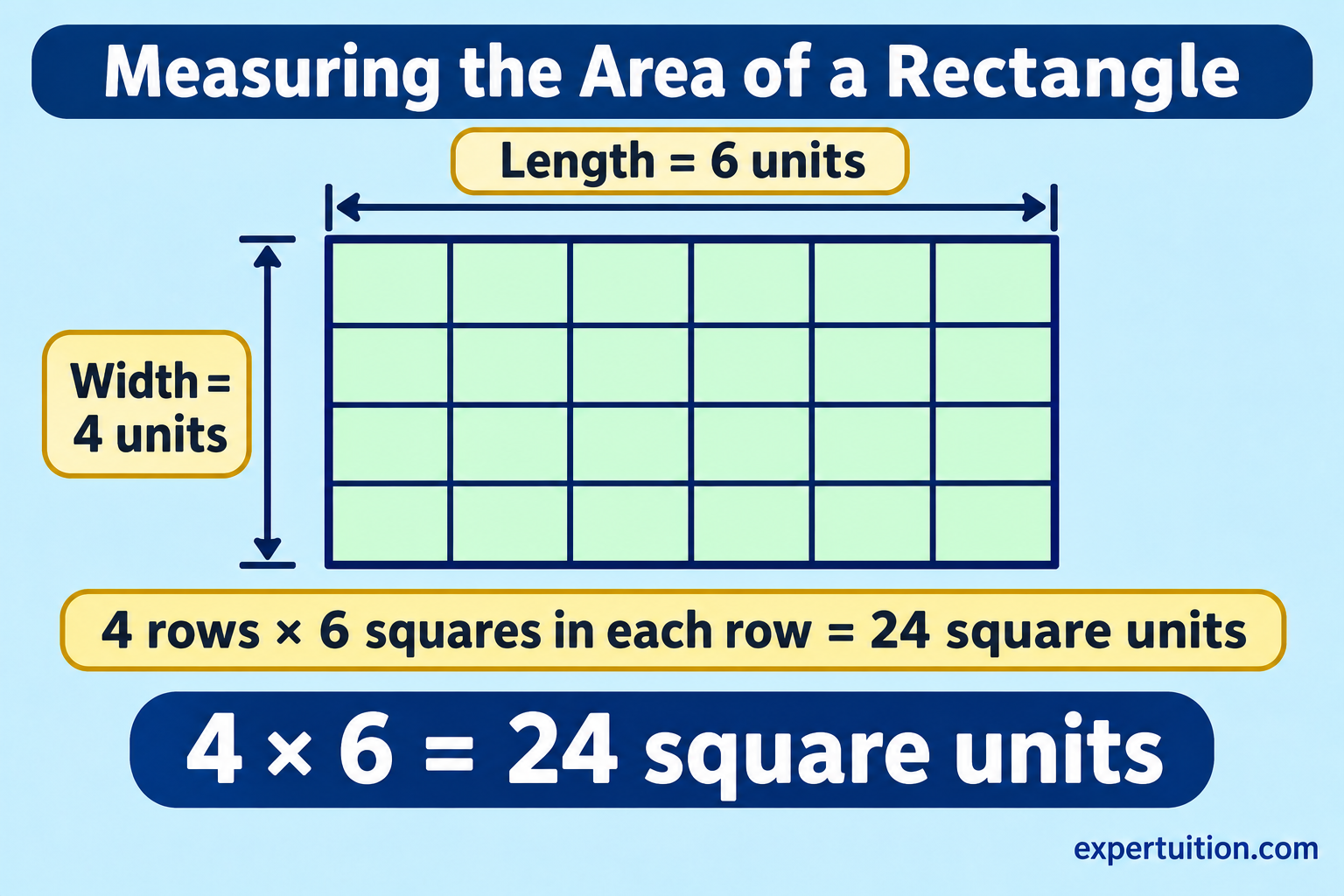
This rectangular array shows why multiplication works when finding area. Each row contains the same number of squares, so multiplication gives the total number of unit squares covering the rectangle.
If each unit square measures 1 unit by 1 unit, the 6 squares in each row represent a length of 6 units, while the 4 rows represent a width of 4 units. The rectangle therefore measures 6 units by 4 units, giving an area of 24 square units.
How to Develop the Area Formula
In a rectangular array, the number of squares in each row corresponds to one dimension of the rectangle, while the number of rows corresponds to the other dimension. When the squares are arranged with their sides aligned to the rectangle, these counts represent its length and width.
Multiplying the two dimensions gives the total number of square units covering the rectangle.
The area formula is:
A = l × w
Here:
- A represents area.
- l represents length.
- w represents width.
For example, a rectangular classroom floor is 8 m long and 5 m wide. Find its area.
Start with the formula:
A = l × w
Substitute the dimensions:
A = 8 × 5
Multiply:
A = 40 m²
The classroom floor covers 40 square meters.
The dimensions are measured in meters, but the area is expressed in square meters. Each square meter represents a square measuring 1 m by 1 m. Multiplying meters by meters produces square meters:
m × m = m²
The formula is more than a shortcut to memorize. It represents the number of equal-sized square units arranged in rows and columns across the rectangle.
Finding a Missing Length or Width
You can find an unknown length or width when you know the rectangle’s area and its other dimension.
The area formula represents a multiplication relationship between two dimensions. Finding a missing dimension means finding the unknown factor in that multiplication equation.
For example, a rectangular room has an area of 48 square meters and a length of 8 meters. Find its width.
Step 1: Identify the known measurements.
- Area = 48 square meters
- Length = 8 meters
- Width = unknown
Step 2: Write the area relationship.
8 × w = 48
Step 3: Find the missing factor.
Since 8 multiplied by the unknown width gives 48, divide 48 by 8 to find the missing factor:
48 ÷ 8 = 6
The room’s width is 6 meters.
Check the answer by multiplying the length and width:
8 × 6 = 48 m²
The calculation confirms that the rectangle has an area of 48 square meters.
Division works here because it is the inverse of multiplication. You are finding the number that, when multiplied by 8, gives 48.
This type of problem is an important part of Grade 4 standard 4.MD.A.3, which requires students to apply area and perimeter formulas for rectangles, including finding an unknown width when the area and length are known. The standard treats the area formula as a multiplication equation with an unknown factor. See the Grade 4 standard 4.MD.A.3.
The unit of the missing dimension is also important. Dividing square meters by meters gives meters, so the width is expressed in meters rather than square meters.
The Relationship Between Area and Perimeter
Area and perimeter both depend on a rectangle’s dimensions, but changing those dimensions does not affect the two measurements in exactly the same way.
Two rectangles can have the same area but different perimeters. Likewise, two rectangles can have the same perimeter but different areas.
Comparing their dimensions and calculations makes these relationships easier to see.
Rectangles with the Same Area but Different Perimeters
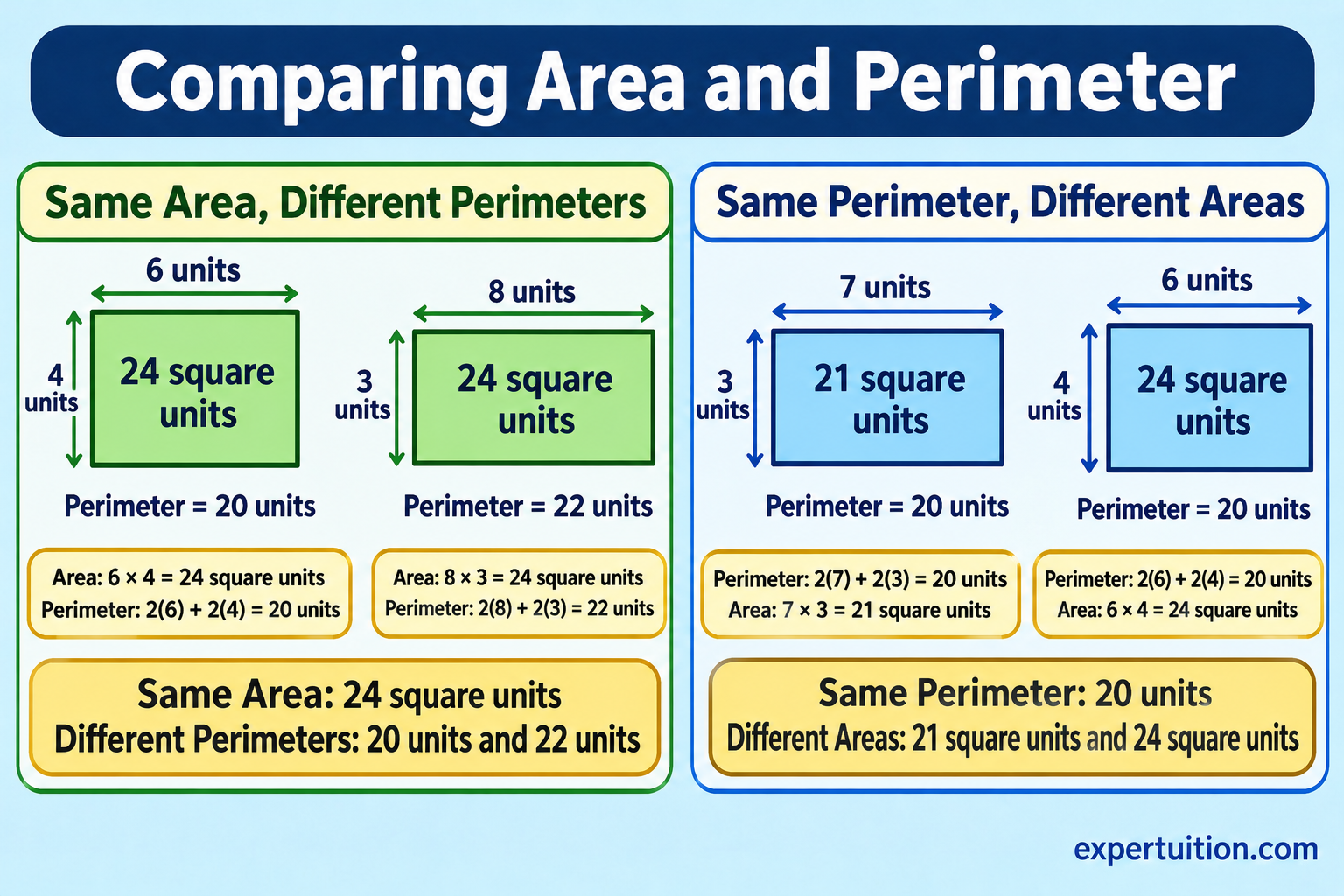
Rectangles can cover the same amount of surface while having different distances around their boundaries.
Compare these two rectangles:
| Rectangle | Length | Width | Area | Perimeter |
|---|---|---|---|---|
| A | 6 units | 4 units | 24 square units | 20 units |
| B | 8 units | 3 units | 24 square units | 22 units |
Both rectangles have an area of 24 square units:
- Rectangle A: 6 × 4 = 24 square units
- Rectangle B: 8 × 3 = 24 square units
However, their perimeters differ:
- Rectangle A: 2(6) + 2(4) = 20 units
- Rectangle B: 2(8) + 2(3) = 22 units
The rectangles cover the same amount of surface, but Rectangle B has a perimeter that is 2 units greater than Rectangle A’s.
The reason becomes clearer when you compare the dimensions. Both pairs of dimensions have a product of 24, so the areas are equal. However, their sums are different:
- Rectangle A: 6 + 4 = 10
- Rectangle B: 8 + 3 = 11
Since the perimeter is twice the sum of the length and width, the different sums produce different perimeters.
Equal areas do not necessarily mean equal perimeters.
Rectangles with the Same Perimeter but Different Areas
Rectangles can also have the same perimeter but cover different amounts of surface.
Compare these two rectangles:
| Rectangle | Length | Width | Perimeter | Area |
|---|---|---|---|---|
| A | 7 units | 3 units | 20 units | 21 square units |
| B | 6 units | 4 units | 20 units | 24 square units |
Both rectangles have a perimeter of 20 units:
- Rectangle A: 2(7) + 2(3) = 20 units
- Rectangle B: 2(6) + 2(4) = 20 units
Their areas are different:
- Rectangle A: 7 × 3 = 21 square units
- Rectangle B: 6 × 4 = 24 square units
Rectangle B covers 3 more square units than Rectangle A, even though both have the same perimeter.
The reason is that both pairs of dimensions have the same sum:
- Rectangle A: 7 + 3 = 10
- Rectangle B: 6 + 4 = 10
Since the perimeter is twice the sum of the length and width, both rectangles have a perimeter of 20 units. However, multiplying their dimensions produces different areas.
Equal perimeters do not necessarily mean equal areas.
These comparisons show why area and perimeter cannot be used interchangeably. Both describe a rectangle, but each measures a different property.
These relationships build on ideas introduced in Grade 3, when students explore rectangles with the same area but different perimeters and rectangles with the same perimeter but different areas. See Grade 3 standard 3.MD.D.8.
Solving Area and Perimeter Word Problems
Real-world problems involving rectangles often require you to find either area or perimeter. Some problems require both.
The first step is to identify what the situation asks you to measure. Then choose the appropriate formula, substitute the known dimensions, and interpret the answer using the correct units.
Identifying What a Problem Asks You to Find
Consider two situations involving a rectangular garden and a classroom floor.
Fencing a garden
A family wants to install a fence around a rectangular garden. The fence follows the garden’s outside boundary, so the family needs to calculate its perimeter.
Covering a classroom floor
A school wants to cover a rectangular classroom floor with tiles. The tiles cover the inside surface, so the school needs to calculate its area.
The difference comes down to what is being measured:
- Fencing, borders, and edging involve the distance around a shape.
- Flooring, carpeting, and covering a surface involve the space inside a shape.
Words such as around, cover, and inside can provide useful clues, but they should not replace understanding the situation. A problem’s context determines whether area or perimeter is needed.
Applying Area and Perimeter Formulas
Once you identify the measurement a problem asks you to find, use the corresponding formula.
Example 1: Finding perimeter
A rectangular garden is 9 m long and 4 m wide. How much fencing is needed to go around it?
The problem asks for the distance around the garden, so calculate its perimeter.
P = 2l + 2w
P = 2(9) + 2(4)
P = 18 + 8
P = 26 m
Answer: The garden needs 26 meters of fencing.
Example 2: Finding area
A rectangular classroom floor is 9 m long and 4 m wide. How much floor space does it cover?
The problem asks for the surface covered by the floor, so calculate its area.
A = l × w
A = 9 × 4
A = 36 m²
Answer: The classroom floor covers 36 square meters.
Both examples use the same dimensions, but the questions require different calculations. The fencing problem involves perimeter, while the flooring problem involves area.
Solving Problems Involving Both Measurements
Some real-world situations require you to calculate both area and perimeter.
For example, a rectangular garden is 10 m long and 6 m wide. A gardener wants to cover the ground with grass and install a fence around the garden.
Find:
- The area to be covered with grass.
- The length of fencing required.
Step 1: Calculate the area.
The grass covers the inside surface, so use the area formula.
A = l × w
A = 10 × 6
A = 60 m²
The garden covers 60 square meters.
Step 2: Calculate the perimeter.
The fence follows the outside boundary, so use the perimeter formula.
P = 2l + 2w
P = 2(10) + 2(6)
P = 20 + 12
P = 32 m
The gardener needs 32 meters of fencing.
The two answers describe different measurements:
- 60 square meters of grass coverage.
- 32 meters of fencing.
A problem can also require you to find a missing dimension before calculating area or perimeter. For example, if you know a garden’s area and length, first find its width using division. You can then use the dimensions to calculate its perimeter.
Working through each measurement separately helps prevent confusion between the two formulas.
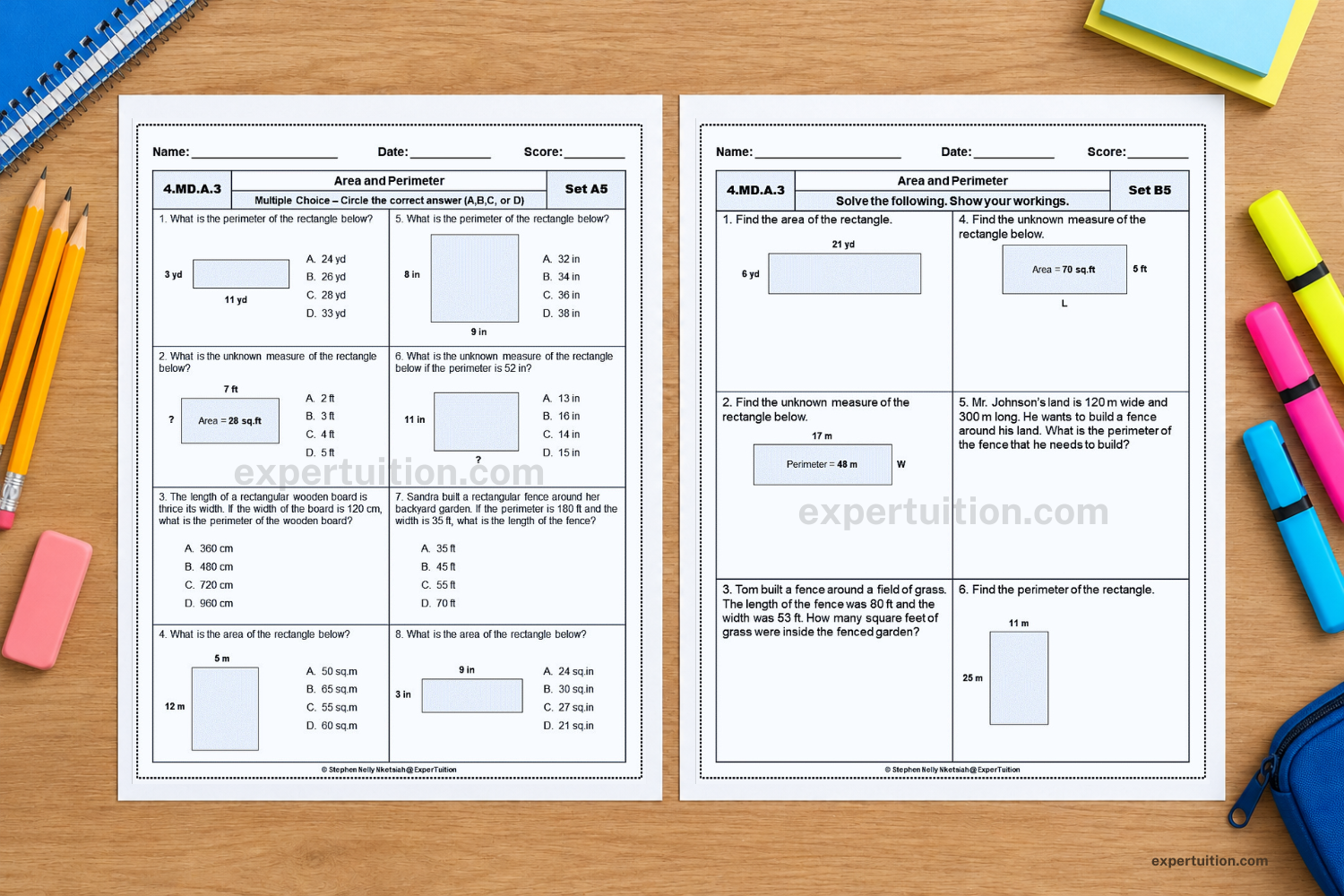
For additional practice applying these concepts, explore the Area and Perimeter Practice Worksheets.
Common Area and Perimeter Mistakes
Students sometimes confuse area and perimeter because both involve the dimensions of a rectangle. Other errors occur when they apply the wrong operation, overlook a side, or use incorrect units.
Recognizing these mistakes helps clarify what each calculation represents.
Confusing Area with Perimeter
The mistake: Calculating the distance around a rectangle when the problem asks for the surface it covers, or calculating the surface when the problem asks for the distance around it.
The correction: Return to the difference between the outside boundary and the inside surface. A diagram showing the perimeter along the boundary and area inside the rectangle makes the distinction clear.
Forgetting That a Rectangle Has Two Pairs of Equal Sides
The mistake: Adding the length and width only once when finding perimeter.
The correction: Label all four sides of the rectangle. Show that the length occurs twice and the width occurs twice.
Using the Wrong Units
The mistake: Expressing perimeter in square units or area in linear units.
The correction: Connect the unit to the measurement. Perimeter measures distance and uses linear units, while area counts square units covering a surface.
Making Errors When Finding a Missing Dimension
The mistake: Dividing incorrectly, using the wrong known measurement, or failing to check the result.
The correction: Identify the known and unknown dimensions before calculating. For area, use the relationship between multiplication and division to find the missing factor. For perimeter, account for the known sides and determine the length of the remaining equal sides. Check the answer using the original formula.
For more opportunities to practice calculating and comparing area and perimeter, use the Area and Perimeter Practice Task Cards.
Understanding Area and Perimeter
Area and perimeter describe different properties of a rectangle, and understanding the distinction helps students make sense of measurement problems. They need to recognize what a problem asks them to measure, select the appropriate calculation, and express their answers using the correct units.
As students work with different rectangles, they should also recognize that changing the dimensions can affect area and perimeter in different ways. Being able to explain these relationships, find missing dimensions, and apply the formulas to real-world situations helps them use these Math concepts with greater understanding.