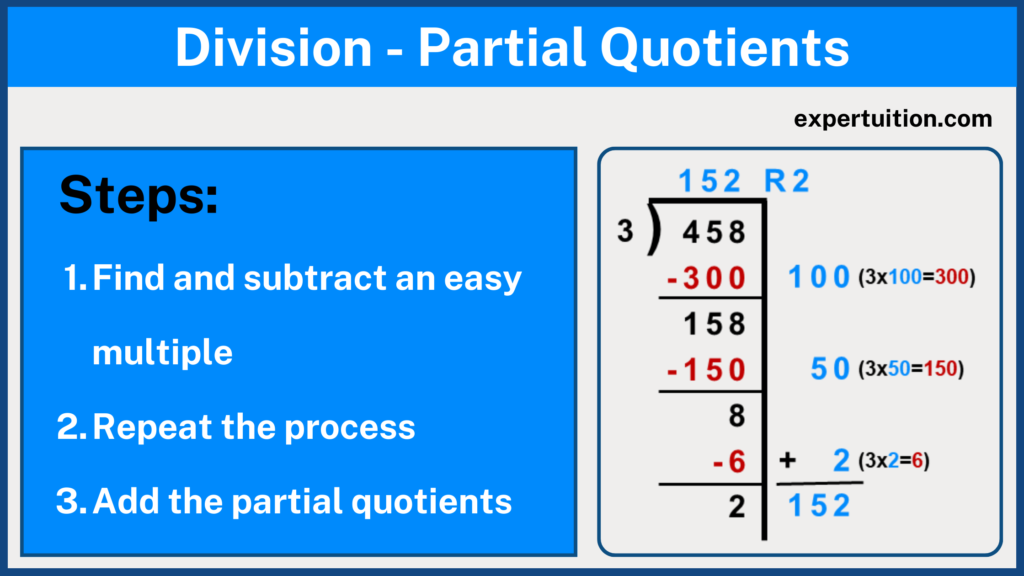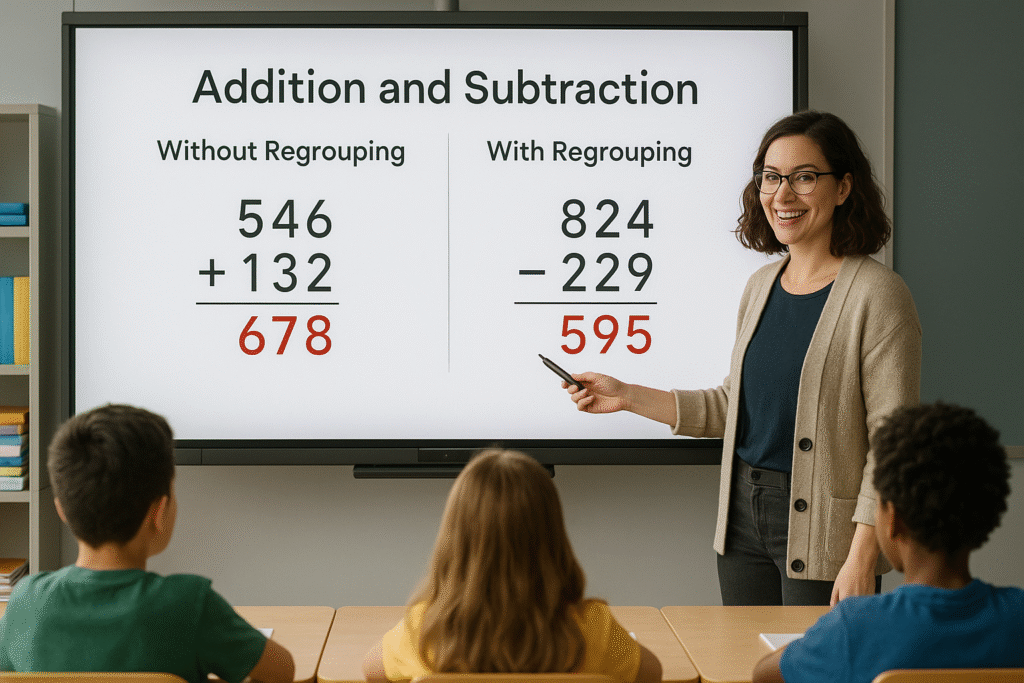
Addition and subtraction are two of the most essential skills students develop in elementary math. In this post, we’ll explore step-by-step strategies, scaffolded practice ideas, and ready-to-use classroom resources that can help your students confidently add and subtract multi-digit whole numbers with and without regrouping.
Start With Place Value Understanding
Before students can successfully add or subtract, they need to grasp the concept of place value.
They should understand that every digit has a value depending on its position — ones, tens, hundreds, thousands, and so on.
Use base-ten blocks, place value charts, or expanded form to show how numbers are built.
Once students understand how numbers are structured, they’re ready to move to computation.
Teaching Addition Without Regrouping
Start simple. Begin with problems that don’t require regrouping — where each column adds to less than ten.
For example: 321 + 134.
Have students line up the digits carefully and add column by column.
Using graph paper can help keep numbers aligned and reduce errors.
Encourage students to estimate the answer before adding — this helps them spot mistakes and strengthens number sense (“about 300 + 100 = 400, so the answer should be around that”).
Tip: Practice neat vertical alignment before moving to larger numbers.
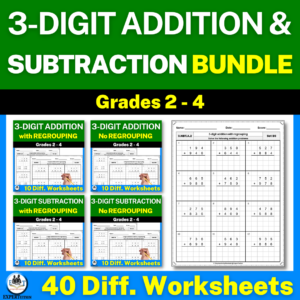
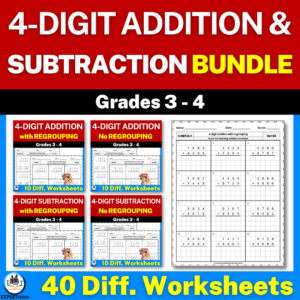
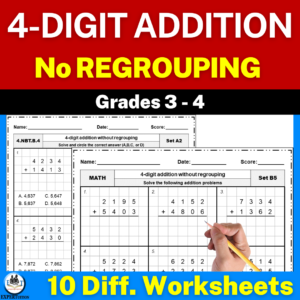
When students are ready for extra practice, the 3-digit addition without regrouping worksheets and the 4-digit addition without regrouping worksheets are perfect tools.
They provide structured, differentiated exercises that reinforce precision and confidence in early computation.
-
 $ 3.25
 -
$ 3.25

Teaching Addition With Regrouping (Carrying)
Now comes the part that challenges many students — regrouping (or “carrying”).
Use manipulatives to demonstrate that when you have 10 ones, you trade for 1 ten.
For example:
456 + 289
Show what happens when 6 ones + 9 ones = 15 ones — that’s 1 ten and 5 ones left.
Transition gradually from visuals (like base-ten blocks) to expanded form, and finally to the standard algorithm.
Highlight regrouped numbers using color-coding or highlighters so students can easily follow the process.
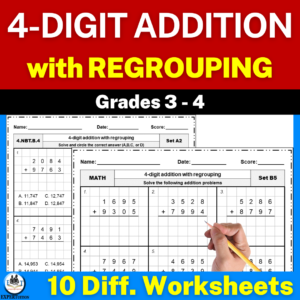
When you’re ready to give your students more structured practice, the 3-digit addition with regrouping worksheets and the 4-digit addition with regrouping worksheets offer just what you need — step-by-step problems that help students strengthen accuracy and understanding through repetition and variety.
-
$ 3.25
-
$ 3.25

Teaching Subtraction Without Regrouping
Just like addition, subtraction begins with alignment and understanding.
Start with problems that don’t require borrowing or regrouping.
For example: 842 − 321.
Focus on the relationship between addition and subtraction — one undoes the other.
Have students check their subtraction answers by adding the difference back to the smaller number.
Encourage mental math and estimation before solving — students can round numbers to the nearest ten or hundred to ensure their answers make sense.
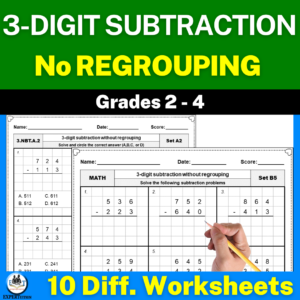
To give your students practice that reinforces accuracy, the 3-digit subtraction without regrouping worksheets and the 4-digit subtraction without regrouping worksheets provide well-designed exercises to build confidence and precision.
-
$ 3.25
-
$ 3.25

Teaching Subtraction With Regrouping (Borrowing)
Here’s where many students get tripped up.
Subtraction with regrouping, or “borrowing,” makes sense when students can visualize trading 1 ten for 10 ones.
Use base-ten blocks or visuals to make it concrete.
For example, when solving 793 – 468, show that you can’t take 8 ones from 3 ones — so you “borrow” from the tens place, convert 1 ten to 10 ones, and then subtract.
This step-by-step modeling turns an abstract idea into something students can visualize and understand.
Gradually move from hands-on models to paper-pencil problems, emphasizing each trade clearly.
Common student mistake: borrowing from the wrong place.
Address it early by modeling slowly and checking for alignment after each regroup.
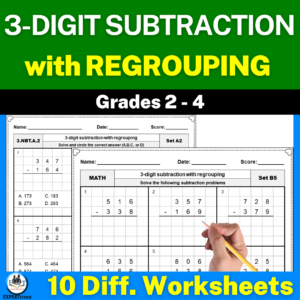
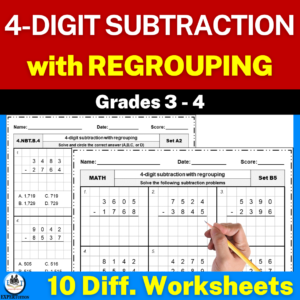
Once your students are ready for independent practice, the 3-digit subtraction with regrouping worksheets and the 4-digit subtraction with regrouping worksheets will give the right mix of guided and open-ended problems to help them gain both speed and accuracy over time.
-
$ 3.25
-
$ 3.25
Strategies for Mixed Addition and Subtraction Practice
Now that your students understand both operations, combine them in one lesson.
When students mix addition and subtraction in the same activity, they’re challenged to think critically.
Use word problems, math riddles, or real-life scenarios where students must decide which operation fits the situation.
Encourage estimation before solving, and let students explain why they chose addition or subtraction.
This builds reasoning and flexible thinking — skills that go far beyond computation.
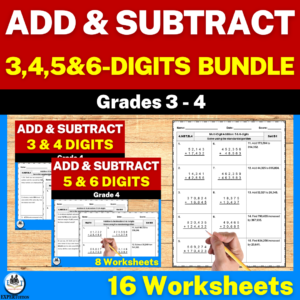
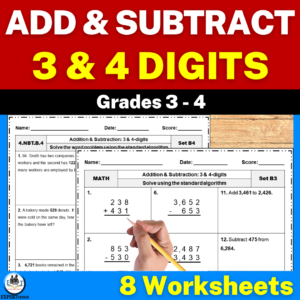
If your students are ready for a challenge, the 3- and 4-digit mixed addition and subtraction worksheets are perfect for practice and assessment. To extend their skills, try the 5- and 6-digit set, which is a smooth next step toward mastering larger numbers.
-
$ 3.25
-
$ 3.25

Scaffolding and Differentiation Ideas
Every class has a range of learners, and scaffolding is key. Differentiation helps every student find success at their own pace.
Use differentiated worksheets that include either regrouping or non-regrouping problems.
This will help students build confidence before they tackle mixed addition and subtraction problems.
Offer graph paper for students who need visual alignment, and provide enrichment problems for those who master the basics quickly.
The built-in differentiation of the addition and subtraction resources makes it easy to assign the right level of practice for each student, whether they’re just beginning or ready to extend their skills.
Final Thoughts
Mastery of addition and subtraction doesn’t happen overnight.
It comes from consistent practice, reflection, and lots of real-world connections.
Use routines like daily warm-ups, exit tickets, or homework to reinforce strategies.
When students can confidently add and subtract with and without regrouping, they’re ready to tackle everything from multi-step word problems to higher-level math operations.
SAVE MORE WITH BUNDLES (20% – 30% OFF)
-
Product on saleOriginal price was: $ 13.00.$ 10.40Current price is: $ 10.40.
-
Product on saleOriginal price was: $ 13.00.$ 10.40Current price is: $ 10.40.
-
Product on saleOriginal price was: $ 6.50.$ 5.20Current price is: $ 5.20.
-
Product on saleOriginal price was: $ 32.50.$ 22.80Current price is: $ 22.80.