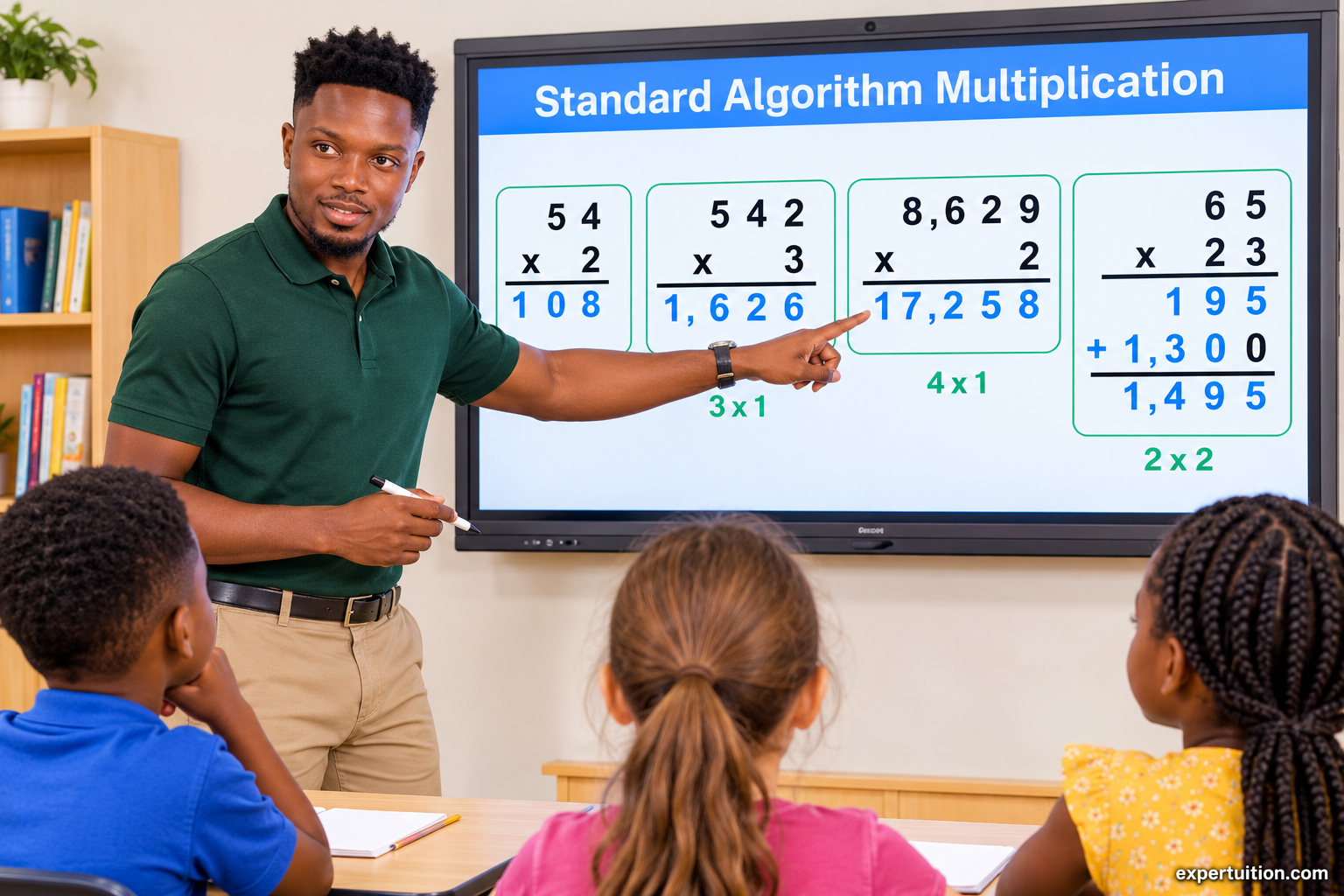
Learn how the standard algorithm for multiplication works using place value, regrouping, and partial products. Follow three worked examples, understand why the method works, and learn to avoid common multiplication errors.
What Is the Standard Algorithm for Multiplication?
The standard algorithm for multiplication is a place-value-based procedure for finding the product of whole numbers. It uses a vertical arrangement to multiply the digits according to their place values, regroup when necessary, and combine the resulting partial products to find the final product.
The Role of Place Value and Partial Products
The standard algorithm relies on place value and the distributive property of multiplication.
Place value determines what each digit represents. For example, in 65, the digit 6 represents 6 tens, or 60, while 5 represents 5 ones.
Partial products are the products obtained when one factor is multiplied by each place-value part of the other factor. In the standard algorithm, these products are calculated in separate rows and then added to find the final product.
Regrouping is necessary when a product contains ten or more units of a place value. For example, 2 × 5 tens = 10 tens. Since 10 tens equal 1 hundred, they are regrouped as 1 hundred.
The position of each partial product also matters. When multiplying by a digit in the tens place, the resulting product represents multiplication by tens, not ones. The second partial product therefore begins in the tens column because the multiplier digit represents tens.
How to Multiply Using the Standard Algorithm
To multiply using the standard algorithm, follow these steps:
- Write the factors vertically, aligning their digits according to place value.
- Multiply the top number by each digit of the bottom number, starting with the ones place.
- Regroup when a product contains ten or more units of a place value.
- Record each partial product in the correct place-value position.
- Add the partial products to find the final product.
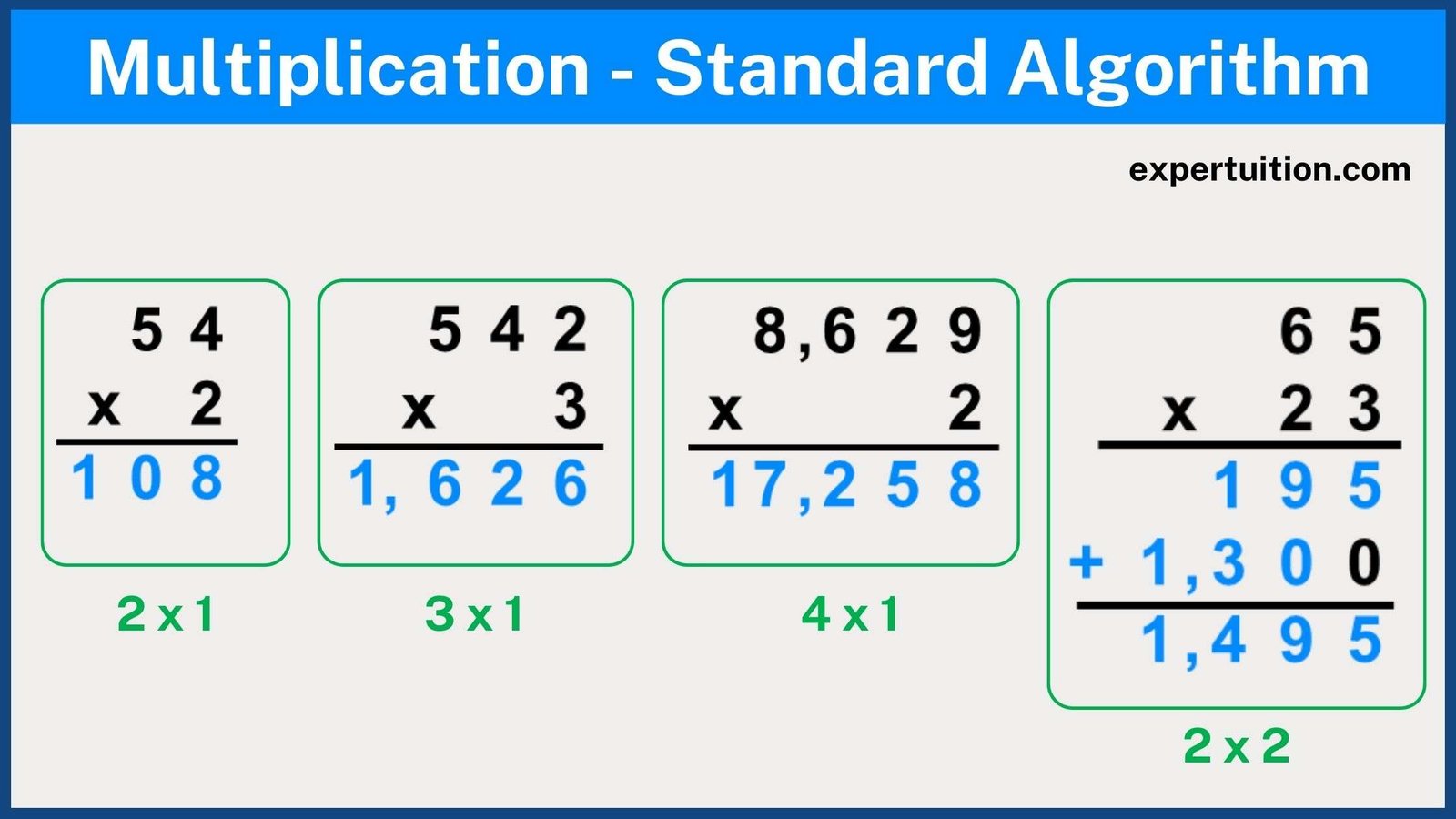
Example 1: Multiply 54 × 2
Write the numbers vertically, aligning the ones digits:
  54
×  2
----
Start with the ones place:
- Multiply 2 × 4 = 8. Write 8 in the ones place.
- Multiply 2 × 5 tens = 10 tens. Since 10 tens equal 1 hundred, the product has 1 hundred, 0 tens, and 8 ones.
The product is:
  54
×  2
----
 108
Therefore, 54 × 2 = 108.
Example 2: Multiply 65 × 23
Write the numbers vertically, aligning the digits by place value:
  65
× 23
----
Step 1: Multiply by the ones digit.
Start with 3 in the ones place.
- Multiply 3 × 5 = 15. Write 5 in the ones place and regroup 1 ten.
- Multiply 3 × 6 tens = 18 tens. Add the regrouped 1 ten to get 19 tens.
- Write 9 in the tens place and regroup 1 hundred.
- Record the regrouped hundred in the hundreds place.
The first partial product is 195.
Step 2: Multiply by the tens digit.
The 2 in 23 represents 2 tens, or 20. The second partial product must therefore represent multiplication by 20. Since this is multiplication by tens, the second row begins in the tens column.
- Multiply 20 × 5 = 100. This is the product of 20 and the 5 ones in 65.
- Multiply 20 × 60 = 1,200. This is the product of 20 and the 6 tens in 65.
- Add 100 + 1,200 = 1,300.
The second partial product is 1,300.
Step 3: Add the partial products.
   65
×  23
-----
  195
 1300
-----
 1495
Therefore, 65 × 23 = 1,495.
Example 3: Multiply 2,346 × 3
Write the numbers vertically, aligning the ones digits:
  2,346
×     3
-------
Start with the ones place and work from right to left.
- Multiply 3 × 6 = 18. Write 8 in the ones place and regroup 1 ten.
- Multiply 3 × 4 tens = 12 tens. Add the regrouped 1 ten to get 13 tens. Write 3 in the tens place and regroup 1 hundred.
- Multiply 3 × 3 hundreds = 9 hundreds. Add the regrouped 1 hundred to get 10 hundreds. Write 0 in the hundreds place and regroup 1 thousand.
- Multiply 3 × 2 thousands = 6 thousands. Add the regrouped 1 thousand to get 7 thousands.
The product is:
  2,346
×     3
-------
  7,038
Therefore, 2,346 × 3 = 7,038.
Why Does the Standard Algorithm Give the Correct Answer?
The standard algorithm gives the correct answer because it accounts for every place-value part of the factors and combines their products according to the distributive property.
Consider 65 × 23. The number 23 contains 2 tens and 3 ones. The two rows in the standard algorithm represent multiplying 65 by each of these parts:
65 × 20 = 1,300
65 × 3 = 195
Adding these partial products gives:
1,300 + 195 = 1,495
This is an application of the distributive property:
65 × (20 + 3) = (65 × 20) + (65 × 3)
The standard algorithm organizes these calculations vertically. Each row represents the product of one place-value part of the multiplier and the other factor. Regrouping preserves the value of the digits within each calculation, while correct column placement ensures that the partial products represent their actual values when added.
Common Errors When Using the Standard Algorithm
Errors can occur when regrouping, recording partial products, or aligning digits. Here are some common mistakes and ways to address them.
1. Forgetting to Add a Regrouped Value
Students may record a regrouped digit but forget to include it in the next multiplication.
How to address it: Have students identify the place value of the regrouped amount and add it to the next product before recording the result.
2. Starting the Second Partial Product in the Ones Place
When multiplying by a digit in the tens place, students may begin the second partial product directly under the ones column.
How to address it: Reinforce that the digit in the tens place represents tens, not ones. Have students identify the value of the multiplier digit before calculating the second row.
3. Misaligning Digits by Place Value
Students may write the factors or partial products without keeping the ones, tens, and hundreds in their correct columns.
How to address it: Encourage students to use graph paper or draw place-value columns to keep their calculations aligned.
4. Adding the Partial Products Incorrectly
Students may calculate both partial products correctly but make an error when adding them.
How to address it: Have students align the partial products by place value before adding. They can also estimate the product to check whether their answer is reasonable.
Standard Algorithm Multiplication Worksheets
For additional practice, explore my Standard Algorithm Multiplication Worksheets Bundle or browse my Standard Algorithm Multiplication Worksheets Collection for individual worksheet sets.
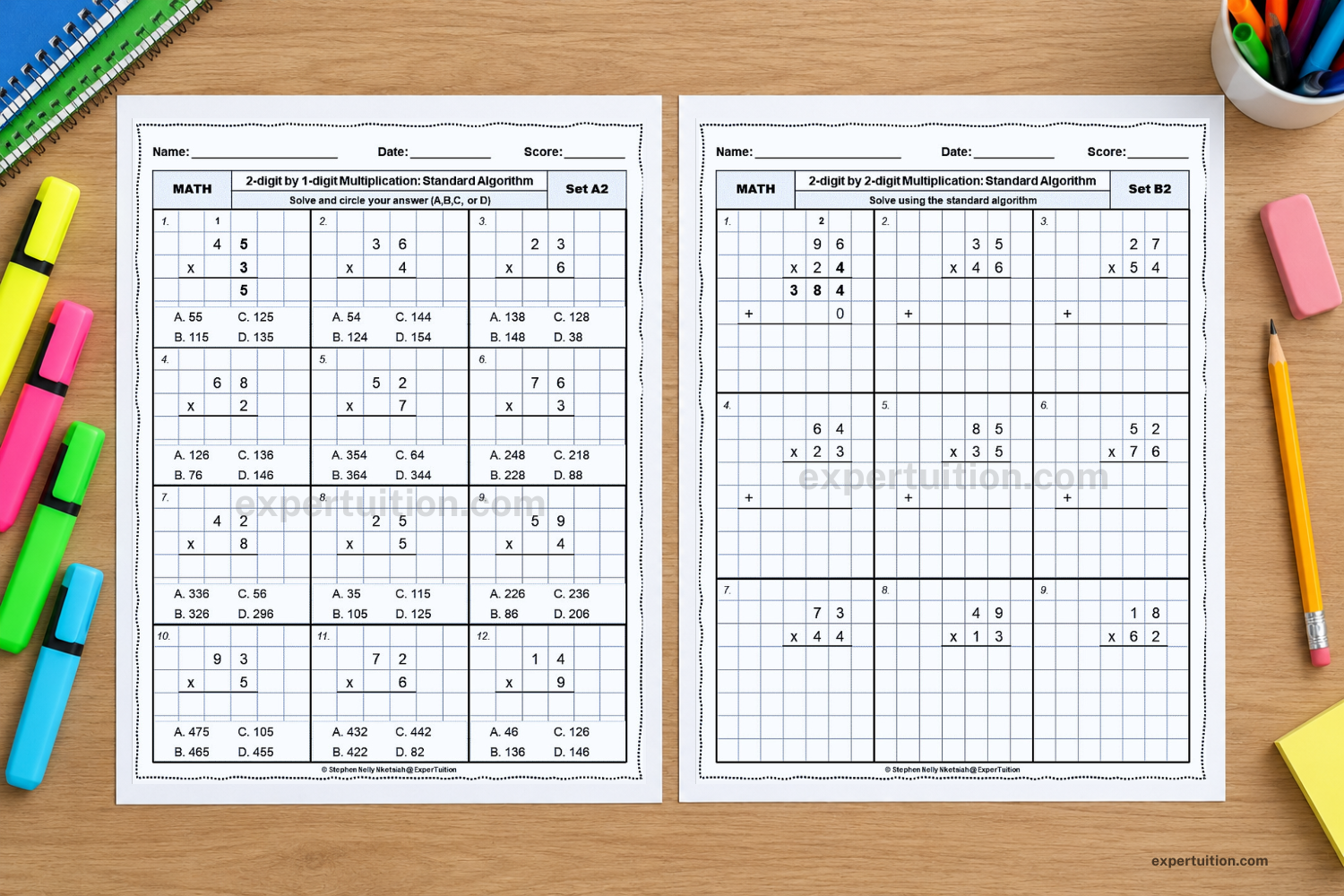
Individual worksheet sets are available for different factor combinations, including 2 Digit by 1 Digit and 2 Digit by 2 Digit Standard Algorithm Multiplication Worksheets.
For help comparing multiplication worksheets and bundles by method, factor size, and other features, and choosing the resources that best fit your classroom, see my Multiplication Worksheets for Grades 4–5 article.
Understanding Standard Algorithm Multiplication
The standard algorithm uses place value, regrouping, and partial products to organize multiplication. Understanding what each digit represents and how the partial products are formed helps students follow the procedure accurately and explain why it works.