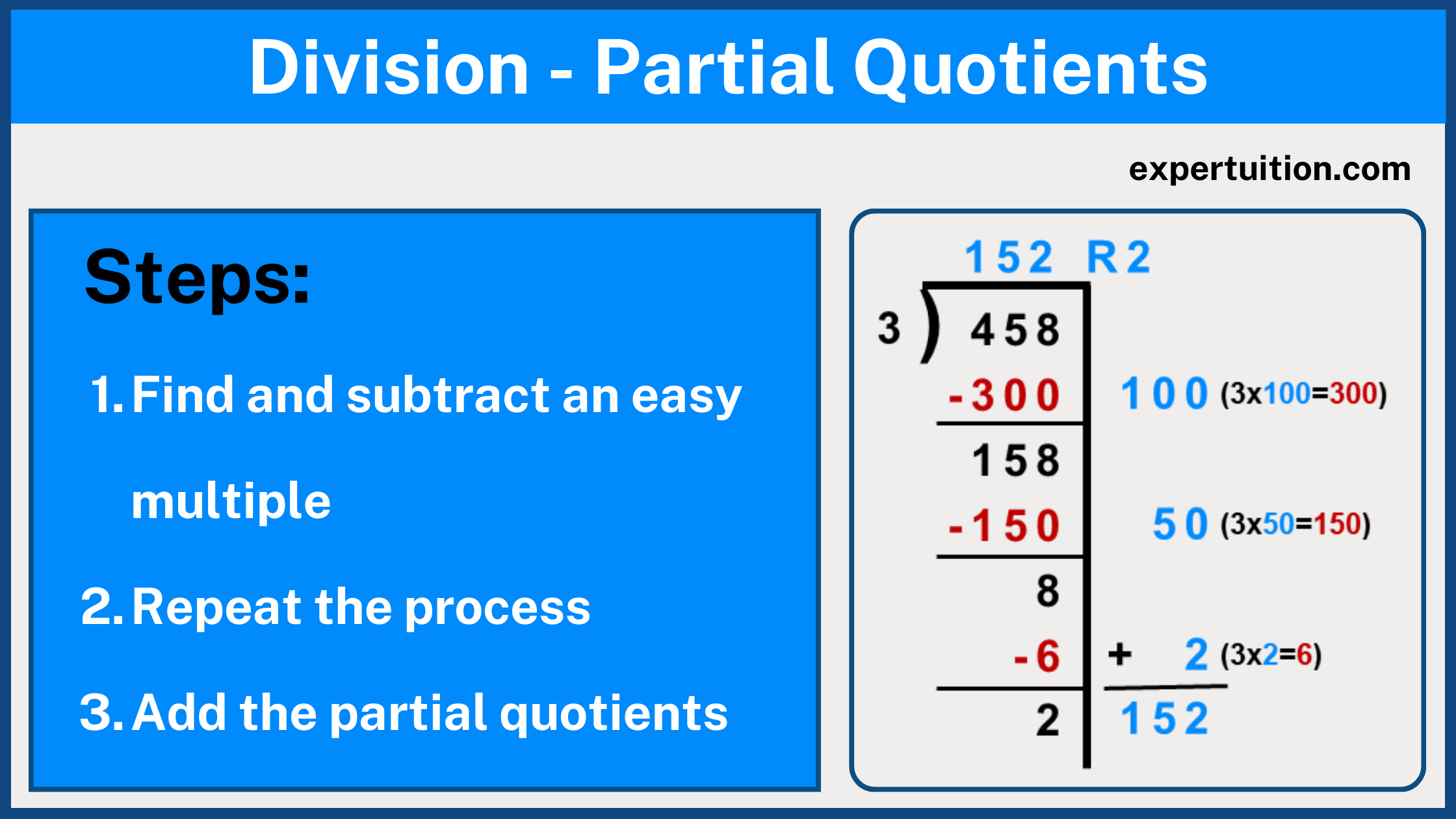
Learn how the partial quotients division method works through step-by-step examples with 1-digit and 2-digit divisors. Find out how to choose multiples of the divisor, subtract from the dividend, and combine partial quotients to find the quotient. The article also explains how to handle remainders and check division answers.
What Is the Partial Quotients Division Method?
A division problem does not always have to be solved in one step. The partial quotients division method breaks it into smaller calculations. You subtract multiples of the divisor, record how many groups each subtraction represents, and add those numbers to find the quotient.
Each subtraction removes a known number of groups from the dividend. The partial quotients keep track of those groups until no more complete groups can be removed. Multiplication, subtraction, and place value all help you work through the problem.
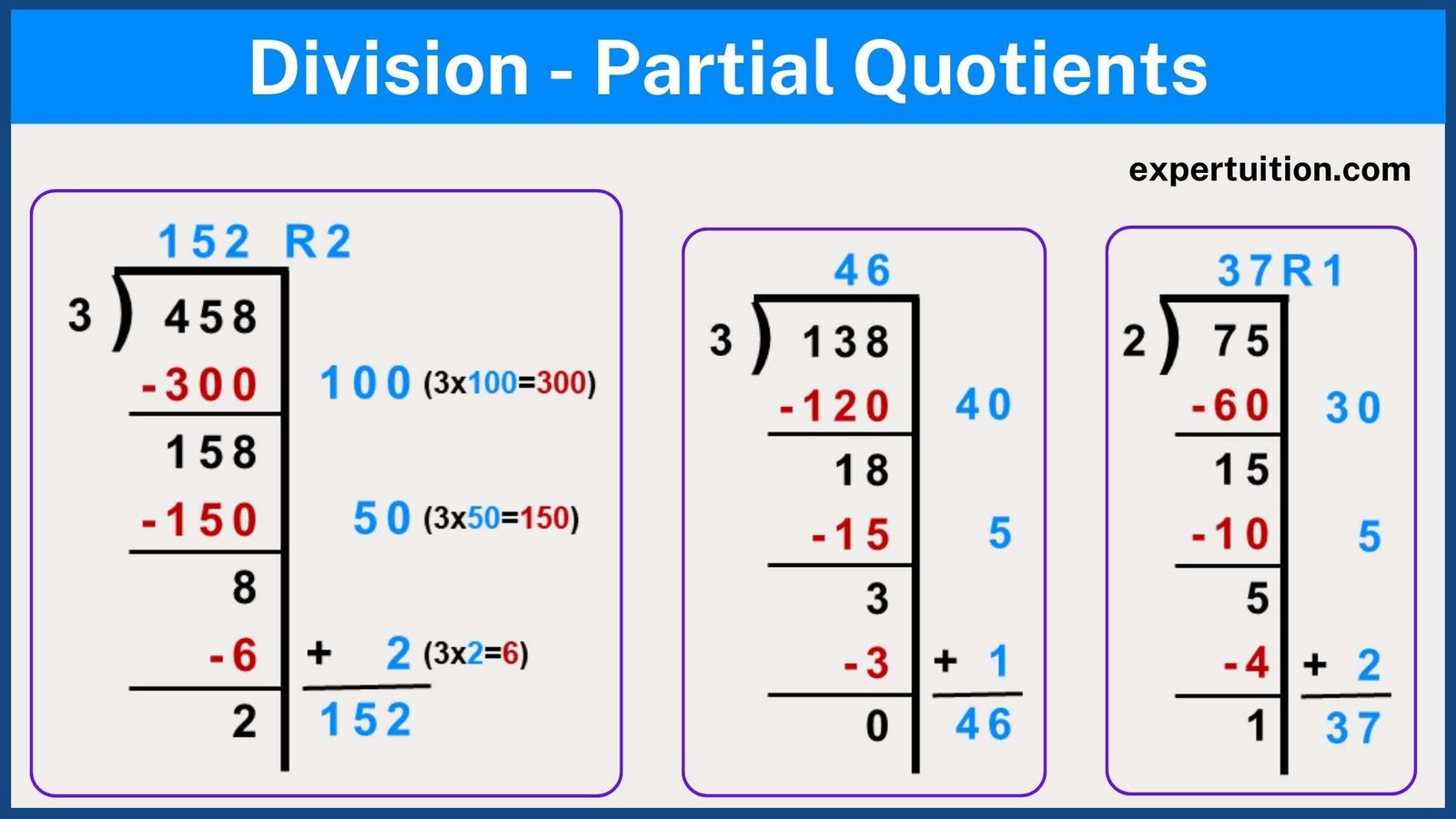
How to Divide Using the Partial Quotients Method
Consider:
458 ÷ 3
The task is to find how many complete groups of 3 fit into 458 and what remains.
The method follows three main steps:
- Find and subtract an easy multiple.
- Repeat the process.
- Add the partial quotients.
Step 1: Find and Subtract an Easy Multiple
Set up the problem like a long division calculation, leaving space on the right to record the partial quotients.
Choose an easy multiple of the divisor that does not exceed the dividend.
For example:
3 × 100 = 300
Subtract 300 from 458:
458 − 300 = 158
Write 300 beneath 458 and record 100 on the right as the first partial quotient.
The number 100 represents 100 groups of 3 because 3 × 100 = 300. You have accounted for 100 groups, with 158 left to divide.
Step 2: Repeat the Process
Work with the amount remaining after the first subtraction.
There are 158 left. Choose another easy multiple of 3:
3 × 50 = 150
Subtract:
158 − 150 = 8
Write 150 beneath 158 and record 50 as the next partial quotient.
There are now 8 left. You can subtract another multiple of 3:
3 × 2 = 6
Subtract:
8 − 6 = 2
Write 6 beneath 8 and record 2 as the third partial quotient.
The remaining 2 is smaller than the divisor, 3. No more complete groups of 3 can be removed, so the division is complete.
Step 3: Add the Partial Quotients
Add the partial quotients recorded on the right:
100 + 50 + 2 = 152
The quotient is 152, and the remainder is 2.
Therefore:
458 ÷ 3 = 152 R 2
Check the answer by multiplying the divisor by the quotient and adding the remainder:
3 × 152 + 2 = 458
The result returns the original dividend, so the calculation is correct.
Why Does the Partial Quotients Method Work?
Every subtraction removes a whole number of groups of the divisor. The partial quotients record those groups, so adding them gives the total number of groups removed.
In 458 ÷ 3, the subtractions account for:
300 + 150 + 6 = 456
Each amount is a multiple of 3:
(3 × 100) + (3 × 50) + (3 × 2) = 456
Using the distributive property, this can be written as:
3 × (100 + 50 + 2) = 456
The partial quotients add up to 152, so:
3 × 152 = 456
Thus, 152 groups of 3 account for 456. The 2 left over from 458 is the remainder.
The quotient is the sum of all the partial quotients, not just the last number recorded. Each partial quotient contributes to the total number of groups.
How Do You Choose the Multiples?
You can choose different multiples of the divisor and still get the correct quotient. Each amount subtracted must be a multiple of the divisor and must not exceed the amount remaining.
For 458 ÷ 3, you could subtract 300, 150, and 6. You could also subtract 150, 150, 90, 60, and 6. Both sequences work because each subtraction removes a whole number of groups of 3.
The first approach takes three subtractions. The second takes five. Smaller multiples may be easier to calculate mentally, while larger multiples can reduce the number of steps.
Use these checks when choosing a multiple:
- Check the divisor: The amount subtracted must be a multiple of it.
- Check what remains: You cannot subtract more than the current amount.
- Record the groups correctly: If you subtract 150 when dividing by 3, record 50 because 150 ÷ 3 = 50.
Multiplication facts, place-value knowledge, and estimation help you choose useful multiples. For example, knowing that 3 × 100 = 300 lets you remove 100 groups in one subtraction.
You do not have to choose the largest possible multiple every time. Choose amounts you can calculate accurately, and keep track of every partial quotient.
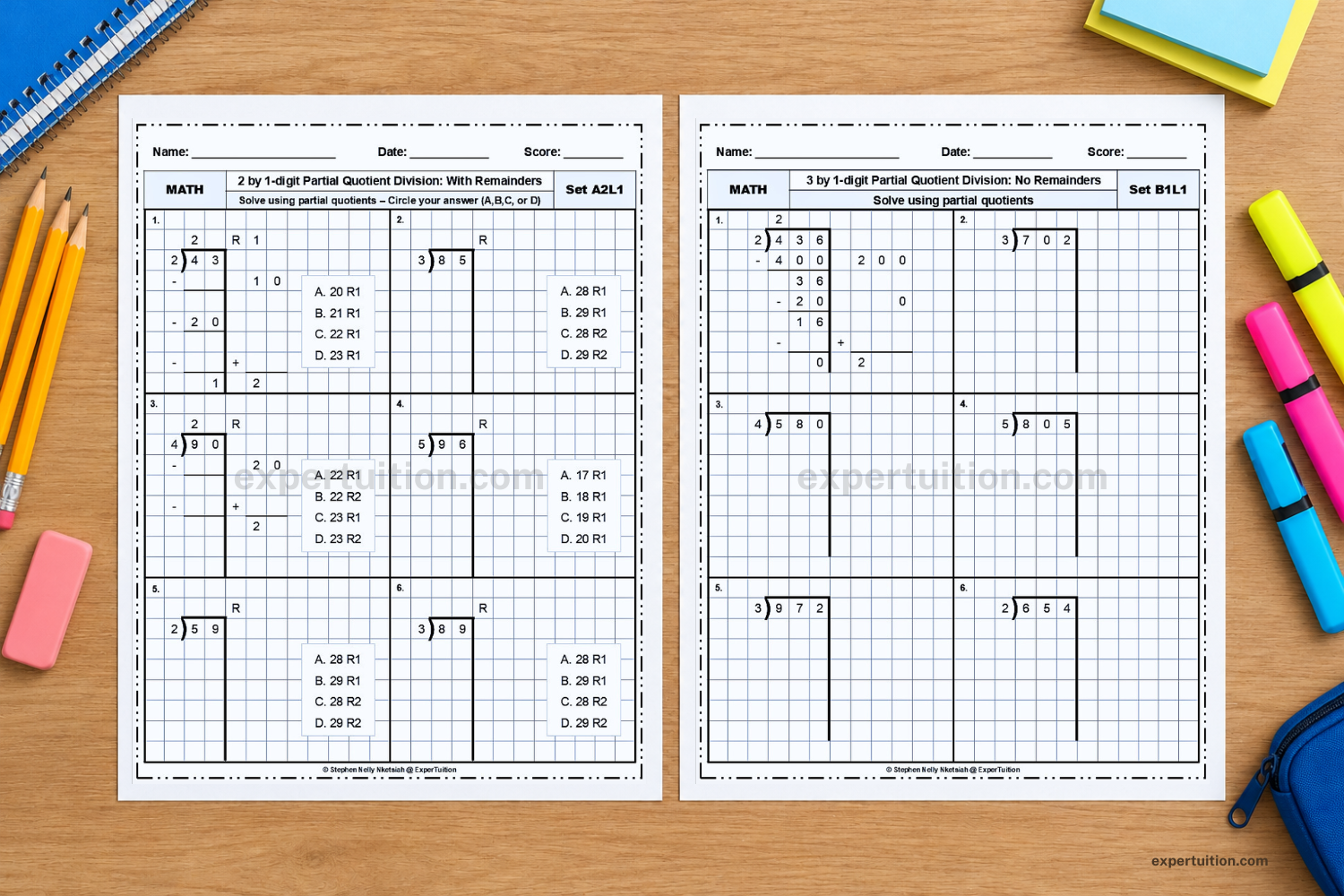
For practice with one-digit divisors and larger dividends, the Partial Quotients Division Worksheets Bundle includes problems with and without remainders.
Understanding Remainders in Partial Quotients Division
The remainder is what is left when no more complete groups of the divisor can be removed.
In 458 ÷ 3, the partial quotients add up to 152:
3 × 152 = 456
Subtracting 456 from 458 leaves 2. Because 2 is smaller than 3, another complete group cannot be formed.
The final remainder must be nonnegative and smaller than the divisor. If the amount remaining is equal to or greater than the divisor, you can still remove at least one complete group.
You can check any division problem with a remainder using this relationship:
Dividend = (Divisor × Quotient) + Remainder
For 458 ÷ 3 = 152 R 2:
458 = (3 × 152) + 2
The equation returns 458, the original dividend. If it does not, check the quotient, remainder, and subtractions.
How Does Partial Quotients Division Work with Two-Digit Divisors?
The same principle applies when dividing by a two-digit number. Subtract multiples of the divisor, record the number of groups represented by each subtraction, and add the partial quotients.
Consider:
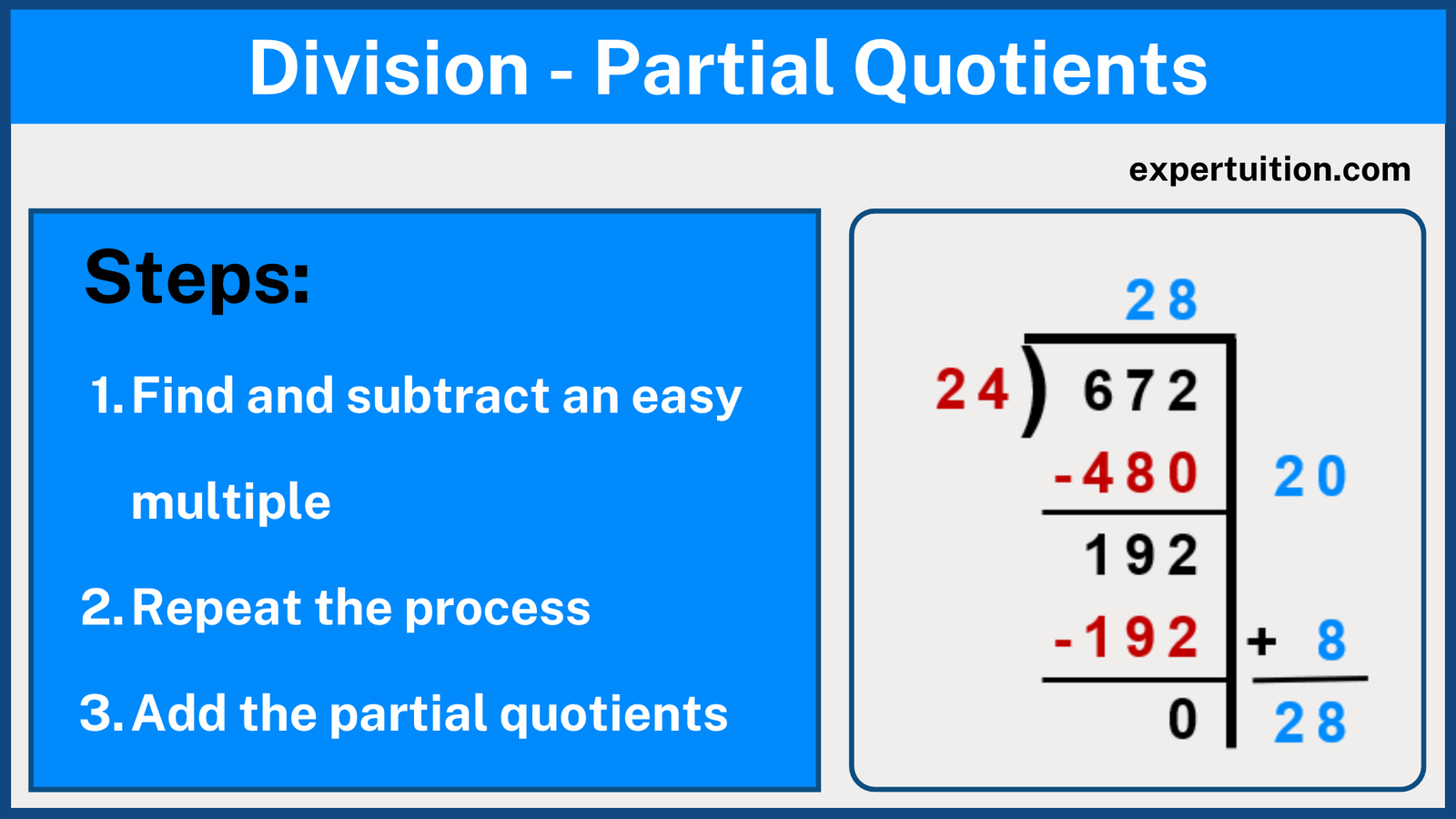
672 ÷ 24
Start with a useful multiple:
24 × 20 = 480
Subtract 480 from 672:
672 − 480 = 192
Record 20 as the first partial quotient.
Next:
24 × 8 = 192
Subtract:
192 − 192 = 0
Record 8 as the second partial quotient. No amount remains, so the division is complete.
Add the partial quotients:
20 + 8 = 28
Therefore:
672 ÷ 24 = 28
Check the answer:
24 × 28 = 672
The same reasoning applies with a two-digit divisor. Choosing useful multiples may require more estimation and multiplication, but the steps remain the same.
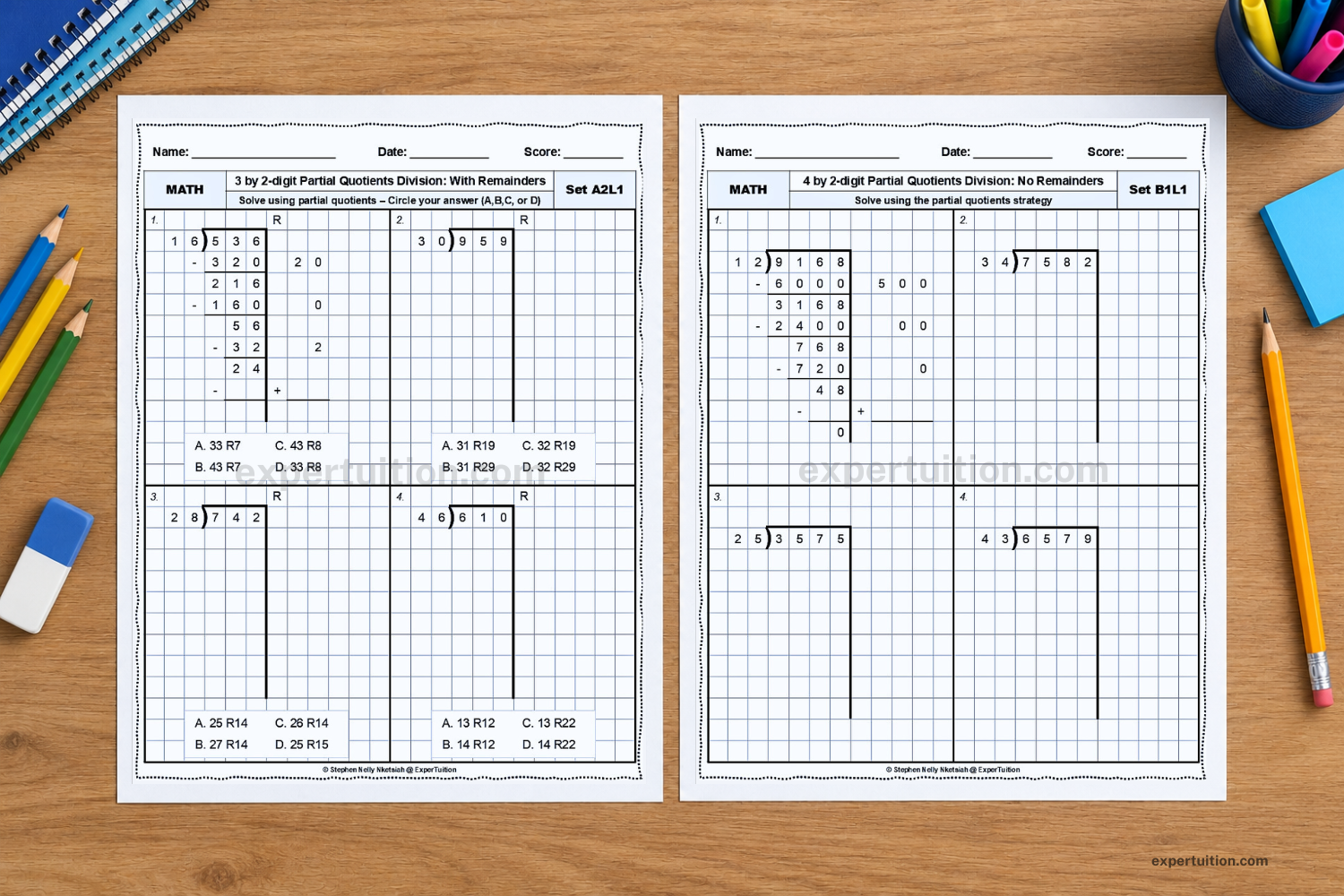
The 2-Digit Divisors Partial Quotients Division Worksheets Bundle includes practice with three-digit and four-digit dividends by two-digit divisors.
Common Errors in Partial Quotients Division
Subtracting a Number That Is Not a Multiple of the Divisor
When solving 458 ÷ 3, subtracting 200 would be incorrect because 200 is not a multiple of 3. It does not represent a whole number of groups of 3.
By contrast, 3 × 50 = 150, so subtracting 150 accounts for 50 complete groups.
Forgetting to Add the Partial Quotients
The final quotient is the sum of all the partial quotients, not just the last one.
For 458 ÷ 3:
100 + 50 + 2 = 152
Leaving out any value means leaving out groups already accounted for in the division.
Stopping Too Soon
Do not stop while another complete group of the divisor can still be removed. For example, if 5 remains when dividing by 3, subtract another 3, leaving a remainder of 2.
Recording an Invalid Remainder
A remainder must be nonnegative, smaller than the divisor, and satisfy the division check.
For 458 ÷ 3 = 152 R 2:
(3 × 152) + 2 = 458
If the equation does not return the original dividend, revisit the calculations.
Final Check: What the Partial Quotients Method Shows Us
The partial quotients method keeps track of the groups removed in each subtraction. Adding the partial quotients gives the quotient, and any amount left after all complete groups have been removed is the remainder.
Students should be able to explain why each amount is subtracted, what each partial quotient represents, and why the process stops when the remainder is smaller than the divisor.
For more examples and practice, visit the Partial Quotients Division Worksheets collection.
For an overview of how partial quotients, area models, and long division fit into Grade 4 and Grade 5 instruction, read Division Strategies for Grade 4 and Grade 5.