Teaching angle measurement is an exciting way to help students see geometry in action. In this post, we’ll explore how to teach the concepts of angle measurement effectively using clear visuals, hands-on practice, and engaging no-prep resources to reinforce understanding.
What Are Angles and How Are They Measured?
An angle is formed when two rays share a common endpoint, called the vertex.
Angles measure the amount of rotation between the two rays.
For example, when one ray turns around the vertex to meet the other, it creates a measurable amount of “turn.”
The degree (°) is the unit we use to measure this turn.
A full circle measures 360°, meaning that smaller angles represent smaller parts of this full rotation.
Connecting this to real life helps students grasp the concept quickly — for instance:
- A quarter turn (¼ of a circle) equals 90°
- A half turn (½ of a circle) equals 180°
- A three-quarter turn (¾ of a circle) equals 270°
These visual and real-world examples help students make sense of abstract numbers.
Relating Angles to Fractional Parts of a Circle
Angles are closely related to fractions — each degree represents a fractional part of a circle.
If a full circle equals 360°, then:
- 1° = ¹⁄₃₆₀ of a full circle
- 90° = ¼ of a full circle
- 120° = ⅓ of a full circle
Helping students visualize these relationships builds both fraction fluency and geometric understanding.
One great classroom activity is to give students paper circles divided into equal parts.
Ask them to color a fraction (like ¼ or ⅓) and then label how many degrees that section represents.
This bridges the gap between fractions and geometry in a tangible way.
Connecting Angles and Rotations
Angles aren’t static — they represent movement.
A rotation of 90° means a quarter turn, while 180° means turning halfway around.
Students can better understand this when they move their bodies:
- Turn ¼ of a circle to face a new direction (90°).
- Turn halfway (180°) to face the opposite way.
- Complete a full spin (360°) to return to the starting point.
These physical movements anchor the idea that angles measure how much something turns, not how long its sides are.
To reinforce this visually, show clock hands moving or use arrows on the board to model the turns.
Exploring One-Degree Angles
Before measuring large angles, students should first understand a one-degree angle.
Explain that a one-degree angle is the smallest measurable turn, ¹⁄₃₆₀ of a circle.
Show how combining many one-degree angles makes larger angles:
- 10 one-degree angles make 10°
- 45 one-degree angles make 45°
- 90 one-degree angles make a right angle
Using transparent protractors or tracing overlays can help students visualize how these small turns add up.
Bringing Fractions and Angles Together
When students connect fractions to degrees, they start seeing patterns across math domains.
For example:
- ½ of a circle = 180°
- ⅓ of a circle = 120°
- ¼ of a circle = 90°
- ⅙ of a circle = 60°
Challenge students with questions like:
“If one-sixth of a circle is 60°, what’s one-third of a circle?”
This encourages reasoning, not rote memorization — and helps students apply fractional thinking to geometry.
Common Misconceptions About Angles
Many students struggle with angle measurement because they hold common misconceptions, such as:
- Confusing side length with angle size.
- Thinking a larger shape must have larger angles.
- Forgetting that an angle measures turn, not distance.
To address these, use multiple representations such as visual diagrams, movement, and manipulatives to reinforce that angles describe rotation, not length.
Engaging Classroom Strategies for Teaching Angles
Here are a few practical ways to make angle measurement engaging and hands-on:
- Paper Plate Angles: Use paper plates to model circles and fold them into fractions (halves, quarters) to explore degree measures.
- Angle Hunts: Have students find and measure angles in the classroom (book corners, door frames, desk edges).
- Turn and Learn: Incorporate movement — students physically rotate by ¼, ½, and full turns to represent angles.
- Protractor Challenges: Give students angles to estimate before measuring, then compare results.
Assessing Understanding and Providing Practice
To check for understanding, combine:
- Quick checks (exit tickets, angle flashcards).
- Reasoning questions (“Explain how you know this is a right angle”).
- Skill-based practice worksheets for reinforcement.
Differentiating instruction is easy when you mix multiple-choice and open-ended tasks.
Use data trackers to monitor growth and answer keys to simplify grading — ensuring that students receive immediate feedback as they build accuracy.
Resources for Practicing Angle Measurement Concepts
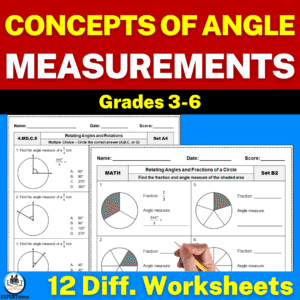
If you’re looking for structured, no-prep support, these concepts of angle measurement worksheets are ideal for reviewing and practicing:
- Relating angles, rotations, and fractional parts of a circle
- Understanding one-degree angles
- Connecting fractions and degrees
- Solving angle word problems
They include multiple-choice and open-ended formats, answer keys, and data trackers — everything you need to make angle measurement lessons effective and efficient.
-
 $ 4.00
Final Thoughts
Angle measurement is more than just using a protractor — it’s about understanding rotation, fractions, and space.
By connecting these ideas visually and physically, you help students see that math is both logical and creative.
Encourage exploration, use movement, and give plenty of practice opportunities, and you’ll see your students’ confidence in geometry grow turn by turn.
SAVE WITH THE BUNDLE (20% OFF)
-
Product on saleOriginal price was: $ 15.75.$ 12.60Current price is: $ 12.60.