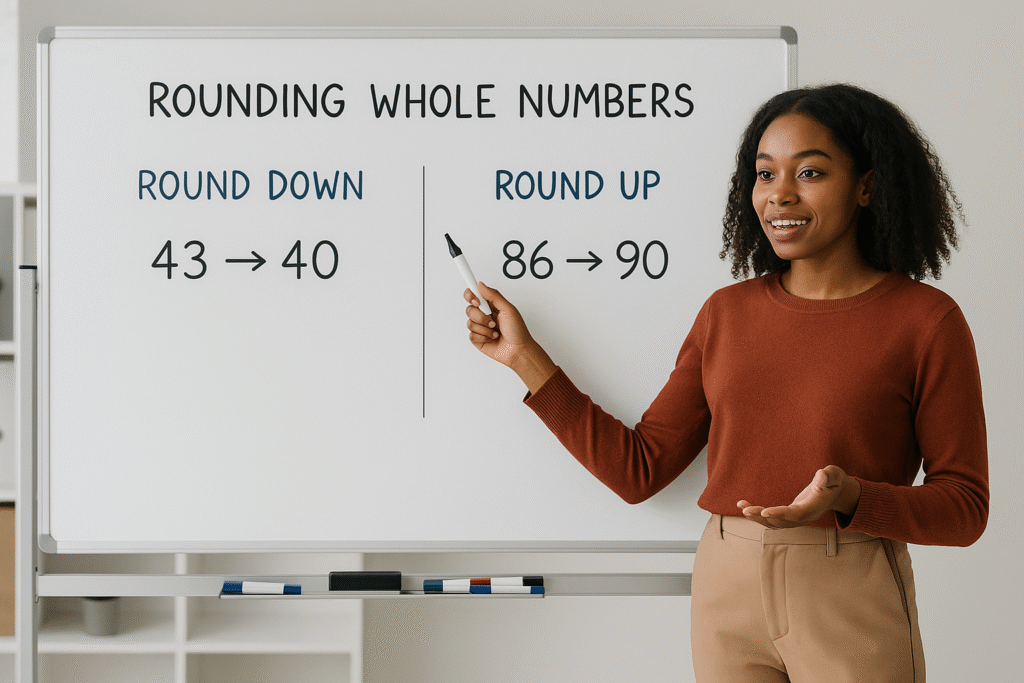
Rounding whole numbers can be one of those skills that seem simple until you try to explain why 347 rounds to 300 and not 400. In this post, we’ll explore how to teach rounding whole numbers step-by-step, engaging strategies, common misconceptions, and ready-to-use classroom tools to make your lessons smoother and more effective.
Why Rounding Matters in Math
Rounding helps students make quick, reasonable estimates in everyday life.
Whether they’re estimating the cost of snacks or checking if a sum “makes sense,” rounding builds strong number sense and confidence with large numbers.
It’s also an essential skill for understanding place value, estimation, and mental math, which are key foundations for problem-solving in upper grades.
The good news?
With visuals, guided practice, and the right tools, rounding can become crystal clear and less confusing.
Teaching Rounding to the Nearest 10 and 100
When students first learn to round in grade 3, visuals are everything.
That’s why number lines are one of the most effective ways to introduce rounding.
1. Start with Real-Life Connections
Ask: “If you have 48 pencils, would you say you have 40 or 50?”
This naturally leads into a discussion about what rounding means—simplifying a number to make it easier to work with, while keeping it close to the original value.
2. Use Number Lines to Visualize
Show students how to find the two tens (or hundreds) a number falls between.
For example, 78 is between 70 and 80.
The midpoint—75—helps students decide whether to round up or down.
When students can see that 78 is closer to 80, rounding suddenly makes sense.
3. Provide Guided Practice
At this stage, scaffolding is important.
Start with problems that include number lines and prompts, then gradually remove the supports.
This helps students build confidence and independence.
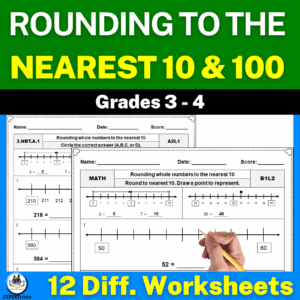
If you’re looking for structured practice, rounding to the nearest 10 and 100 worksheets with number lines are excellent tools.
They reinforce the visual connection while giving students the chance to practice both guided and independent rounding.
(This approach aligns perfectly with 3.NBT.A.1—using place value understanding to round whole numbers to the nearest 10 or 100.)
-
 $ 3.75
Moving to Multi-Digit Rounding: Building on Place Value
Once students master rounding smaller numbers, it’s time to expand the skill to multi-digit numbers in grades 4 and 5.
This includes rounding to the nearest thousand, ten thousand, hundred thousand, or even million.
1. Reinforce Place Value Understanding
Students need to know which place they’re rounding to and what digits will change.
A simple strategy: underline or color-code the rounding place.
For example, in 583,746, rounding to the nearest ten thousand means focusing on the 8 in the ten-thousands place.
2. Apply the Rounding Rule
Remind students of the classic rule:
“5 or more, raise the score; 4 or less, let it rest.”
So, when rounding 583,746 to the nearest ten thousand, the 8 (in the ten-thousands place) looks at the next digit, 3.
Since 3 is less than 5, the number rounds down to 580,000.
3. Make It Interactive
Try classroom games like:
- Rounding Race: students compete to round numbers correctly.
- Estimation Station: students estimate quantities, then check accuracy.
- Rounding Word Problems: help students see rounding in real-life contexts—like population estimates or distances.
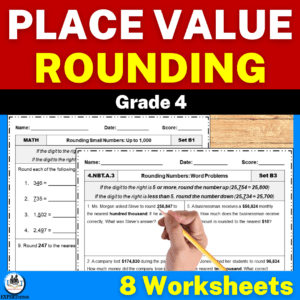
For focused practice, rounding multi-digit whole number worksheets are perfect for upper grades.
They include both multiple-choice and open-ended questions, allowing students to reason through their answers.
(This connects to standard 4.NBT.A.3—using place value understanding to round multi-digit whole numbers.)
-
$ 3.25
Common Rounding Mistakes (and How to Fix Them)
Even when students understand the steps, rounding can still trip them up.
Here are a few common pitfalls and how to address them:
1. Rounding the Wrong Place
Students often look at the wrong digit when rounding.
Fix: Have them underline or highlight the place they’re rounding to before starting.
2. Always Rounding Up
Some students think every number should go higher.
Fix: Emphasize the 5 or more rule and use number lines to show when a number is closer to rounding down.
3. Dropping Zeros
Students sometimes write “58” instead of “580” after rounding.
Fix: Reinforce place value—remind them that zeros hold the place values steady.
Engaging Classroom Activities for Rounding
Here are some fun, hands-on ways to make rounding more memorable:
Rounding Roller Coaster
Draw a big number line on the board and have students “ride” their number up or down based on which ten or hundred they’re closest to.
Estimate It!
Show real-world items (like a jar of paperclips) and have students round their estimates before counting.
Roll and Round
Students roll dice to create random numbers and then round them to a given place.
It’s quick, competitive, and perfect for math centers.
Assessing Rounding Skills
Consistent assessment helps you see where students need extra support.
You can use data trackers to monitor progress over time and answer keys to save grading time.
Include a mix of question types, multiple choice for fluency, and open-ended for reasoning to build both speed and understanding.
Final Thoughts
Rounding isn’t just about shortening numbers; it’s about developing strong number sense, logical reasoning, and estimation skills.
When students can confidently round numbers of any size, they’re better prepared for more advanced math concepts.
By combining visuals, practice, and real-world connections, you can make rounding one of the most engaging and understandable topics in your math classroom.
And if you want to save prep time, these ready-to-use resources are designed to make teaching rounding effortless and effective.