Angle measurement concepts connect degrees, turns, and fractions of a circle. Learn what 360° represents, how fractions of a circle correspond to angle measures, and how clockwise and counterclockwise rotations describe different turns.
What Is an Angle and What Does It Measure?
An angle describes the amount of rotation between two rays that share a common endpoint. Its measure tells us how far one ray turns from the other, not how long the rays are or how large the shape appears. When describing a rotation, the direction and amount of turning also matter because the same starting and ending directions can represent different amounts of rotation.
The two rays form an angle, and their common endpoint is called the vertex. The rays show the starting and ending directions of the angle, while the amount of rotation between them determines its measure.
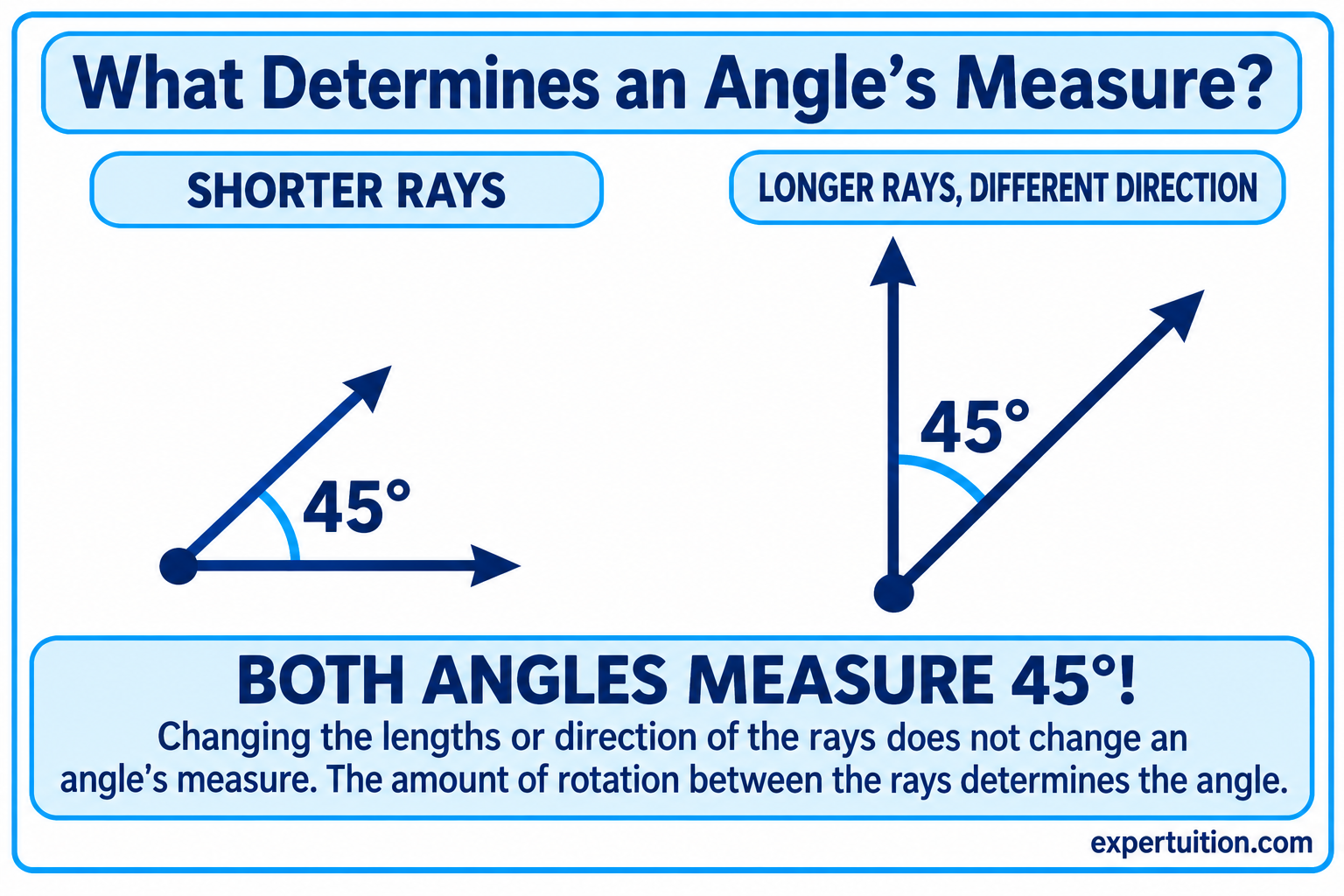
An angle’s measure depends on how far one ray rotates from the other. Extending or shortening the rays does not change the amount of rotation between them. For example, two angles may have different ray lengths but both measure 45°.
An angle can also be drawn in different orientations without changing its measure. A 90° angle remains 90° whether its rays point upward, downward, sideways, or in other directions. What matters is the amount of rotation between the rays, not their position on the page.
How Is Angle Measurement Related to a Circle?
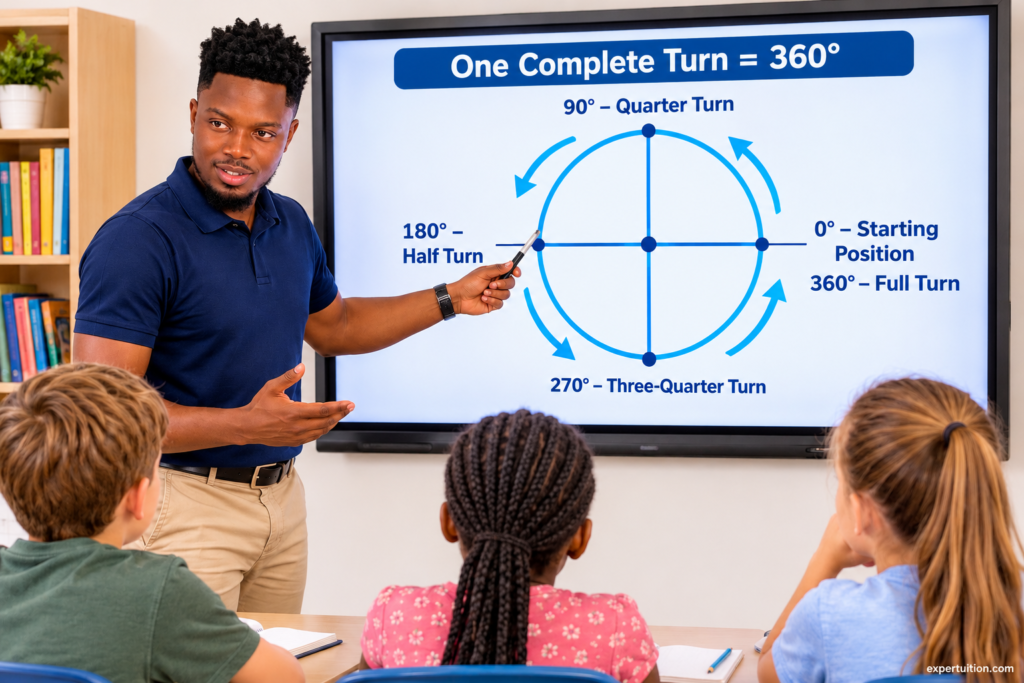
A circle provides a useful reference for understanding and measuring angles because it represents a complete rotation around a point. One complete turn around a circle measures 360°.
The vertex of an angle can be placed at the center of a circle. From this point, the two rays extend outward and intersect the circle at two points. The portion of the circular arc corresponding to the rotation between the rays represents the angle’s rotation.
The circle can be drawn with a larger or smaller radius without changing the angle measure. What matters is the amount of rotation between the rays, not the size of the circle. A larger circle and a smaller circle can represent the same angle because the rays form the same amount of rotation.
A full circle represents one complete turn, while portions of the circle represent fractions of that turn. For example, rotating halfway around a circle represents half a turn, and rotating a quarter of the way around represents a quarter turn.
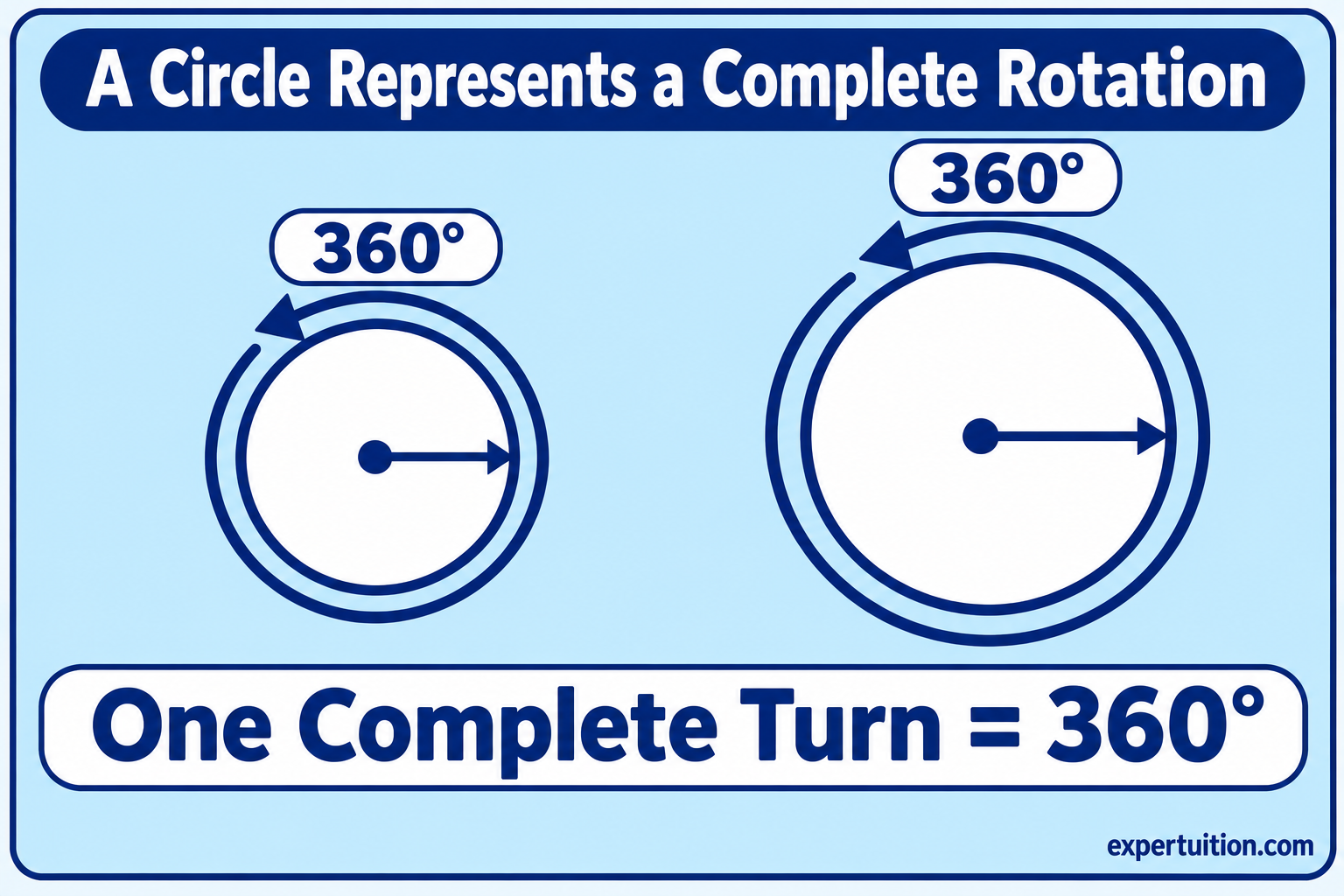
This connection between angles and circles provides a reference for understanding degrees and how different angle measures relate to a complete rotation.
What Is a Degree and How Is an Angle Measured in Degrees?
A degree (°) is a unit used to measure angles. Since a complete rotation measures 360°, it can be divided into 360 equal parts, with each part representing one degree.
One degree is therefore 1/360 of a complete rotation. When a ray turns through a number of one-degree units, the angle measures that number of degrees. For example, a rotation through 45 one-degree units measures 45°, while a rotation through 120 one-degree units measures 120°.
An angle’s measure tells us how much rotation it represents. For instance, 90° represents a quarter of a complete turn, while 180° represents half of a complete turn.
Degrees measure the amount of rotation, and 360° represents one complete turn.
How Do Fractions of a Circle Relate to Degrees?
Since a complete circle represents 360°, fractions of a circle can be used to determine angle measures. When a circle is divided into equal parts, each part represents an equal fraction of the complete rotation.
For example, dividing a circle into four equal parts means each part represents 1/4 of the circle. Since a full circle measures 360°, each quarter measures 90°.
The relationship between fractions of a circle and degrees can be used to determine different angle measures.
| Fraction of a circle | Angle measure |
|---|---|
| 1/2 | 180° |
| 1/4 | 90° |
| 3/4 | 270° |
| 1/3 | 120° |
| 1/6 | 60° |
| 1/8 | 45° |
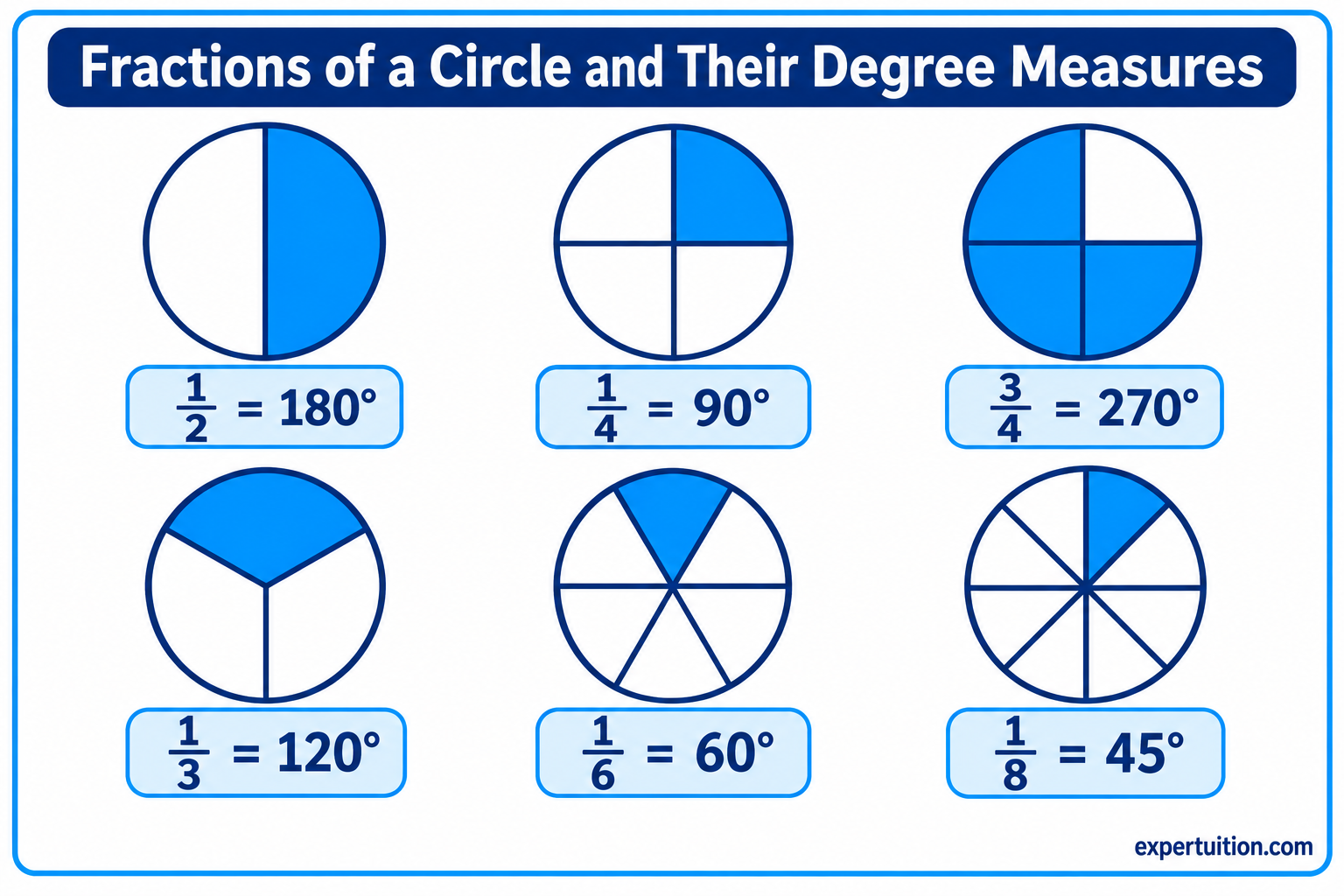
To determine the angle measure represented by a fraction of a circle, divide 360° by the denominator. If the numerator is greater than 1, multiply the result by the numerator.
Example 1: Finding 1/2 of a circle
A half-circle represents 1/2 of a complete rotation.
360° ÷ 2 = 180°
Therefore, 1/2 of a circle measures 180°.
Example 2: Finding 1/4 of a circle
A quarter-circle represents 1/4 of a complete rotation.
360° ÷ 4 = 90°
Therefore, 1/4 of a circle measures 90°.
Example 3: Finding 3/4 of a circle
Three-quarters of a circle represents three equal parts of a circle divided into four sections.
(360° ÷ 4) × 3 = 270°
Therefore, 3/4 of a circle measures 270°. This represents the larger angle, or three-quarter turn, around the circle rather than the smaller angle between the two rays.
Example 4: Finding 1/3 of a circle
A circle divided into three equal parts gives each part a measure of:
360° ÷ 3 = 120°
Therefore, 1/3 of a circle measures 120°.

Example 5: Finding 1/6 of a circle
A circle divided into six equal parts gives each part a measure of:
360° ÷ 6 = 60°
Therefore, 1/6 of a circle measures 60°.
Example 6: Finding 1/8 of a circle
A circle divided into eight equal parts gives each part a measure of:
360° ÷ 8 = 45°
Therefore, 1/8 of a circle measures 45°.
These relationships connect fractions to angle measures and show how different portions of a complete turn can be represented in degrees.
How Can Angle Measures Be Represented as Turns?
Angle measures can also be described using turns. A turn represents the amount of rotation from a starting direction to an ending direction. Connecting turns to degrees makes it easier to interpret angle measures and understand how different rotations relate to one another.
| Turn | Angle measure |
|---|---|
| Quarter turn | 90° |
| Half turn | 180° |
| Three-quarter turn | 270° |
| Full turn | 360° |
A quarter turn represents 1/4 of a complete rotation, or 90°. A half turn represents 1/2 of a complete rotation, or 180°. A three-quarter turn represents 3/4 of a complete rotation, or 270°, while a full turn represents one complete rotation, or 360°.
Rotations can occur clockwise or counterclockwise. Clockwise rotation moves in the direction of a clock’s hands, while counterclockwise rotation moves in the opposite direction.
Two rays can define a smaller angle and also represent a larger rotation when the direction of turning is specified. For example, the smaller angle between two rays may measure 90°, while a ray rotating 270° counterclockwise from the same starting direction reaches the same final position as a 90° clockwise rotation. The 270° rotation represents three-quarters of a complete turn, not the smaller angle between the rays.
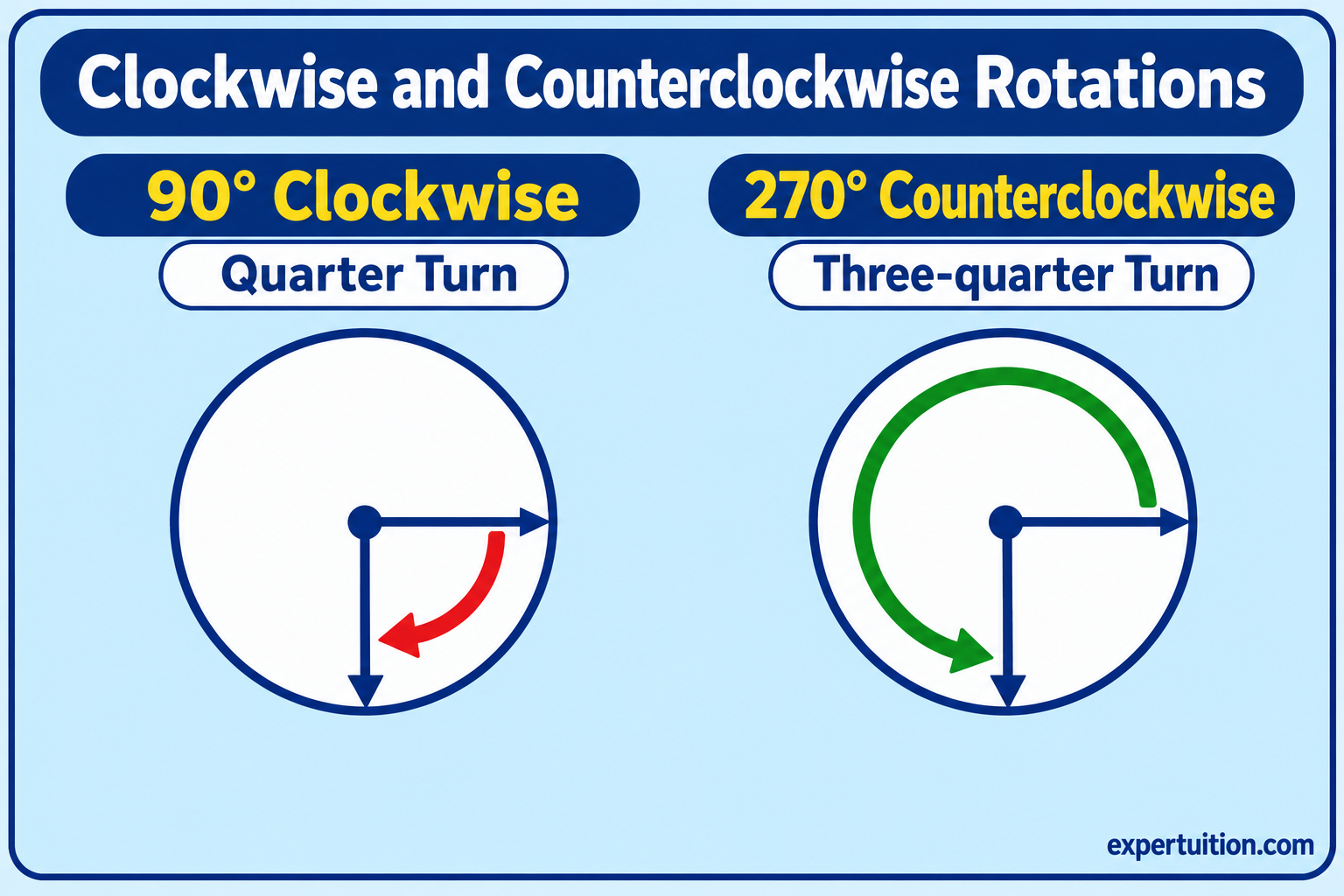
A ray can therefore reach the same final position through different amounts of rotation. The direction and amount of turning matter when describing a rotation, particularly when it exceeds 180°.
Turns can be observed in familiar situations, such as:
- Turning a corner while walking.
- Rotating the hands of a clock.
- Turning a steering wheel.
- Rotating a figure or object.
- Changing direction during movement.
These situations illustrate how angles describe rotation and how different amounts of turning can be represented using degrees and fractions of a circle.
How Can You Reason About Angle Measures?
Understanding angle measurement involves connecting degrees, fractions of a circle, and rotations. These relationships help compare angles, interpret unfamiliar representations, and explain why angles have certain measures.
Example 1: Comparing angles with different ray lengths
Two angles have different ray lengths, but both measure 45°. Are the angles equal?
Yes. Angle measure depends on the amount of rotation between the rays, not the length of the rays. Both angles represent the same amount of rotation and therefore have the same measure.
Example 2: Recognizing a half turn
A ray rotates 180° from its starting position. What fraction of a complete turn does this represent?
Since a complete turn measures 360°, 180° represents half of 360°.
180° ÷ 360° = 1/2
Therefore, the rotation represents a half turn.
Example 3: Reasoning about a rotation greater than half a turn
A ray rotates 270° in a counterclockwise direction. What fraction of a complete turn does this represent?
Since 270° is three times 90° and 90° represents 1/4 of a complete turn, 270° represents 3/4 of a complete turn.
Example 4: Reasoning about angles in different orientations
Two angles each measure 45°. One is drawn with a ray pointing horizontally to the right, while the other is rotated so that its rays point in different directions. Are the angles still equal?
Yes. Rotating an angle does not change its measure. Both angles represent the same amount of rotation between their rays, even though they are drawn in different orientations.
These relationships also help clarify common misconceptions, such as assuming that longer rays form larger angles, that an angle’s measure depends on its orientation, or that a rotation must be less than 180°.
Understanding how angles relate to degrees, fractional turns, and the complete circle provides the foundation for measuring and sketching angles with a protractor. Measuring and sketching angles with a protractor builds on this conceptual understanding by explaining how to measure and represent angles accurately.
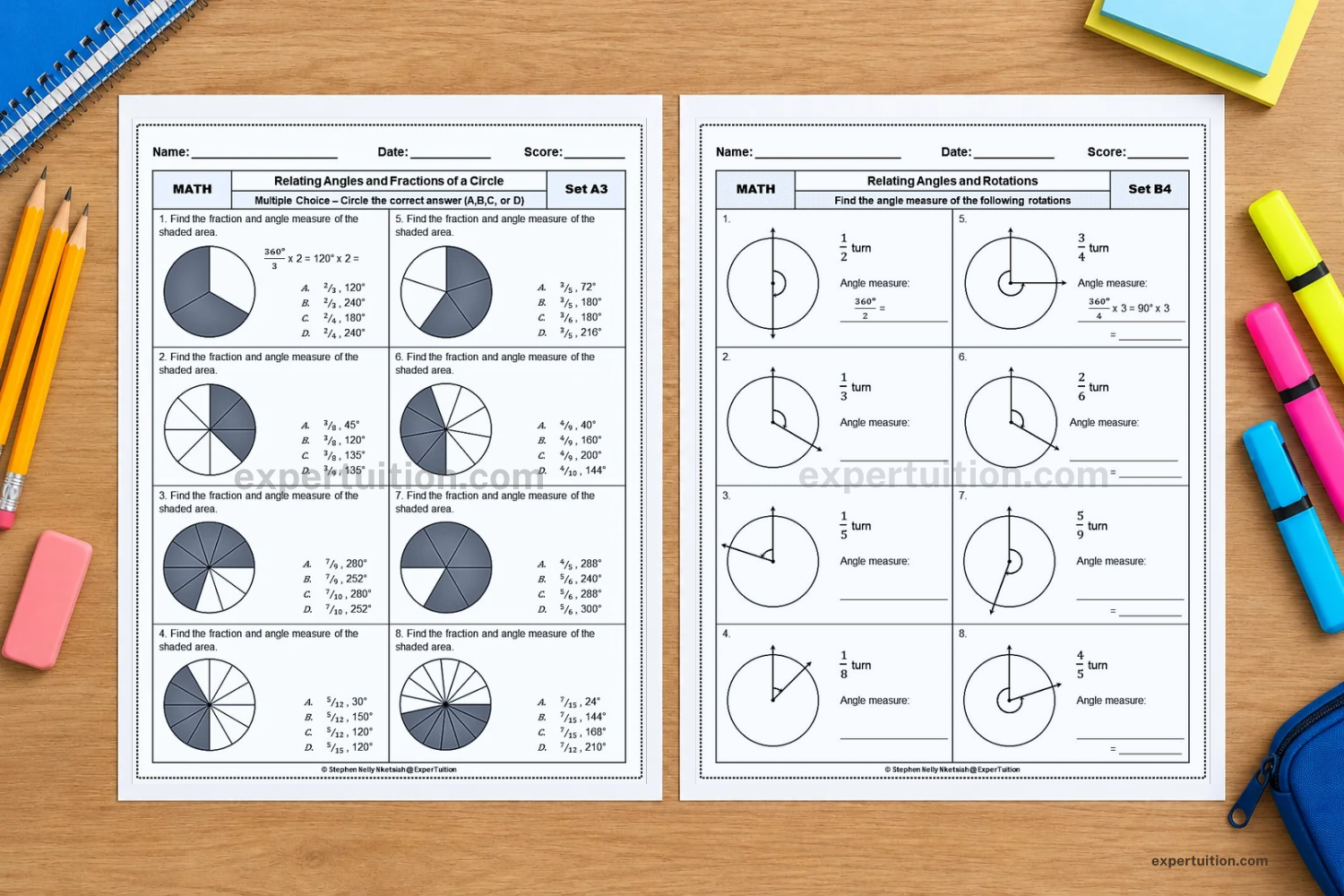
For additional practice with angle measurement, Concepts of Angle Measurement Worksheets offer a useful resource. More activities are available in the Angle Measurement Resources collection.
Why Understanding Angle Measurement Matters
Angle measurement is about more than recognizing numbers such as 45°, 90°, or 180°. It involves understanding how much rotation an angle represents and how that rotation relates to a complete circle.
Degrees provide a standard unit for describing angles, while fractions and turns offer different ways to represent portions of a complete rotation. These connections make it easier to compare angles, interpret different representations, and understand why an angle’s measure remains the same regardless of its orientation or the length of its rays.
SAVE WITH THE BUNDLE (20% OFF)
-
Product on sale
 Original price was: $ 15.75.$ 12.60Current price is: $ 12.60.