Teaching area and perimeter is one of the most practical ways to show students how math connects to the real world. In this post, we’ll explore effective strategies, engaging activities, and classroom tools that make teaching area and perimeter clear, fun, and meaningful.
Understanding the Difference Between Area and Perimeter
Before diving into formulas, students need a strong conceptual understanding of what area and perimeter represent.
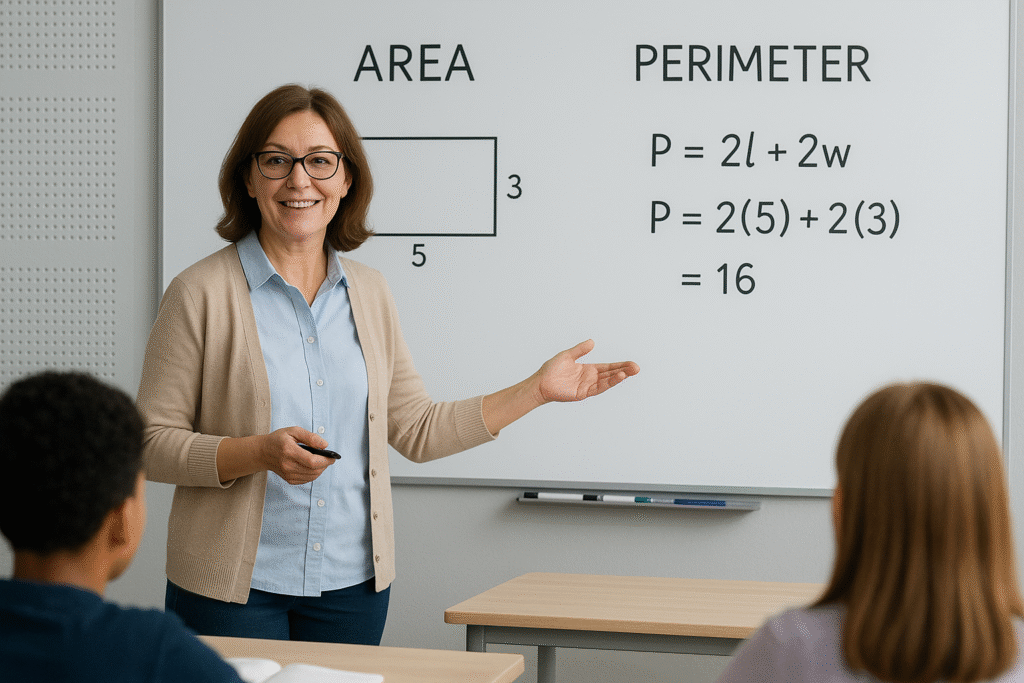
- Perimeter is the total distance around a shape.
- Area measures the space inside that shape.
A simple way to introduce this is with real-life analogies:
Wrapping a gift represents perimeter, while covering the top of a box with wrapping paper represents area.
Start with visual models—use grid paper, tiles, or manipulatives so students can count the units around and inside shapes.
This hands-on approach helps students see why these two measurements are different, even if they use the same dimensions.
Teaching Strategies for Perimeter
When teaching perimeter, begin with counting units around basic shapes on grid paper.
Once students grasp the concept, introduce formulas like:
- Rectangle: P = 2l + 2w
- Square: P = 4 × side length
Use real-world examples—such as finding the length of a fence or border—to make the lesson more engaging.
Hands-on activities like measuring classroom objects with string or rulers can help reinforce understanding.
Encourage students to label side lengths, write equations, and show all their steps.
For deeper learning, include word problems where students must apply perimeter formulas in context.
Teaching Strategies for Area
Area instruction should begin visually as well.
Use square tiles or grid paper to model how area measures the “space inside” a shape.
Once students can count unit squares, introduce the formula for rectangles and squares:
- Rectangle: A = l × w
- Square: A = side × side
Connect area to multiplication and repeated addition.
For example, a 4 × 6 rectangle can be viewed as 4 groups of 6 squares.
As students become more confident, challenge them with irregular and composite figures—teaching them to find areas of smaller rectangles and combine the results.
Real-life examples like flooring a classroom, planting a garden, or designing a playground help bring meaning to the numbers.
Finding Unknown Measures
A powerful way to extend learning is to explore unknown side problems.
For example, if students know the perimeter of a rectangle and one side length, can they find the other?
This type of problem encourages reasoning, logic, and algebraic thinking—skills that bridge the gap between arithmetic and pre-algebra.
Provide opportunities for students to solve for unknown sides in both area and perimeter contexts using diagrams, formulas, and reasoning statements.
Solving Area and Perimeter Word Problems
Word problems are where conceptual understanding meets application.
Teach students a structured approach:
- Read carefully. Identify whether the problem is about area, perimeter, or both.
- Visualize. Draw the shape or diagram.
- Plan. Write down the formula needed.
- Solve. Substitute values and calculate.
- Check. Ask if the answer makes sense.
Multi-step problems, especially those that combine area and perimeter, help students strengthen their critical thinking and problem-solving abilities.
Differentiation and Practice
Differentiation is key when teaching area and perimeter.
Some students need more visual support, while others are ready for abstract problem solving.
Start with guided practice using manipulatives and grids for struggling learners, and gradually move to independent practice with word problems and open-ended tasks.
For meaningful practice, use a variety of formats:
- Worksheets for structured review and assessment.
- Task cards for small groups, stations, or early finishers.
- Real-world projects to help students connect math to life.
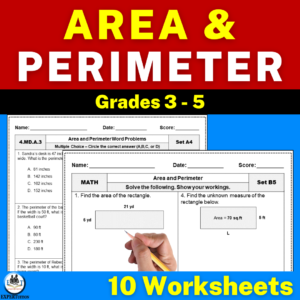
Resources like differentiated worksheets and task cards can make it easy to provide multiple levels of challenge.
They also include answer keys and data trackers, saving valuable time and supporting progress monitoring.
-
 $ 3.75
 -
$ 3.75

Common Student Misconceptions
Even confident students can mix up area and perimeter. Here are a few common issues to watch for:
- Adding instead of multiplying when finding area.
- Forgetting to include correct units (square units vs. linear units).
- Confusing the difference between “around” and “inside.”
Create anchor charts that highlight key differences and display them in your classroom as visual reminders.
Engaging Classroom Activities for Area and Perimeter
Turn abstract concepts into hands-on fun with these engaging ideas:
- “Design Your Dream Bedroom” Project: Students draw a floor plan, measure, and calculate the area and perimeter of each piece of furniture.
- Perimeter Walk: Use strings to measure objects around the classroom.
- Area and Perimeter Scavenger Hunt: Find items in the classroom that fit certain measurements.
- Task Card Rotations: Students move through stations solving different types of area and perimeter problems.
These activities encourage collaboration, movement, and discussion, making learning both active and memorable.
Assessing Student Understanding
Formative assessments can help teachers identify gaps early.
Try using exit tickets, mini-quizzes, or student reflection journals to gauge understanding.
A mix of multiple-choice and open-ended questions provides insight into both procedural fluency and conceptual understanding.
Tracking student data over time helps teachers differentiate instruction more effectively.
Final Thoughts
Teaching area and perimeter goes beyond memorizing formulas; it’s about helping students understand the “why” behind the math.
When students understand why formulas work and can connect them to real-life situations, their confidence in math grows naturally.
By combining hands-on activities, visual models, and regular practice, teachers can turn these concepts from abstract ideas into skills students use with understanding and pride.
Ready to make teaching area and perimeter more engaging and stress-free?
Explore these no-prep worksheets and task cards perfect for math centers, practice, or assessment, all designed to support deeper understanding and confident problem-solving in your classroom.