
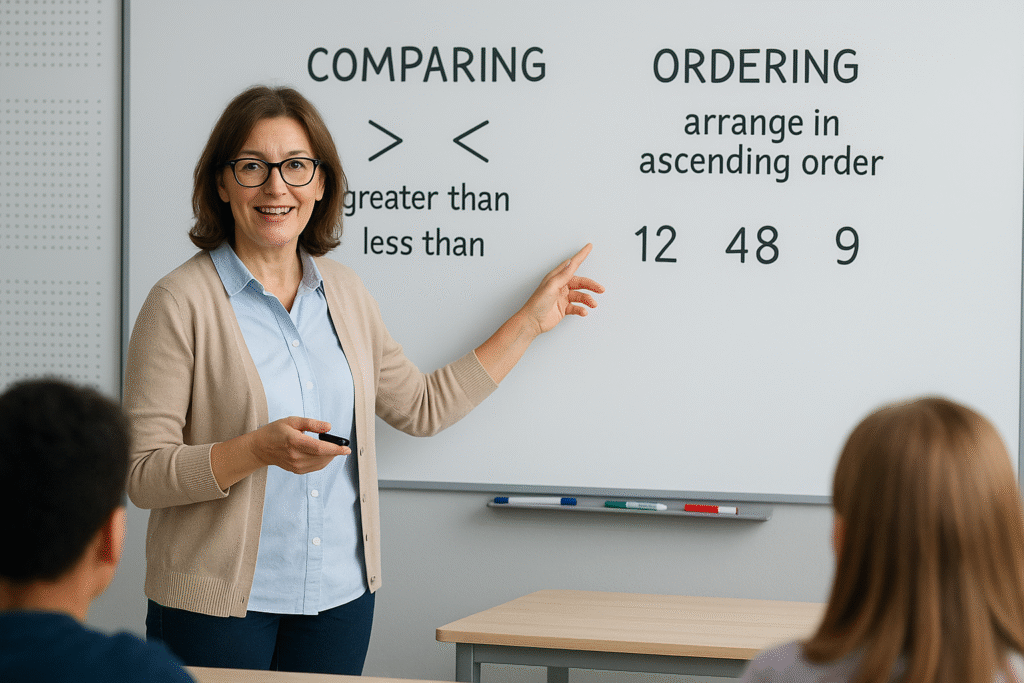
Comparing and ordering whole numbers is a fundamental part of understanding place value. In this post, we’ll explore how to teach comparing and ordering multi-digit whole numbers effectively, using place value strategies, classroom visuals, and differentiated practice activities that strengthen understanding for all learners.
What Does It Mean to Compare and Order Numbers?
When teaching students to compare and order whole numbers, it’s helpful to start with clear definitions:
- Comparing numbers means determining which number is greater than, less than, or equal to another number.
For example: 3,482 > 2,976. - Ordering numbers means arranging a set of numbers in order from least to greatest or greatest to least.
For example: 2,145 < 3,208 < 5,021.
At the core of both skills is place value understanding.
Students must learn that the value of a digit depends on its position in the number — not just the digit itself.
That’s why teaching these concepts side by side with place value lessons ensures deeper comprehension and accuracy.
Common Challenges Students Face
Even students who understand place value can struggle when comparing or ordering numbers.
Here are a few common difficulties teachers often observe:
- Comparing numbers by focusing only on the last digits instead of the highest place value.
- Misinterpreting numbers with different digit lengths (e.g., thinking 4,532 is less than 653 because 6 is “bigger” than 4).
- Confusing the meaning of greater than (>) and less than (<) symbols.
- Struggling to order a mixed group of multi-digit numbers without a systematic process.
Addressing these challenges with visual supports, hands-on activities, and consistent vocabulary can make a big difference in student understanding.
Strategies for Teaching Comparing and Ordering Whole Numbers
1. Build on Place Value Understanding
You can begin by reinforcing place value.
Encourage students to compare digits starting from the leftmost place value — the largest one.
For instance, when comparing 56,324 and 62,948, students should first look at the ten-thousands place.
Use place value charts, base-ten blocks, or expanded form to help students visualize the relationship between digits.
This step-by-step approach helps prevent guesswork and promotes reasoning.
2. Introduce Comparison Symbols with Context
The comparison symbols (>, <, =) can be confusing at first, so introduce them with real-world examples.
Compare familiar quantities like scores, ages, or distances to make the symbols meaningful.
For example:
- “7,245 meters is greater than 6,980 meters.”
- “4,503 points is less than 4,800 points.”
Encourage students to verbalize their comparisons using complete sentences before moving to symbolic notation.
3. Use Number Lines to Visualize Order
Number lines are a powerful tool for helping students visualize how numbers relate to one another.
Placing numbers on a number line allows students to see which are larger or smaller and how they are spaced apart.
For large multi-digit numbers, consider using open number lines and label only benchmark numbers to focus attention on relative size.
4. Guide Students in Ordering Sets of Numbers
Once students can compare pairs of numbers, move on to ordering three or more.
Encourage them to line up numbers vertically by place value, compare from left to right, and then rewrite them in ascending or descending order.
Using expanded form can also help:
For example, when comparing 4,562 and 4,362, the expanded form shows clearly that 500 is greater than 300.
5. Make Practice Engaging and Hands-On
Turn practice into games or interactive activities to reinforce skills:
- “Order It!” Card Game – Give students number cards to arrange from least to greatest.
- “Who’s Greater?” Relay – Teams compete to compare or order numbers correctly.
- Real-Life Math Connections – Compare populations, distances, or large numbers from data sets in science or social studies.
These activities keep students motivated while building fluency and understanding.
Differentiated Practice for Every Learner
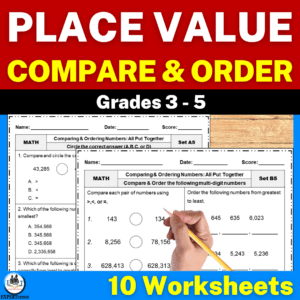
Effective instruction includes a mix of question types — both multiple-choice for fluency and open-ended for reasoning.
Differentiation allows students to practice comparing and ordering numbers at their own level, from 3-digit numbers to 7-digit numbers.
For example, my Comparing & Ordering Multi-Digit Numbers Worksheets include:
- Multiple-choice sets for targeted skill practice.
- Open-ended sets for explanation and reasoning.
- Built-in data trackers for progress monitoring.
- Answer keys for quick grading.
These tools make it easy to reinforce concepts through varied practice, whether used for morning work, assessments, or homework.
-
 $ 3.50
Assessment and Progress Tracking
Assessment is key to ensuring students truly understand how to compare and order numbers.
Quick checks like exit tickets or mini-quizzes can provide insight into student thinking.
Encourage students to explain why one number is greater than another to demonstrate conceptual understanding, not just procedural knowledge.
Tracking data over time helps teachers identify who needs additional support or enrichment.
Final Thoughts
Teaching students to compare and order whole numbers lays the groundwork for nearly every other area of math.
By combining place value understanding, visual models, and differentiated practice, teachers can build both fluency and confidence in their students.
When students understand how numbers relate, they’re not just memorizing rules — they’re learning to think mathematically.

